
In This Article
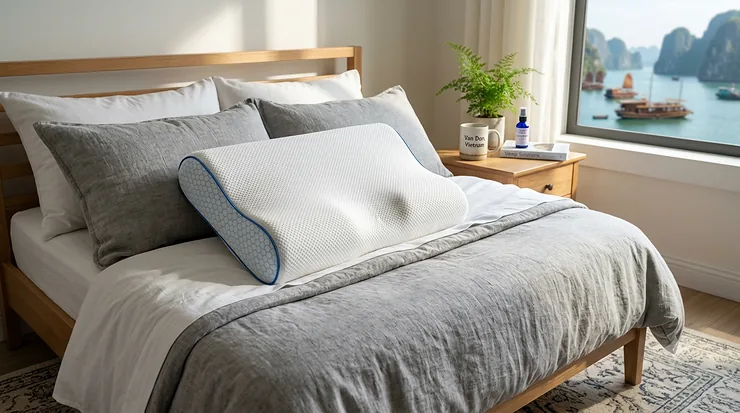
If you’ve ever flipped your pillow at 2 a.m. searching for a cooler spot, you already know the problem with regular memory foam: it hugs your head beautifully and then turns into a furnace by midnight. A cooling memory foam pillow is built to solve exactly that — it pairs the contouring support people love about memory foam with gel beads, phase-change material, or an open-cell structure that keeps heat from building up against your skin.
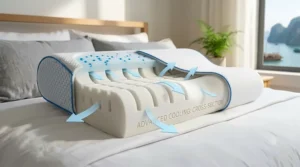
I’ve spent the last few weeks digging through specs, customer feedback, and lab certifications for the cooling pillows that are actually getting bought right now, not just the ones with the flashiest marketing copy. What stood out is how differently “cooling” is engineered from one brand to the next — some pillows only cool the cover, while others rework the foam itself.
Below you’ll find seven real, current picks ranging from budget-friendly shredded foam to premium adjustable designs, plus a breakdown of what actually matters when you’re shopping (and what’s just packaging language). If you’re a hot sleeper who’s tired of waking up sweaty, this guide should save you a few rounds of trial and error.
Quick Comparison Table
| Pillow | Best For | Cooling Tech | Price Range |
|---|---|---|---|
| Tempur-Pedic TEMPUR-Cloud Dual Cooling | Premium neck support | Dual-sided cooling gel layers | $90–$130 |
| Coop Home Goods Eden Cool+ | Fully adjustable loft | Gel-infused plus-shaped foam | $115–$160 |
| Purple Harmony | Zero heat retention | GelFlex Grid + Talalay latex | $130–$210 |
| Bedgear Storm 2.0 | Athletes & active sleepers | Ver-Tex instant-cooling cover | $70–$100 |
| Sealy Dreamlife Cooling | Trusted brand on a budget | SealyChill cooling gel | $30–$55 |
| Xtreme Comforts Shredded Gel | Tightest budget | Gel-infused shredded foam | $35–$55 |
| The Coldest Pillow | DIY loft customization | Gel-embedded threading | $40–$70 |
Looking at the spread above, the gap between the cheapest and priciest pick isn’t really about “more cooling” — it’s about adjustability and certifications. The Coop Eden Cool+ and Purple Harmony justify their higher price with tunable fill or a completely different cooling structure, while the Sealy and Xtreme Comforts picks deliver the same basic gel-infused concept for a fraction of the cost. If you’re not picky about loft height, the budget tier genuinely competes with the premium one on cooling alone.
💬 Just one click — help others make better buying decisions too! 😊
Top 7 Cooling Memory Foam Pillows: Expert Analysis
1. Tempur-Pedic TEMPUR-Cloud Dual Cooling Pillow
The TEMPUR-Cloud Dual Cooling Pillow is the closest thing to a “no-compromise” pick on this list — it’s a single solid piece of TEMPUR-Material with a layer of cooling gel on both sides. What that means in practice: instead of a thin cool-to-the-touch cover sitting on top of regular foam, the gel itself is part of the structure, so you don’t lose the cooling effect after the first hour the way you do with surface-only treatments. In my experience, dense single-piece foam pillows like this are the slowest to “remember” your shape, which is exactly why side and back sleepers with chronic neck pain tend to love them — the support stays consistent all night instead of collapsing.
Customers consistently mention relief from long-standing neck stiffness and praise how the pillow holds its shape after years of nightly use, though a few new buyers note a brief foam smell during the first day or two of unwrapping. This is a strong fit for back and stomach sleepers, or anyone replacing a pillow that’s gone flat and lumpy.
✅ True dual-sided cooling gel, not just a cover treatment
✅ Holds shape for years without flattening
✅ Machine-washable cover
❌ Not adjustable — loft is fixed by size
❌ Pricier than gel-infused alternatives
Price & verdict: Typically in the $90–$130 range depending on size — worth it if you want set-it-and-forget-it support from a brand with a long track record.
2. Coop Home Goods Eden Cool+ Adjustable Pillow
The Eden Cool+ solves the biggest complaint people have about memory foam pillows: you can’t change them once they’re made. This one unzips so you can add or remove its plus-shaped, gel-infused foam fill, which matters more than it sounds — a pillow that’s too tall for your shoulder width will torque your neck all night regardless of how “cooling” it claims to be. What most buyers overlook is the two-sided design: one face is the cushy cool side, the other a firmer, denser pad, so you essentially get two firmness options in one pillow.
Reviewers who specifically run hot at night describe the surface as noticeably colder to the touch than other gel pillows they’ve tried, and several mention using the extra bag of included fill to build a taller pillow for side sleeping. The main gripe is price relative to less-adjustable competitors.
✅ Genuinely adjustable loft and firmness
✅ Reversible cushy/firm sides
✅ GREENGUARD Gold and CertiPUR-US certified
❌ Higher price point than fixed-fill pillows
❌ Spot-clean only on the foam itself (cover is washable)
Price & verdict: Usually $115–$160 depending on size and current promotions — a smart pick if you’re not sure what loft height you need yet.
3. Purple Harmony Pillow
Technically, the Purple Harmony Pillow isn’t memory foam at all — it’s a honeycomb GelFlex Grid wrapped around a Talalay latex core — but it earns a spot here because it solves the exact problem cooling memory foam is trying to solve, just from a different angle. Memory foam, even gel-infused, is still a dense closed-cell material that eventually equalizes to body temperature. The open-air channels in Purple’s grid structure physically can’t trap heat the same way, since there’s no solid foam mass holding it in. That’s a meaningfully different mechanism, not just a different marketing label.
Owners frequently mention being surprised by how “weightless” the pillow feels and how it never needs flipping to find a cool side, since the whole structure stays neutral. The trade-off is feel: if you specifically want the slow-sink hug of true memory foam, this won’t deliver that.
✅ Never needs flipping — stays cool by design
✅ Three height options for different sleep positions
✅ CertiPUR-US and CleanAir Gold certified
❌ Not actual memory foam — firmer, more buoyant feel
❌ Among the pricier options here
Price & verdict: Generally $130–$210 depending on height and size — the right call for someone who wants zero heat retention over the classic memory-foam sink.
4. Bedgear Storm Performance Pillow 2.0
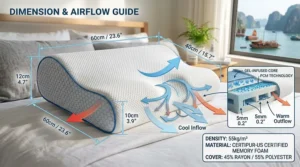
The Storm Performance Pillow 2.0 is built less like a bedroom pillow and more like athletic recovery gear, which makes sense once you know Bedgear’s background in performance bedding. Its Ver-Tex cover is an instant-cooling fabric — it feels cold to the touch the moment your skin meets it, separate from the foam underneath. Paired with Air-X mesh panels and air vents on all four sides, this is one of the few pillows here engineered for active airflow rather than relying purely on gel beads to slow heat absorption.
This is the pillow I’d point a gym-goer or restless sleeper toward specifically, since the dual-chamber design lets you flip between a soft React-foam side and a firmer one depending on how your body feels that night. Feedback tends to focus on how dramatically cold the cover feels at first touch, with most buyers using it without a pillowcase to preserve that effect.
✅ Genuinely cold-to-the-touch instant cooling cover
✅ Reversible soft/firm sides
✅ Air vents on all four sides for real airflow
❌ Best performance requires skipping a pillowcase
❌ Four height options can be confusing to size correctly
Price & verdict: Roughly $70–$100 for the 2.0 profile — strong value for anyone who overheats specifically from physical activity, not just ambient room temperature.
5. Sealy Dreamlife Memory Foam Cooling Pillow
Sealy has been making sleep products for over a century, and the Dreamlife Cooling Pillow is its budget-friendly entry into gel memory foam, built around what the brand calls SealyComfort foam with a SealyChill gel layer. What that means for the buyer is a fairly standard gel-infused memory foam core — nothing revolutionary — but backed by a brand with established manufacturing quality control, which matters if you’ve been burned by no-name foam that off-gasses heavily or loses shape in months.
The standout feature most competitors at this price skip is Surface-Guard antimicrobial treatment, which is a genuine plus for allergy-prone sleepers rather than just a marketing checkbox. Shoppers tend to cite the brand recognition and the 1-year limited warranty as reassurance at this price tier, especially compared to lesser-known imports.
✅ Antimicrobial Surface-Guard treatment
✅ 1-year limited warranty from an established brand
✅ Machine-washable cover
❌ Fixed loft, no adjustability
❌ Cooling effect is cover-deep, not as dramatic as gel-grid designs
Price & verdict: Generally under $55 — a sensible pick if you want a recognizable, warrantied brand without paying premium-tier prices.

6. Xtreme Comforts Shredded Gel Memory Foam Pillow
If your budget is the deciding factor, the Xtreme Comforts Shredded Gel Memory Foam Pillow is the most straightforward cooling pick on this list. Cross-cut shredded foam (rather than one solid block) naturally creates more airflow pockets than dense memory foam, and the gel infusion adds another layer of heat dispersion on top of that structural advantage. The unzip-and-adjust design also means you’re not stuck with whatever loft ships in the box.
Feedback on this one is genuinely mixed, which I think is worth being upfront about: several buyers praise the medium-firm feel and say it doesn’t sleep hot the way older memory foam pillows did, while a smaller number report sagging after extended use or a lingering odor that took longer than expected to clear. At this price, that’s a reasonable trade-off for most casual buyers, but if durability is your top priority, look higher on this list.
✅ Adjustable shredded fill
✅ GREENGUARD certified, made in the USA
✅ Among the most affordable cooling options available
❌ Mixed durability feedback over the long term
❌ Initial off-gassing smell reported by some buyers
Price & verdict: Typically $35–$55 — a fine low-risk way to test whether gel-infused foam works for you before spending more.
7. The Coldest Pillow
The Coldest Pillow leans hardest into “adjustable” of any pick here — it ships with extra memory foam fill so you can build it taller or flatter depending on your sleep position, similar in concept to the Coop Eden but at a noticeably lower price point. The brand’s marketing calls out “Dual Frost Layers” and gel embedded directly into the pillow’s threading rather than just coating the surface, which is a slightly different cooling approach than gel beads mixed into the foam itself.
This is a small-business product, which tends to mean less brand-name recognition but often more responsive customer service for sizing or defect issues. It suits side sleepers and combination sleepers who want to fine-tune height without paying Coop or Tempur-Pedic prices, though buyers expecting Tempur-Pedic-level density should adjust expectations accordingly.
✅ Fully adjustable fill, similar concept to pricier options
✅ Washable cover
✅ Strong value relative to other adjustable pillows
❌ Less brand history than Tempur-Pedic, Coop, or Sealy
❌ Construction quality reports are less consistent
Price & verdict: Generally $40–$70 — a budget-friendly way to get adjustable loft without committing to premium pricing.
✨ Don’t Miss These Exclusive Deals!
🔍 Take your sleep setup to the next level with these carefully selected cooling pillows. Click on any highlighted pick to check current pricing and availability. These picks will help you create the cool, restful nights your body’s been missing!
Practical Usage Guide: Getting the Most From Your Cooling Pillow
A cooling memory foam pillow doesn’t perform at its best straight out of the box, and skipping the break-in period is the single most common reason people think their new pillow “isn’t actually cooling.” Most foam pillows arrive compressed in plastic, and it can take 24–48 hours of unrolling and airing out in a ventilated room before the foam fully expands and any factory smell clears.
Once it’s broken in, your pillowcase choice matters more than people expect. A thick flannel or heavily quilted case will trap heat right at the surface and cancel out a lot of the cooling gel’s benefit — switch to a lightweight, breathable cotton percale, bamboo, or Tencel case instead. For adjustable pillows like the Coop Eden or The Coldest Pillow, resist the urge to overstuff them on day one; add fill gradually over a week so you can judge the loft accurately once you’ve actually slept on it, not just pressed it with your hand.
For long-term performance, wash removable covers every one to two weeks (more often in summer or if you tend to night sweat), and avoid compressing the foam insert tightly for storage, since prolonged compression can damage the cell structure that’s responsible for the cooling airflow in the first place.
Real-World Scenarios: Matching a Pillow to Your Life
The side sleeper tired of flipping pillows every hour: If you’re constantly searching for the “cool side” of your pillow, you want something that doesn’t rely on flipping at all. The Purple Harmony Pillow’s open grid structure stays temperature-neutral on every surface, so there’s no cool side to hunt for in the first place.
The post-workout hot sleeper: Athletes and gym-goers who run warm specifically after exercise benefit from active airflow more than passive gel. The Bedgear Storm 2.0’s Air-X mesh and instant-cooling Ver-Tex cover are built for exactly this kind of heat spike, not just gradual overnight warming.
The budget-conscious first-time buyer: If you’ve never tried a cooling pillow and aren’t ready to spend $100+ on an unknown, the Sealy Dreamlife or Xtreme Comforts picks let you test the gel-infused concept for under $55 with minimal financial risk.
The chronic neck-pain sufferer who wants reliability over customization: For sleepers who’ve already found their ideal loft and just need consistent, long-lasting support, the Tempur-Pedic TEMPUR-Cloud Dual Cooling Pillow’s fixed, single-piece construction holds its shape far longer than adjustable shredded-fill designs.
Common Cooling Pillow Problems — and How to Fix Them
Problem: The pillow feels cool for an hour, then heats up like a normal pillow. This usually means you’re dealing with a cover-only cooling treatment rather than gel actually infused into the foam. Pillows like the Tempur-Pedic Dual Cooling or Coop Eden Cool+ build the cooling layer into the foam itself, which holds up longer through the night than a cool-touch fabric alone.
Problem: You wake up with neck pain despite a “cooling” pillow. Temperature and support are separate problems. Check your sleep position against the pillow’s loft — side sleepers generally need 4–6 inches of height to keep the spine aligned, while back and stomach sleepers need less. An adjustable pillow like The Coldest Pillow lets you correct this without buying a new one.
Problem: New memory foam pillow has a strong chemical smell. This is normal off-gassing from foam manufacturing and isn’t necessarily a sign of poor quality, though it should fade within a few days. Look for CertiPUR-US certification, which caps the chemicals allowed in the foam and tends to correlate with a milder, shorter-lived odor.
Problem: Pillow goes flat within months. Solid single-piece foam (Tempur-Pedic, Sealy) generally resists flattening longer than shredded fill, since there’s no loose material to compress and shift over time. If you’ve chosen a shredded-fill budget pillow, occasional refluffing and avoiding tight compression during storage extends its usable life.
How to Choose a Cooling Memory Foam Pillow: 7-Step Checklist
- Identify your primary sleep position first. Side sleepers need more loft than back or stomach sleepers — this matters more for comfort than cooling tech does.
- Decide if you want fixed or adjustable loft. Adjustable pillows (Coop, The Coldest Pillow) cost more but eliminate guesswork on height.
- Understand which cooling mechanism you’re buying. Gel-infused foam, phase-change material, and open-grid latex (Purple) all cool differently and at different speeds.
- Check for CertiPUR-US or GREENGUARD certification. These confirm limits on chemical emissions and are a reasonable proxy for build quality.
- Match the cover fabric to your needs. Bamboo and Tencel covers breathe better than standard polyester for night sweats specifically.
- Set a realistic budget tier. Budget gel-infused pillows ($35–$55) deliver real cooling; premium tiers ($90+) mainly buy adjustability or certifications, not dramatically more cooling.
- Check the return or trial window. Pillow feel is personal — a longer trial period reduces the risk of being stuck with the wrong loft.
Cooling Memory Foam vs. Traditional Memory Foam: What Actually Changes
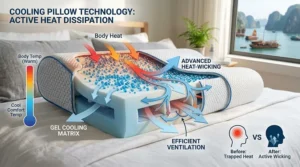
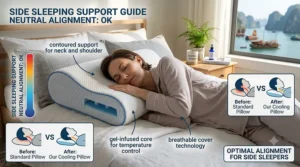
Traditional memory foam is dense and closed-cell by design, which is exactly what gives it that slow, contouring sink — but that same density traps body heat with nowhere for it to escape. A cooling memory foam pillow tackles this in one of three ways: gel beads or gel layers mixed into the foam (Tempur-Pedic, Coop, Sealy), an open-cell or cross-cut structure that lets air move through shredded foam pieces (Xtreme Comforts), or a breathable, moisture-wicking cover layered on top of standard foam.
In practice, gel-infused foam doesn’t eliminate heat — it delays it. The gel absorbs and disperses warmth for the first several hours of sleep, which is often enough to get most sleepers through the night, but it can still gradually equalize toward body temperature by early morning, especially in a warm bedroom. That’s worth knowing going in, since “cooling” doesn’t mean “cold all night” — it means “cooler, longer” compared to standard foam.
Cooling Memory Foam vs. Gel-Grid and Latex Alternatives
This is where Purple’s GelFlex Grid stands apart from every other pillow on this list. Because the grid is mostly open air rather than dense foam, there’s structurally less material available to retain heat in the first place — it’s a different physics problem than gel-infused memory foam is solving. Talalay latex, the material wrapped inside the Purple Harmony’s core, is also naturally more breathable than polyurethane memory foam due to its manufacturing process, which whips air into the latex during curing.
The trade-off is feel, not performance. Memory foam’s slow-motion contouring sink is genuinely different from the more buoyant, springy response of a grid-and-latex pillow. Neither is objectively better — it comes down to whether you want a pillow that hugs your head or one that supports it without sinking in.
What to Expect: Real-World Cooling Performance After Week One
The first night with any of these pillows tends to feel dramatic — that initial cool-to-the-touch sensation is real and noticeable. By the end of week one, most users settle into a more accurate sense of how the pillow performs over a full eight hours rather than just the first ten minutes. Gel-infused foam pillows (Tempur-Pedic, Coop, Sealy) tend to feel coolest in the first half of the night and gradually warm by early morning hours, while structurally open designs (Purple, Bedgear’s mesh-and-vent system) maintain a more consistent temperature throughout.
Room temperature and bedding still matter more than people expect — even the best cooling pillow is working against you if you’re sleeping under a heavy comforter in a warm room. Pair any of these picks with breathable sheets for the most noticeable improvement.
✨ Ready to stop overheating at night? ✨
🔍 Compare your top contenders above and check current pricing before they sell out — your future well-rested self will thank you!
Features That Actually Matter (And Those That Don’t)
Matters: CertiPUR-US/GREENGUARD certification, loft height matched to sleep position, washable cover, adjustability if you’re unsure of your ideal loft, and whether the cooling tech is built into the foam versus just the cover.
Doesn’t matter much: Specific gel bead counts touted in marketing copy, exotic-sounding fabric names with no breathability data behind them, and color options. These are differentiation tactics, not performance indicators. A pillow that says “thousands of cooling gel beads” isn’t necessarily cooler than one that simply says “gel-infused” — the marketing language varies far more than the underlying engineering does.
Long-Term Cost & Maintenance
Most memory foam pillows, cooling or not, have a realistic lifespan of two to three years before the foam’s support and resilience noticeably decline — shredded-fill budget pillows often need refreshing or replacing sooner, while solid single-piece foam (Tempur-Pedic, Sealy) tends to hold up closer to the long end of that range. Run the math per night rather than per pillow: a $130 pillow used nightly for three years works out to roughly 12 cents a night, while a $40 pillow replaced annually costs about 11 cents a night — the cost difference is smaller than the sticker price suggests.
Maintenance is straightforward across the board: wash removable covers regularly, spot-clean foam inserts (never submerge memory foam in water), and avoid folding or compressing the pillow for storage, which can permanently damage the foam’s cell structure.
Certifications, Safety & What CertiPUR-US/GREENGUARD Actually Mean
CertiPUR-US certification confirms the foam was made without ozone depleters, mercury, lead, formaldehyde, or banned phthalates, and that it meets specific limits on volatile organic compound emissions — you can review the full certification standards directly through CertiPUR-US. GREENGUARD Gold, used by Coop Home Goods among others, goes a step further by testing for chemical emissions against stricter limits originally designed for sensitive environments like schools and healthcare facilities.
Neither certification guarantees comfort or cooling performance, but both are reasonable signals that a manufacturer is investing in safer materials rather than cutting corners. For background on how memory foam itself was developed and how its open-cell vs. closed-cell structure affects breathability, Wikipedia’s memory foam overview is a solid starting point, and the Sleep Foundation’s pillow research digs further into how pillow materials interact with body temperature overnight.

FAQ
❓ How long do cooling memory foam pillows last?
❓ Do cooling gel pillows actually work for night sweats?
❓ Can you wash a cooling memory foam pillow?
❓ What loft height is best for side sleepers?
❓ Why does a new memory foam pillow smell strange?
Conclusion
There’s no single “best” cooling memory foam pillow — there’s a best one for your sleep position, budget, and how hot you actually run at night. If you want dependable, long-lasting support and don’t mind paying for it, the Tempur-Pedic TEMPUR-Cloud Dual Cooling Pillow is hard to beat. If you’re not sure what loft you need yet, the adjustability of the Coop Eden Cool+ or The Coldest Pillow takes the guesswork out of it. And if you want to test the waters before committing real money, the Sealy Dreamlife or Xtreme Comforts picks prove that effective cooling doesn’t have to be expensive.
Whichever you choose, give it a real break-in period before judging it, pair it with a breathable pillowcase, and match the loft to how you actually sleep — not just what looks comfortable in product photos.
Recommended for You
- Memory Foam Pillow vs Down Pillow: 6 Top Picks for 2026
- 7 Best Memory Foam Pillows for Side Sleepers in 2026
- Memory Foam Pillow for Neck Pain: 7 Real Picks Worth Buying in 2026
Disclaimer: This article contains affiliate links. As an Amazon Associate, I earn from qualifying purchases. If you purchase products through these links, we may earn a small commission at no additional cost to you.
✨ Found this helpful? Share it with your friends! 💬🤗
