

In This Article
Somewhere around 2 a.m., most of us stop caring about thread counts and start caring about one thing only: does this pillow feel like a cloud or a sandbag? That’s usually the moment people start Googling goose down vs duck down pillow, trying to figure out why one bag of feathers costs $40 and another costs $300 for what looks, from the outside, like the exact same thing.

Here’s the short version, and we’ll spend the rest of this article proving it: goose down and duck down are both natural insulators harvested from the soft under-plumage of waterfowl, but they differ in cluster size, loft, warmth-to-weight ratio, and — frankly — smell, in ways that matter a lot once you’re the one lying on them at 2 a.m. Geese are simply bigger birds, so their down clusters are bigger too, which tends to translate into fluffier, longer-lasting pillows. Duck down is nearly as good and considerably kinder to your wallet.
This guide walks through seven real, currently available pillows spanning budget to splurge-worthy, breaks down what actually separates goose from duck fill, and tackles the questions people ask most: is goose down worth the price, why do some duck down pillows develop an odor, and how do you actually choose between the two without a lab coat and a microscope. As the Sleep Foundation’s down pillow guide explains, goose down tends to form thicker clusters than duck down, which is a big part of why goose-filled pillows often feel plusher and more insulating. We’ll unpack exactly why that happens and whether it’s worth paying for.
By the end, you’ll know which of these seven pillows fits your sleep style, your budget, and your tolerance for the occasional barnyard whiff. Let’s get into it.
Quick Comparison Table
Before the deep dive, here’s a scan-and-decide table for anyone who wants the highlights without reading all 4,000-plus words (though we hope you stick around).
| Pillow | Down Type | Fill Power (approx.) | Price Range | Best For |
|---|---|---|---|---|
| Puredown Natural Goose Down and Feather Pillow | Goose down/feather blend | 550-600 | $50-$80 | Budget stomach sleepers |
| DOWNCOOL Goose Down Bed Pillows | Goose down | 500-550 | $45-$70 | Versatile back/side sleepers |
| Downlite Extra Soft Duck Down Pillow | Duck down | 525-550 | $40-$65 | Hot sleepers on a budget |
| Pacific Coast Double Down Around Pillow | Duck feather + duck down | 550-600 | $90-$140 | Structured support, side/back |
| Continental Bedding Premium Firm White Goose Down Pillow | 100% goose down | 550 | $110-$160 | Firm support, larger sleepers |
| Three Geese White Goose Feather & Cotton Pillow | Goose feather | 400-450 | $55-$85 | Hotel-style feel on a budget |
| Quince Luxe Goose Down Pillow | Goose down (RDS-certified) | 600-700 | $150-$220 | Luxury, allergy-conscious buyers |
Looking at the spread, the price gap between the cheapest and priciest option is roughly $170, but the fill power gap (400 versus 700) is where that money actually goes. Higher fill power means each ounce of down traps more air, so Quince Luxe Goose Down Pillow and Pacific Coast Double Down Around Pillow hold their shape night after night in a way the lower-fill-power picks eventually stop doing. If your budget caps out under $70, that’s not a dealbreaker — it just means slightly more frequent fluffing and, eventually, replacement.
💬 Already leaning toward one? Compare current prices and availability before you decide — stock on down pillows shifts fast around bedding sale seasons.
💬 Just one click — help others make better buying decisions too!😊
Top 7 Goose Down and Duck Down Pillows: Expert Analysis
We picked these seven with one goal: cover every realistic budget and sleep style, while giving you a fair, side-by-side look at goose down vs duck down pillow performance in the real world. Three are goose, two are duck, one blends both fills, and one leans on feather structure for a firmer feel.
1. Puredown Natural Goose Down and Feather Pillow — best budget goose down pick
The standout here is simple: real goose down at a price that doesn’t require a second mortgage. This pillow blends roughly 95% goose feathers with 5% goose down in a single chamber, which keeps costs low but changes the feel compared to higher-down-ratio options.
The single-chamber construction means the feathers and down mix rather than separating into distinct layers, and the loft measures noticeably lower — around 6 inches when fluffed — than dual-chamber competitors. In practice, that low profile is exactly why it works so well for stomach sleepers, who need a flatter surface to avoid neck strain, but it can leave side sleepers wanting more height under the ear.
Based on the spec comparison with pricier goose down pillows, the tradeoff is clear: you’re getting genuine down content, just less of it, and a single-stitch seam rather than double-stitched construction. Reviewers consistently note that the pillow flattens faster than premium alternatives and that some quills can be felt through the fabric, a common complaint with single-chamber feather-heavy fills.
Pros:
- ✅ Real goose down at an entry-level price point
- ✅ Low loft works well for stomach sleepers
- ✅ Machine washable cotton cover
Cons:
- ❌ Flattens faster than dual-chamber designs
- ❌ Quills can be felt through single-stitch seams
Priced around $50-$80 for a set, this is a fair value pick if you sleep on your stomach and don’t mind re-fluffing it nightly, but side and back sleepers should look further down this list.

2. DOWNCOOL Goose Down Bed Pillows — most versatile for mixed sleep positions
What stands out on the DOWNCOOL Goose Down Bed Pillows is the medium loft that splits the difference between too-flat and too-tall, making it one of the more adaptable options on this list for people who switch positions throughout the night.
The fill is genuine goose down at a moderate fill power, wrapped in a breathable cotton shell with piped edges for structural integrity. What that means in practice: the pillow holds a rounder shape out of the box than single-chamber budget options, so it needs less aggressive fluffing to look and feel right.
What most buyers overlook about this model is that its mid-range loft makes it genuinely usable for back, side, and stomach sleepers rather than being optimized for just one camp — a rarer trait among down pillows, which typically specialize. Aggregated customer sentiment on Amazon points to strong marks for softness and initial loft, with a recurring theme that the pillow requires occasional re-fluffing to maintain its shape by the second or third month of use.
Pros:
- ✅ Adaptable medium loft for multiple sleep positions
- ✅ Genuine goose down fill, not a blend
- ✅ Piped edges hold shape better than budget rivals
Cons:
- ❌ Needs monthly fluffing to maintain loft
- ❌ Firmness softens noticeably after a few months
At around $45-$70, this is one of the stronger all-around values if you’re not sure which sleep position dominates your night.
3. Downlite Extra Soft Duck Down Pillow — best for hot sleepers on a budget
The Downlite Extra Soft Duck Down Pillow leads with a specific advantage: a 250 thread count cotton damask shell that’s intentionally looser-woven for breathability rather than chasing a high thread-count marketing number.
This pillow uses 100% white duck down at a fill power in the 525-550 range, encased in that lower-thread-count cover. Here’s what to weigh: a lower thread count usually signals a cheaper shell, but in this case it’s a deliberate cooling choice, since tighter weaves trap heat against the scalp and neck. The low, flat loft also targets stomach sleepers specifically rather than trying to be universal.
Reviewers consistently report that this pillow sleeps cooler than most down competitors, which tracks with the breathable shell design, and that it holds up well for people who run warm at night. The tradeoff is support: back and side sleepers report insufficient height, and the softness that makes it comfortable for stomach sleeping becomes a liability for anyone needing neck alignment.
Pros:
- ✅ Breathable shell genuinely sleeps cooler
- ✅ Hypoallergenic duck down processing
- ✅ Budget-friendly for a full duck down fill
Cons:
- ❌ Too low-loft for side or back sleepers
- ❌ Softens quickly, needs frequent fluffing
At roughly $40-$65, it’s a smart pick specifically for stomach sleepers who overheat at night — less so for anyone else.
4. Pacific Coast Double Down Around Pillow — best structured support from a dual-fill design
The clever engineering here is the headline: a duck feather core surrounded by a layer of duck down, essentially building two pillows into one shell.
That dual-layer construction is the whole story. The inner feather core supplies firm, springy support that resists flattening, while the outer down layer delivers the soft, moldable surface your face actually touches. Reviewers and product testers alike note this hybrid approach solves the classic “all down goes flat, all feather feels scratchy” tradeoff by giving you both in one pillow.
On paper, this means side and back sleepers get a rare combination: enough structural support to keep the neck aligned, plus a plush top layer for comfort. What the spec sheet won’t tell you, but long-term owners note, is that the two-layer build also means the pillow keeps its shape considerably longer than single-chamber duck down alternatives, which matters if you’re trying to avoid replacing your pillow every 12 months.
Pros:
- ✅ Feather core resists flattening over time
- ✅ Down outer layer keeps the plush feel
- ✅ Strong support for side and back sleepers
Cons:
- ❌ Heavier than single-fill duck down pillows
- ❌ Premium construction costs more than basic duck down
Expect to pay in the $90-$140 range, which puts it solidly mid-tier — a smart step up if the two budget duck down options above left you wanting more support.
5. Continental Bedding Premium Firm White Goose Down Pillow — best for firm support and larger frames
This one earns its heading with a straightforward promise: 100% white goose down at 550 fill power in a firm configuration, rather than the medium-soft feel most down pillows default to.
The spec sheet reads simply — pure goose down, Egyptian cotton shell, roughly 27 ounces of fill — but the real-world meaning is a pillow with genuine structural height that doesn’t collapse under a heavier head or shoulder. Based on the spec comparison with softer goose picks on this list, the firmness here comes from fill density rather than any synthetic support core, so it stays breathable in a way memory foam alternatives don’t.
What most buyers overlook about firm down pillows generally is that “firm” doesn’t mean hard — it means slower compression, so your head still sinks in, just more gradually and with more rebound. That combination suits back and side sleepers who need real neck support, and reportedly works well for broader-shouldered or heavier sleepers who flatten softer pillows within weeks. The Egyptian cotton shell also breathes noticeably better than the cheaper polycotton blends used on this list’s budget entries.
Pros:
- ✅ Genuine firmness from dense 550 fill power goose down
- ✅ Egyptian cotton shell improves breathability
- ✅ Holds support for heavier sleepers longer than softer picks
Cons:
- ❌ Too firm for people who prefer a sink-in feel
- ❌ Priced above most mid-range duck down options
Priced around $110-$160, it’s a strong pick specifically for anyone who has bounced off soft down pillows because they wanted more head support.

6. Three Geese White Goose Feather & Cotton Pillow — best hotel-style feel on a budget
The hook is right there in the name: a 600 thread count organic cotton cover wrapped around goose feather fill, chasing that five-star hotel feel without the five-star hotel markup.
This is a feather-forward rather than down-forward pillow, which changes the equation compared to the other goose entries here — feather fill has less loft and a firmer, springier compression than down clusters. That firmness, paired with the notably high 600 thread count shell, gives it a crisp, cool-to-the-touch surface that feels more like the pillow you’d find at a boutique hotel than a cloud-soft luxury pillow.
Here’s what to weigh: because this is feather rather than down-dominant fill, it’s a fundamentally different product than the goose down entries on this list, even though “goose” appears in both names. Reviewers consistently note the higher thread count cover as a standout feature, alongside good initial loft, while some buyers report the feather fill feels firmer and less moldable than they expected from a “goose” pillow, so it’s worth reading that distinction twice before buying.
Pros:
- ✅ High 600 thread count cover feels premium
- ✅ Firm, hotel-style feel at a mid-budget price
- ✅ Good loft retention thanks to feather structure
Cons:
- ❌ Feather fill is firmer and less moldable than true down
- ❌ Not ideal if you specifically want a soft, sink-in pillow
At about $55-$85, it’s a smart pick for anyone who wants that structured hotel pillow feel rather than a plush down experience.
7. Quince Luxe Goose Down Pillow — best true luxury goose down pick
The standout advantage is right in the specs: a high fill-power goose down cluster fill wrapped in a silky cotton sateen cover, positioned as the closest thing on this list to a genuine five-star hotel pillow.
According to Quince’s own product documentation and third-party reviews, this pillow carries Responsible Down Standard certification, meaning the down is independently verified as ethically sourced. Per the Textile Exchange’s official RDS standard, the certification bans any removal of down or feathers from live birds, including live plucking or molt harvesting, and requires third-party auditing across the entire supply chain. That’s meaningfully different from unverified “cruelty-free” claims you’ll see on cheaper listings.
Based on the spec comparison with the rest of this list, the higher fill power here means more air trapped per ounce of down, translating to a pillow that feels lighter in your hands but loftier under your head — the textbook definition of a good warmth-to-weight ratio. Reviewers consistently describe the cotton sateen cover as notably smoother than standard cotton percale used elsewhere on this list, and the extended trial period offered by similar premium brands in this category suggests manufacturers are confident buyers won’t want to return it.
Pros:
- ✅ RDS-certified ethical goose down sourcing
- ✅ High fill power for genuine loft and warmth
- ✅ Silky sateen cover feels distinctly premium
Cons:
- ❌ Priced well above every other pick on this list
- ❌ Overkill if you’re a casual, budget-focused buyer
Priced in the $150-$220 range, this is the pillow to buy if you’ve already decided goose down is worth the price and just want the best version of it.
Practical Usage Guide: Getting the Most from Your Down Pillow
Buying the right pillow is half the battle — the other half is not ruining it in the first month. Down pillows need more care than a synthetic pillow, but that care isn’t complicated once you know the routine.
Start by fluffing your new pillow immediately out of the packaging, since most goose down and duck down pillows arrive vacuum-compressed and can take 24-48 hours to fully decompress. Punch, knead, and shake it — this isn’t a delicate process, and skipping it is the single most common first-week mistake, leading buyers to assume a pillow is “flat” when it just hasn’t finished expanding.
For ongoing maintenance, fluff your pillow daily or every few days, since down clusters shift and settle from the weight of your head overnight. Wash according to the manufacturer’s care label, typically a gentle cold cycle with a small amount of mild detergent, then tumble dry on low with a couple of clean tennis balls or dryer balls to help the clusters redistribute evenly rather than clumping. Skipping the dryer balls step is another common first-month mistake — clumped, unevenly dried down is what creates those lumpy, cold-spot patches people complain about.
Rotate between two pillows if you can, giving each one time to fully re-loft between uses, and always use a breathable cotton pillowcase rather than synthetic fabric, which traps moisture and accelerates both odor and allergen buildup. Most down pillows last two to three years with this kind of care, versus closer to one year when neglected.
Real-World Scenarios: Which Sleeper Are You?
Specs only mean so much until you match them to an actual person and an actual life. Here are three composite profiles built from the buyer patterns and review themes across these seven pillows.
Consider a college student sharing a small apartment, sleeping on their stomach most nights, and working with a tight budget after rent and textbooks. That profile points straight at the Downlite Extra Soft Duck Down Pillow or the Puredown Natural Goose Down and Feather Pillow — both low-loft, both budget-friendly, and both well-suited to stomach sleeping where a tall, firm pillow would strain the neck.
Now picture a side-sleeping professional in their 40s who runs warm at night and has dealt with recurring neck stiffness. That combination of needed support plus heat sensitivity points toward the Pacific Coast Double Down Around Pillow, whose feather-core-plus-down-layer construction supplies the height and support side sleeping demands, in a natural fill that breathes better than memory foam.
Finally, imagine someone furnishing a guest room to hotel standard, with a bigger budget and a preference for products that carry real ethical certifications. That’s the exact use case for the Quince Luxe Goose Down Pillow — RDS-certified, high fill power, and priced to match the “guest room that outshines the primary bedroom” ambition. Matching your actual sleep position, temperature preference, and budget to these profiles will get you closer to the right pillow than fill power alone ever could.
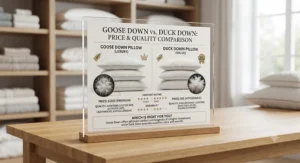
Goose Down vs Duck Down Pillow: Which Is Better?
This is the question that brought most readers here, so let’s answer it directly: neither goose down nor duck down is universally “better” — they differ in specific, measurable ways that matter more or less depending on your priorities.
Goose down clusters are physically larger because geese are larger birds, and larger clusters trap more air per ounce of fill. That translates into a better warmth-to-weight ratio, meaning goose down pillows tend to feel lighter while still delivering strong loft and insulation — thicker clusters generally mean a plusher, more insulating pillow overall. Goose down also tends to be more durable over time, retaining loft through more wash-and-fluff cycles before flattening for good.
Duck down, meanwhile, comes from a smaller bird, so its clusters run smaller and slightly denser. In practice, that means duck down pillows are often a touch heavier for a comparable loft and slightly less airy in feel — but the gap is smaller than marketing copy often suggests, especially at the mid-to-premium fill power range where the Pacific Coast Double Down Around Pillow competes comfortably with goose-filled rivals. Duck down is also more prone to developing an odor over time, since duck oil composition differs slightly from goose, a topic we’ll cover in detail below.
The honest verdict: if budget is a secondary concern and you want maximum longevity and the lightest possible feel, goose down is the better long-term investment. If you’re budget-conscious and willing to do slightly more maintenance, a well-made duck down pillow like the Downlite Extra Soft Duck Down Pillow or Pacific Coast Double Down Around Pillow delivers most of the comfort at a meaningfully lower price.

How to Choose Between Goose Down and Duck Down Pillow
Cutting through the marketing, here’s the decision-making process that actually matters, in order.
- Identify your primary sleep position first. Stomach sleepers need low loft, side and back sleepers need more height and support — this eliminates several options before price even enters the conversation.
- Set a real budget range, not a target price. Down pillows have a huge price spread, and knowing whether you’re working with $50 or $200 narrows the field immediately.
- Check the fill power, not just the fill type. A high-fill-power duck down pillow can outperform a low-fill-power goose down pillow — the number matters as much as the bird.
- Look for third-party ethical certification if it matters to you. RDS certification is the clearest signal of humane sourcing currently available in this category.
- Consider your temperature sensitivity. Hot sleepers should prioritize breathable, lower-thread-count cotton shells over tightly woven “luxury” fabric that traps heat.
- Factor in maintenance tolerance. If you won’t realistically fluff and wash your pillow regularly, lean toward higher fill power options that hold shape longer with less upkeep.
- Read aggregated review sentiment, not star ratings alone. A 4.5-star average can hide a recurring odor or flattening complaint that matters more to you than it did to other reviewers.
Is Goose Down Worth the Price?
Short answer: yes, if you actually use the extra performance you’re paying for — and no, if you’d be just as happy with a slightly heavier, slightly less airy pillow for half the price.
The price premium on goose down comes from three real, verifiable factors rather than pure branding: larger cluster size requiring more careful sourcing, generally higher fill power, and — increasingly — ethical certification costs like RDS auditing that get built into the retail price. Reviewers consistently note that premium goose down pillows like the Quince Luxe Goose Down Pillow hold their loft for years rather than months, which changes the actual cost-per-year math considerably.
Here’s the honest math: a $180 goose down pillow that lasts four years costs about $45 per year. A $55 duck down pillow that needs replacing every 18 months costs closer to $37 per year — cheaper, but not dramatically so, and that gap narrows further if you’re diligent about washing and fluffing. What most buyers overlook is that the “worth it” question isn’t really about goose versus duck at all — it’s about fill power and construction quality within whichever fill you choose. A high-fill-power duck down pillow beats a low-fill-power goose down pillow on both comfort and longevity, price be damned.
Difference Between Goose and Duck Down Fill
At the cluster level, the difference comes down to bird size and, to a lesser degree, diet and environment. Geese are larger, longer-lived birds, and their down clusters grow correspondingly larger and more resilient. Duck down clusters are smaller and somewhat denser, since ducks are a smaller-bodied species.
That size difference cascades into everything else: goose down traps air more efficiently per gram, giving it a superior warmth-to-weight ratio and a generally plusher hand-feel. Duck down compresses a bit more readily and can feel slightly heavier for an equivalent loft, though high-fill-power duck down — like what’s used in the Pacific Coast Double Down Around Pillow — closes much of that gap.
There’s also a chemical difference worth knowing: duck down carries a somewhat different oil composition than goose down, which is part of why duck-filled products are statistically more prone to developing an odor over time, particularly if they get damp during washing and aren’t dried thoroughly. Neither fill type is inherently “dirty” — both undergo industrial washing before ending up in a pillow — but the raw material chemistry does differ, and manufacturers who cut corners on processing tend to produce duck down products more prone to smell complaints than their goose down counterparts.
Down Cluster Size and Quality Explained
Cluster size is the single most important — and most overlooked — quality indicator in a down pillow, more relevant than the brand name printed on the box.
A down cluster looks nothing like a feather; it’s a soft, three-dimensional, almost dandelion-like puff with no rigid quill, which is exactly why it can trap so much insulating air. Larger clusters, typical of goose down, create bigger air pockets and a springier, more resilient structure that resists permanent compression. Smaller clusters, more common in duck down and in immature or lower-grade down of either type, compress more easily and take longer to rebound after being sat or slept on.
Fill power is the industry’s way of measuring this cluster quality: it’s the volume, in cubic inches, that one ounce of down occupies once fully lofted. A 600 fill power down cluster takes up considerably more space — and traps more air — than a 400 fill power cluster, even though both weigh the same amount. That’s why the Three Geese White Goose Feather & Cotton Pillow, at 400-450 fill power, feels noticeably firmer and less airy than the Quince Luxe Goose Down Pillow at 600-700, despite both technically containing “goose” material. When shopping, treat the fill power number as more informative than the goose-versus-duck label alone.
Waterfowl Down Insulation: How It Keeps You Warm
Down insulation works on a simple physical principle: trapped, still air is an excellent insulator, and down clusters are essentially three-dimensional air traps. Unlike a solid material that conducts heat away from your body, the countless tiny air pockets inside a down cluster slow heat transfer dramatically, which is why the same pillow that feels cool to the touch initially warms up quickly once your head settles in.
This is also why down pillows can sleep hot for some people despite their reputation as a premium product — the same insulating efficiency that keeps you warm on a cold night traps body heat just as effectively in summer. That’s precisely why shell breathability, not just fill quality, matters so much: the Downlite Extra Soft Duck Down Pillow‘s intentionally lower thread count cover exists specifically to counteract the insulating effect of the down inside it, letting heat escape through the fabric even as the fill itself keeps performing.
Waterfowl evolved this insulation to survive on cold water, which is also why down performs so much better than most synthetic alternatives on a pure warmth-per-ounce basis — no manufactured fiber has yet fully replicated the cluster geometry that makes natural down so efficient at trapping air without adding bulk or weight.
Odor in Duck Down Pillows: Causes and Fixes
Let’s address the elephant in the bedroom directly: a faint barnyard smell, especially when a duck down pillow gets warm or slightly damp, is one of the most common complaints in aggregated reviews for budget duck down products.
The cause usually traces back to incomplete industrial washing during processing, residual natural oils in the down itself, or moisture getting trapped inside the fill during a home wash-and-dry cycle that didn’t fully dry the pillow’s core. Reviewers consistently report that the smell is most noticeable right out of the packaging and on humid nights, and that it usually fades with the first one or two home washes and thorough sun-drying.
The fix is mostly preventive: always dry a washed down pillow completely, using low heat and dryer balls over an extended cycle, and check the very center of the pillow for lingering dampness before considering it done — a pillow that feels dry on the surface can still be damp at its core, which is exactly the condition duck down odor thrives in. Airing a new pillow outdoors in direct sun for a few hours before first use also helps dissipate any residual processing smell. If odor persists after proper drying, it typically signals a manufacturing shortcut rather than a fixable home-care issue, and that’s a legitimate reason to contact the seller. On the allergy side, it’s worth checking out the Asthma and Allergy Foundation of America’s certified bedding program, which recommends products scientifically tested to help create a healthier sleep environment — a useful label to look for if odor and allergen concerns both worry you.
Duck Down Pillow Reviews: What Amazon Buyers Are Saying
Pulling together aggregated sentiment across duck down listings on Amazon, a few consistent patterns emerge that are worth knowing before you buy.
Positive themes center on value: buyers consistently report that duck down delivers a comfort level close to goose down at a noticeably lower price, particularly praising the softness and initial loft of options like the Downlite Extra Soft Duck Down Pillow. Reviewers also frequently highlight breathable covers as a standout feature when brands specifically design for cooling rather than chasing high thread counts.
On the negative side, the most recurring complaint across duck down pillow reviews is faster loft loss compared to goose down at equivalent price points, requiring more frequent fluffing to maintain shape. The second most common theme is the odor issue covered above, disproportionately reported on lower-priced, less rigorously processed listings. A smaller but notable complaint cluster involves quills poking through thinner or single-stitched shells, an issue tied more to construction quality than to duck down as a fill type itself.
The takeaway from this pattern: duck down performs well when paired with solid construction — double stitching, adequate fill power, and proper processing — and performs poorly mainly when manufacturers cut corners to hit an aggressive price point. Reading reviews with construction quality in mind, rather than fill type alone, will steer you toward the better duck down listings.
Common Mistakes When Buying a Down Pillow
Even careful shoppers fall into a handful of predictable traps when buying goose or duck down pillows, and most of them are avoidable with a little context.
The first mistake is assuming a higher price automatically means higher quality — as this guide shows, a well-constructed duck down pillow can outperform a poorly made, overpriced goose down listing. The second is ignoring fill power entirely and shopping on the goose-versus-duck label alone, when fill power is actually the more predictive quality signal. The third is skipping the return window: down pillows need a few nights to fully decompress and reveal their true feel, so judging one after a single use often leads to an unnecessary return of a perfectly good pillow.
A fourth common mistake is buying a low-loft pillow as a side sleeper because it was on sale, then blaming “down pillows in general” for neck pain that was really a loft mismatch. Finally, many buyers skip checking for RDS or similar certification altogether, missing the chance to support more humane sourcing practices for what amounts to a small price difference at checkout.
Long-Term Cost & Maintenance
Thinking in cost-per-year rather than sticker price changes the goose down vs duck down pillow calculation considerably. A budget duck down pillow in the $45-$70 range that needs replacing every 12-18 months runs roughly $35-$55 annually. A mid-range option like the Pacific Coast Double Down Around Pillow, priced around $90-$140 but lasting closer to three years with proper care, runs closer to $30-$45 annually — actually a better long-term value despite the higher upfront cost.
Premium goose down, exemplified by the Quince Luxe Goose Down Pillow at $150-$220, can last four to five years with consistent fluffing and proper washing, bringing the annual cost down to roughly $30-$45 as well — meaning the true total cost of ownership across budget, mid-range, and premium tiers is far closer than the sticker prices suggest. The deciding factor becomes maintenance discipline: if you’ll actually fluff daily, wash properly, and dry pillows completely, cheaper options age gracefully. If maintenance is unlikely to happen consistently, paying more upfront for higher fill power and better construction is the more reliable long-term bet.
✨ Ready to stop guessing and start sleeping better? Compare current availability on today’s top pick before prices shift.
Frequently Asked Questions
❓ Is goose down really better than duck down for pillows?
❓ Why does my duck down pillow smell?
❓ How long does a goose down pillow last?
❓ What is fill power in a down pillow?
❓ Are goose down pillows hypoallergenic?
Conclusion
The goose down vs duck down pillow decision really comes down to three variables: your sleep position, your budget, and how much maintenance you’re realistically willing to do. Goose down wins on longevity and warmth-to-weight ratio, making it the better pick if you can stretch the budget and want a pillow you’ll fluff for years rather than months. Duck down, especially in a well-constructed option like the Pacific Coast Double Down Around Pillow, delivers most of that comfort at a friendlier price, provided you’re diligent about drying it fully to avoid odor issues.
Across the seven pillows covered here, budget stomach sleepers should look at the Puredown Natural Goose Down and Feather Pillow or Downlite Extra Soft Duck Down Pillow, side and back sleepers needing real support should consider the Pacific Coast Double Down Around Pillow or Continental Bedding Premium Firm White Goose Down Pillow, and anyone treating themselves to a genuine luxury upgrade should look hard at the Quince Luxe Goose Down Pillow. Whichever you choose, remember that fill power and construction quality matter as much as the goose-versus-duck label — sometimes more.
Sleep well, fluff often, and let the pillow do the work you’ve been missing out on.
Recommended for You
- Best Down Pillow 2026: 7 Luxury Picks Worth the Splurge
- Cervical Pillow for Neck Pain: 7 Picks That Actually Help (2026)
- Contour Memory Foam Pillow: 7 Best Picks for Neck Pain 2026
Disclaimer: This article contains affiliate links. As an Amazon Associate, I earn from qualifying purchases. If you purchase products through these links, we may earn a small commission at no additional cost to you.
✨ Found this helpful? Share it with your friends! 💬🤗
