
In This Article
You already know the drill. You wake up, roll your head to check your phone, and your neck screams at you before your coffee’s even brewed. If that’s your morning routine more often than not, the problem might not be your mattress, your posture, or even your pillow’s fluffiness — it might be that you’re sleeping on the wrong pillow for chronic neck pain entirely.

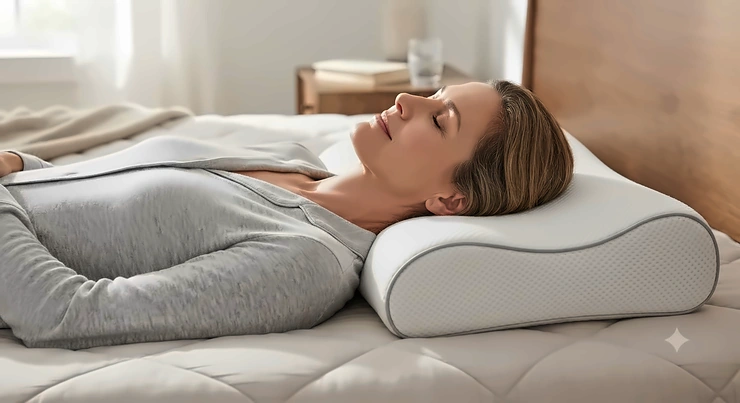
So what is a pillow for chronic neck pain? It’s a pillow engineered — through shape, firmness, and material — to keep the cervical spine in neutral alignment throughout the night, reducing the muscle strain and joint stress that turn a single rough night into a recurring problem. It’s not a gimmick. Researchers analyzing pillow design and cervical alignment have found that pillow height and shape measurably change the pressure distribution across your head and neck, which in turn affects how your cervical spine sits while you sleep.
Here’s the thing nobody tells you at the mattress store: there’s no single “best” pillow for chronic neck pain, because your ideal shape depends on how you sleep, how tall you are, and how firm you like things. A side sleeper needs a completely different loft than a back sleeper, and stomach sleepers need something most orthopedic pillows aren’t even designed for.
This guide is built around real, purchasable products — actual brand names, actual specs, actual aggregated review sentiment — not vague advice. We dug through spec sheets, customer feedback patterns, and clinical research on cervical alignment so you don’t have to gamble $80 on a pillow that ends up in the donation pile. Below, you’ll find seven legitimate options across every budget, a breakdown of what actually matters when you’re shopping, and honest guidance on orthopedic support, firm foam builds, and long-term chronic pain management — the stuff a plain Amazon listing will never tell you.
Quick Comparison Table
Before we get into the deep-dive reviews, here’s the fast version — useful if you’re standing in your bedroom right now trying to make a decision before bedtime.
| Pillow | Best For | Firmness | Price Range |
|---|---|---|---|
| Osteo Cervical Pillow | Budget shoppers wanting butterfly-shape support | Medium-firm | Under $50 |
| UTTU Cervical Pillow | Combination sleepers who switch positions | Adjustable | $40-$55 range |
| EPABO Contour Memory Foam Pillow | First-timers trying a cervical shape | Medium | Under $40 |
| Xtreme Comforts Bamboo Shredded Memory Foam Pillow | Hot sleepers wanting adjustable loft | Adjustable, medium | $50-$65 range |
| Coop Home Goods Eden Pillow | Side sleepers who want to fine-tune height | Adjustable, medium-soft | $109-$139 range |
| Cushion Lab Deep Sleep Pillow | Side and back sleepers wanting a patented contour | Medium-firm | $70-$90 range |
| Tempur-Pedic TEMPUR-Neck Pillow | Buyers who want the firmest, most durable option | Firm | $99-$140+ range |
Notice the spread here: this isn’t seven versions of the same pillow with different logos slapped on. The Osteo Cervical Pillow and EPABO Contour Memory Foam Pillow solve the problem cheaply with a fixed contour shape, while the Coop Home Goods Eden Pillow and Xtreme Comforts Bamboo Shredded Memory Foam Pillow hand you control over the loft yourself. The Tempur-Pedic TEMPUR-Neck Pillow sits at the top for a reason — it’s the option built for people who’ve already tried the cheaper stuff and need something that won’t flatten out in six months. Your sleep position should be the tiebreaker: fixed-contour pillows reward back sleepers, while adjustable-fill options like the Coop Home Goods Eden Pillow are more forgiving for side sleepers and combination sleepers who move around at night.
💬 Just one click — help others make better buying decisions too!😊
Top 7 Pillows for Chronic Neck Pain: Expert Analysis
We picked these seven because they cover every price tier and sleep style, and because each one has a real, verifiable track record on the market — not because they paid for placement (they didn’t; this article contains our own affiliate links, disclosed above).
1. Osteo Cervical Pillow — best-selling budget butterfly shape
The Osteo Cervical Pillow built its reputation on a hollow, butterfly-shaped memory foam core, and it shows in the sheer volume of buyers who’ve stuck with it. Its center cavity is designed to cradle the back of your skull while raised wings support the neck on either side, which in theory keeps your cervical spine from collapsing into a flat pillow’s dead zone.
The foam is a standard viscoelastic memory foam, dense enough to resist bottoming out but soft enough that most side and back sleepers don’t complain about pressure points. Reviewers consistently report noticeable relief from morning stiffness and tension headaches within the first couple of weeks of use, which tracks with what you’d expect from switching a flat pillow for a contoured one. What most buyers overlook is that the “hollow” cutout matters more for stomach sleepers than the marketing suggests — it reduces the twist your neck has to manage face-down, though this shape still isn’t ideal for that position.
Aggregated feedback puts this among the best-reviewed cervical pillows on Amazon, with well over ten thousand five-star ratings logged over its life on the platform — a volume that’s hard to fake and suggests consistent satisfaction across a wide buyer base.
Pros:
- ✅ Extremely high review volume with strong satisfaction rate
- ✅ Butterfly shape suits both side and back sleepers
- ✅ Priced well below most cervical-specific competitors
Cons:
- ❌ Fixed loft, no adjustability for taller or smaller frames
- ❌ Firmness may feel too dense for plush-pillow loyalists
At a price that typically lands under $50, the Osteo Cervical Pillow is one of the easiest low-risk entry points into cervical support — a reasonable value if you’ve never tried a shaped pillow before.

2. UTTU Cervical Pillow — most adaptable sandwich-layer design
The UTTU Cervical Pillow takes a different engineering approach: instead of one solid foam block, it stacks removable memory foam layers in a “sandwich” you can pull apart to change the loft. That’s a meaningful advantage if you’re not sure whether you need a 4-inch or 5-inch profile, because you can test both without buying two pillows.
Its contour shape includes distinct zones for side, back, and stomach sleeping, with a cooling gel-infused top layer aimed at hot sleepers. Based on the spec comparison with rigid single-piece cervical pillows, the layered build gives the UTTU Cervical Pillow an edge for combination sleepers — people who start on their back and end up on their side by 3 a.m. don’t need to fully readjust their neck position when the shape gradually flattens through the night. Reviewers frequently mention the cooling cover as a genuine improvement over standard memory foam, which tends to trap body heat.
The tradeoff is durability of the layered structure itself; a few reviewers note that the removable inserts can shift inside the cover over time, requiring occasional repositioning.
Pros:
- ✅ Removable layers let you customize loft height
- ✅ Cooling gel top layer helps reduce overnight heat buildup
- ✅ Distinct zones support multiple sleep positions in one pillow
Cons:
- ❌ Layers can shift inside the cover with heavy use
- ❌ Queen-size dimensions may feel bulky on smaller beds
Priced in the $40-$55 range, this is a smart pick if you genuinely don’t know your ideal loft yet and want room to experiment.
3. EPABO Contour Memory Foam Pillow — best low-cost way to try a cervical shape
If you’ve never used a contoured pillow and don’t want to commit real money to the experiment, the EPABO Contour Memory Foam Pillow is the low-stakes entry point sleep reviewers repeatedly recommend. It comes in multiple sizes, which matters more than it sounds — a cervical pillow sized for a small frame can feel awkward and unsupportive under a broader set of shoulders.
Its dual-height design (one side taller than the other) means you get two firmness options in a single purchase; flip it depending on whether you want more or less neck elevation that night. That’s a smart bit of engineering for a pillow at this price. The memory foam itself is on the softer end of the cervical-pillow spectrum, so this suits people whose neck pain responds better to gentle cradling than to firm bracing.
Because it’s a budget-tier product, don’t expect the density or edge support of pricier options — but for testing whether a contoured shape helps you at all before spending more, it’s a reasonable low-commitment choice.
Pros:
- ✅ Dual-height sides give two firmness options in one pillow
- ✅ Multiple sizes accommodate different body frames
- ✅ Among the most affordable contoured options available
Cons:
- ❌ Foam density is softer than most true orthopedic models
- ❌ Less durable long-term than higher-density competitors
Typically under $40, this is the pillow to buy if you’re pillow-shopping on a genuine budget and just want to know whether contour support helps you at all.
4. Xtreme Comforts Bamboo Shredded Memory Foam Pillow — most adjustable for hot sleepers
Where the fixed-contour pillows above lock you into one shape, the Xtreme Comforts Bamboo Shredded Memory Foam Pillow hands you a zippered bamboo-derived cover stuffed with shredded memory foam that you can add to or remove by hand. Unzip it, pull out a few handfuls, zip it back up — that’s the entire adjustment process, and it’s genuinely simple enough that most buyers do it within the first week.
The shredded fill matters here in a way a solid foam block can’t replicate: air circulates between the pieces instead of getting trapped, so it sleeps noticeably cooler than dense contoured alternatives. Reviewers consistently note this cooling advantage as the standout reason they chose it over a solid-block cervical pillow, particularly people who run warm at night. What the spec sheet won’t tell you, but user reports suggest, is that the pillow can feel a little lumpy right out of the packaging before the fill settles and redistributes over the first several nights of use.
Aggregated ratings on this line sit comfortably above 4 out of 5 stars across thousands of verified reviews, a track record that’s held up for years rather than a single viral spike.
Pros:
- ✅ Fully adjustable loft via removable shredded fill
- ✅ Better airflow and cooling than solid foam blocks
- ✅ Entirely machine washable, not just the cover
Cons:
- ❌ Can feel lumpy until the fill settles in
- ❌ Removing/adding fill is trial-and-error at first
Landing in the $50-$65 range, and often available as a two-pack, this is the pick for anyone whose main complaint about memory foam has always been overheating.
5. Coop Home Goods Eden Pillow — best adjustable option for side sleepers
The Coop Home Goods Eden Pillow earned its viral reputation honestly: it blends shredded memory foam with a microfiber component for a hybrid feel, and it ships with a spare bag of extra fill so you’re never stuck under-stuffed. Adjustability here isn’t a marketing bullet point — it’s the entire selling proposition, and it delivers.
Here’s what most buyers overlook about this model: the extra fill packet is what separates it from cheaper adjustable pillows. Instead of only being able to remove material, you can add to it, which means side sleepers with broader shoulders can build up the loft rather than settling for whatever ships in the box. Reviewers frequently point to the gel-infused foam and bamboo-derived cover as genuinely effective at keeping the pillow cool, a common complaint with the polyester-fiber-heavy alternatives it competes against. On the downside, a subset of reviewers describe the polyester component as feeling less “memory foam” and more like a traditional fiber pillow at the surface, which may disappoint buyers expecting a denser contour feel.
Because it isn’t a shaped cervical pillow, don’t expect the built-in neck cradle you’d get from the Osteo Cervical Pillow — its support comes entirely from getting the loft height correct for your frame.
Pros:
- ✅ Adjustable fill plus a spare bag for building up loft
- ✅ Gel-infused foam and breathable cover sleep cool
- ✅ Works across back, side, and stomach positions with tuning
Cons:
- ❌ Surface feel is fibrous rather than dense memory foam
- ❌ No built-in cervical contour, so alignment depends on fill level
Sitting in the $109-$139 range, it’s pricier than the fixed-contour budget picks, but the adjustability alone justifies the jump for side sleepers who’ve struggled to find the right loft elsewhere.

6. Cushion Lab Deep Sleep Pillow — best patented ergonomic contour
The Cushion Lab Deep Sleep Pillow takes the contoured-cervical-pillow concept and refines it with a patented ergonomic shape specifically engineered to cradle the head while supporting the neck and shoulder region — a step up in design sophistication from the more generic butterfly shapes at lower price points.
Its build sits in a middle ground: firmer than a standard memory foam pillow, but shaped to distribute pressure rather than resist it outright. Based on the spec comparison with the more basic cervical pillows on this list, the contour geometry here appears more deliberately engineered for shoulder pressure relief specifically, which matters if your neck pain radiates down into your upper back and shoulders rather than staying isolated at the base of your skull. Reviewers commonly cite noticeable shoulder tension relief within the first few nights, alongside praise for the removable, washable cover.
The main knock against it is availability of sizing — because it’s a single dedicated shape rather than a multi-size line, taller or broader sleepers occasionally report it running slightly small compared to standard bed pillows.
Pros:
- ✅ Patented contour targets shoulder pressure, not just neck
- ✅ Firmer support without feeling like a rigid foam block
- ✅ Removable, machine-washable cover simplifies upkeep
Cons:
- ❌ Single dedicated shape may run small for larger frames
- ❌ Premium pricing relative to basic contoured competitors
At roughly $70-$90, it lands between the budget contour pillows and the top-tier Tempur-Pedic option — a strong middle-tier pick if shoulder tension is part of your pain pattern.
7. Tempur-Pedic TEMPUR-Neck Pillow — firmest, most durable long-term investment
The Tempur-Pedic TEMPUR-Neck Pillow is the brand’s original ergonomic pillow, built from proprietary TEMPUR-Material rather than generic memory foam, and it’s noticeably firmer and denser than nearly every other pillow on this list. That firmness is the entire point: it’s engineered to resist compression over years of nightly use rather than months.
Available in multiple sizes tied to your body measurements, its contoured shape supports the natural curve of the neck for back and side sleepers specifically — it isn’t marketed for stomach sleeping, and reviewers confirm it doesn’t suit that position well. What the spec sheet won’t tell you, but longtime owners note, is that the firmness takes a night or two of adjustment if you’re coming from a soft down pillow; once you’re used to it, though, owners consistently describe it as holding its shape years longer than cheaper foam alternatives. The five-year warranty backing it is unusually long for a pillow category where most competitors offer little to no coverage at all.
The honest downside is inflexibility: there’s no adjusting the firmness after purchase, and Tempur-Pedic’s return policy on pillows is stricter than most of its competitors, so sizing correctly up front really matters here.
Pros:
- ✅ Proprietary TEMPUR-Material resists flattening over years
- ✅ Five-year warranty, longer than nearly all competitors
- ✅ Multiple sizes matched to individual body measurements
Cons:
- ❌ Firmness has no adjustability once purchased
- ❌ Stricter return policy makes sizing mistakes costly
Priced from around $99 up to $140+ depending on size and collection, it’s the priciest pick here — but for buyers who’ve cycled through two or three cheaper pillows already, the durability math tends to work out in its favor.
Practical Usage Guide: Getting the Most From Your New Pillow
Buying the right pillow for chronic neck pain is half the equation; using it correctly is the other half, and it’s the part most product pages skip entirely. Start by matching the pillow’s height to your sleep position before your first night: side sleepers generally need the loft to fill the full gap between the ear and the outer shoulder, while back sleepers want a noticeably lower profile that keeps the chin from tipping toward the chest.
Give any new orthopedic pillow, especially foam ones like the Coop Home Goods Eden Pillow or Xtreme Comforts Bamboo Shredded Memory Foam Pillow, about two weeks before judging it. Foam softens and the shredded fill in adjustable models redistributes with use, so a pillow that feels slightly stiff or lumpy on night one often settles into something noticeably better by night ten. During that window, resist the urge to keep adding a second, softer pillow underneath — that habit undoes the alignment the cervical shape is designed to create.
Maintenance matters more than people expect. Fluff shredded-fill pillows weekly to prevent clumping, and wash removable covers every one to two weeks, since sweat and oil buildup compress fibers faster than normal wear. A common first-30-days mistake is judging firmness on the first night while still adjusting your sleep habits from an old pillow — give your neck muscles time to recalibrate before deciding a pillow “doesn’t work.”
Real-World Scenarios: Which Pillow Fits Your Life
Picture three different people shopping for the same problem. A college student who spends six hours a day hunched over a laptop, sleeps on a dorm-issued twin mattress, and has maybe $45 to spend needs something that solves the immediate strain cheaply — the EPABO Contour Memory Foam Pillow or Osteo Cervical Pillow fits that budget and delivers real contour support without a big financial commitment.
Now picture a 45-year-old side sleeper with years of accumulated neck stiffness from a desk job, who’s tried two or three pillows already and is done guessing. That’s the exact buyer the Coop Home Goods Eden Pillow was built for — the adjustable fill removes the guesswork, letting them dial in the precise loft their shoulder width demands instead of hoping a fixed shape happens to fit.
Finally, consider someone managing genuinely chronic, diagnosed neck pain who wants to invest once and be done adjusting pillows for years. That’s where the Tempur-Pedic TEMPUR-Neck Pillow earns its higher price tag — the five-year warranty and proprietary foam are built for buyers who’ve decided durability matters more than experimentation. Matching your actual situation, not just your budget, to one of these profiles will save you more money in the long run than chasing the cheapest option every time.
Problem → Solution: Fixing Common Neck Pain Sleep Issues
Problem: You wake up with a stiff neck almost every morning. This usually points to a pillow that’s either too flat or too high for your sleep position. Solution: measure the gap between your ear and shoulder while lying on your side, and choose a pillow — like the adjustable UTTU Cervical Pillow — that matches that height exactly rather than eyeballing it.
Problem: Your pillow feels supportive at first but flattens within a few months. Cheaper polyester and low-density foam fills compress permanently under repeated pressure. Solution: move toward a higher-density option such as the Tempur-Pedic TEMPUR-Neck Pillow, whose proprietary foam is specifically engineered to resist that kind of long-term collapse.
Problem: You sleep hot and end up kicking the pillow away at 2 a.m. Solid memory foam traps heat by design. Solution: switch to a shredded-fill, breathable-cover pillow like the Xtreme Comforts Bamboo Shredded Memory Foam Pillow, which allows airflow between the foam pieces.
Problem: You switch positions constantly and no single loft feels right all night. Solution: a layered or adjustable design, such as the UTTU Cervical Pillow‘s removable inserts or the Coop Home Goods Eden Pillow‘s add-or-remove fill, adapts as you move rather than locking you into one height.
Problem: Your neck pain radiates into your shoulders, not just your neck itself. Solution: prioritize a pillow engineered for shoulder pressure specifically, like the Cushion Lab Deep Sleep Pillow, rather than a generic cervical contour that only addresses the head and neck.
How to Choose a Pillow for Chronic Neck Pain
- Identify your primary sleep position first. Side, back, and stomach sleepers each need meaningfully different loft heights, and guessing here undermines every other decision you make.
- Measure, don’t estimate, your shoulder-to-ear gap. This single number predicts your ideal pillow height more reliably than firmness preference alone.
- Decide between fixed contour and adjustable fill. Fixed shapes like the Osteo Cervical Pillow are simpler and cheaper; adjustable options like the Coop Home Goods Eden Pillow cost more but eliminate guesswork.
- Factor in temperature regulation if you sleep hot. Shredded, ventilated fills outperform dense solid foam blocks on this specific metric.
- Check the warranty and return policy before buying. A longer warranty, like the five years behind the Tempur-Pedic TEMPUR-Neck Pillow, signals real confidence in long-term durability.
- Read aggregated review sentiment, not star averages alone. Look for recurring, specific complaints (lumpiness, flattening, sizing) rather than just a number out of five.
- Give any new pillow a full two-week trial before judging it. Foam settling and muscle adjustment both take time, and early impressions are frequently wrong.

Cervical Pillow vs Regular Pillow
A standard bed pillow is built for softness and general comfort, filled with down, polyester, or basic foam distributed evenly across a rectangular shape. A cervical pillow, by contrast, is engineered around a specific goal: keeping the neck in neutral alignment with the rest of the spine, which is why models like the Osteo Cervical Pillow and Cushion Lab Deep Sleep Pillow use contoured, uneven shapes rather than a flat rectangle.
The practical difference shows up the moment you lie down. A regular pillow lets your head sink until gravity, not design, decides your neck angle — which is fine if you’re pain-free, but risky if your neck is already sensitive to strain. A cervical pillow actively resists that sink in specific zones, propping the neck while allowing the head to rest slightly lower, which systematic reviews of pillow design and neck pain suggest can measurably reduce waking symptoms compared to unsupportive designs. The tradeoff is adjustment time: cervical pillows often feel unfamiliar for the first several nights, while a regular pillow feels instantly comfortable but offers no real postural correction. If your neck pain is only occasional, a regular pillow might be enough; if it’s chronic, the structured support of a cervical design is worth the adjustment period.
Common Mistakes When Buying a Pillow for Neck Pain
The single most common mistake is buying based on softness preference alone, ignoring sleep position entirely — a plush pillow that feels amazing in a store often provides zero actual neck support once you’re lying down at home. A close second is skipping the sizing guide on adjustable or multi-size pillows like the EPABO Contour Memory Foam Pillow, then blaming the product when a mismatched size fails to fit properly.
Another frequent error: judging a new orthopedic pillow after a single rough night, before the foam has settled or your neck has adjusted to the new shape. Shoppers also tend to underestimate how much heat retention matters — someone who runs warm at night will be miserable on a dense solid-foam pillow regardless of how well it supports the neck, which is exactly the scenario the Xtreme Comforts Bamboo Shredded Memory Foam Pillow was designed to solve. Finally, many buyers skip the warranty and return policy entirely, only to discover after the fact — as with the Tempur-Pedic TEMPUR-Neck Pillow — that pillow returns are handled far more strictly than mattress or bedding returns generally are.
What to Expect: Real-World Performance
On paper, spec sheets promise instant relief. In practice, most people experience a gradual improvement curve rather than an overnight fix. The first few nights on a genuinely supportive cervical pillow often feel unfamiliar, sometimes even slightly uncomfortable, as your neck muscles adjust to a new resting angle they haven’t held before. By the end of the first two weeks, most reviewers across nearly every product on this list report a noticeable drop in morning stiffness — not a total elimination of pain, but a meaningful reduction in frequency and severity.
Expect adjustable models like the Coop Home Goods Eden Pillow to require some initial tinkering before you land on your ideal loft; that trial-and-error period is normal, not a sign the product is defective. Firmer options like the Tempur-Pedic TEMPUR-Neck Pillow tend to hold their supportive shape for years once broken in, while budget foam options gradually soften and may need replacement sooner — typically somewhere in the 18-to-24-month range for daily use, versus considerably longer for denser, higher-density builds.
Long-Term Cost & Maintenance
It’s tempting to compare pillows purely on sticker price, but total cost of ownership tells a more useful story. A $35 pillow that needs replacing every eight to ten months effectively costs more over three years than a $120 pillow that holds its shape for the same stretch of time. Run the math: three replacements of a budget pillow like the EPABO Contour Memory Foam Pillow can add up to roughly the same spend as one Tempur-Pedic TEMPUR-Neck Pillow, backed by its five-year warranty and reputation for resisting compression.
Maintenance costs matter too, though they’re smaller. Removable, washable covers — found on the Cushion Lab Deep Sleep Pillow and Coop Home Goods Eden Pillow — extend usable life by keeping oils and sweat from breaking down the foam itself, while pillows without a removable cover tend to degrade faster regardless of the foam quality underneath. If your budget allows it, prioritizing durability and washability over the lowest upfront price tends to pay off within two to three years for anyone using their pillow nightly, which, unlike a mattress, is essentially everyone.
Orthopedic Support: What It Actually Means for Your Spine
“Orthopedic support” gets stamped on a lot of pillow packaging, but the term has a specific, meaningful definition: it refers to a product designed to maintain proper skeletal alignment, in this case keeping the cervical spine’s natural curve intact rather than letting it flatten or overextend during sleep. This isn’t marketing fluff when it’s backed by real design choices — the contoured shape of the Osteo Cervical Pillow or the shoulder-focused geometry of the Cushion Lab Deep Sleep Pillow are genuine attempts at orthopedic engineering, not just a label slapped on a standard pillow.
Clinical research into cervical spine positioning has found that pillows designed around continuous postural support can meaningfully reduce chronic neck symptoms compared to standard alternatives, reinforcing that orthopedic support isn’t just about comfort — it’s about reducing mechanical strain accumulated over thousands of hours of sleep each year. The takeaway for shoppers: look past the word “orthopedic” itself and check whether the specific shape, firmness, and loft actually match your sleep position, because the term alone doesn’t guarantee the product fits your particular alignment needs.
Firm Pillow for Neck Pain: A Back Sleeper’s Guide
Back sleepers dealing with chronic neck pain generally need a firmer, lower-profile pillow than side sleepers — too much loft tips the chin toward the chest, straining the front of the neck all night, while too little support lets the head tilt backward and overextend the cervical curve in the other direction. A firm pillow for neck pain, in a back-sleeping context, needs to prop the neck’s natural curve without lifting the head excessively.
The Tempur-Pedic TEMPUR-Neck Pillow is purpose-built for exactly this scenario, with its firmer TEMPUR-Material resisting the kind of sink that softer down or basic polyester pillows allow. The Osteo Cervical Pillow‘s butterfly shape also works well here, since its raised wings support the neck while the central cavity keeps the head from tipping too far back. Back sleepers should specifically avoid overly plush, high-loft pillows marketed for side sleepers — the mismatch between sleep position and pillow design is one of the most common reasons chronic neck pain persists even after buying a supposedly “supportive” pillow. If you’re a back sleeper and unsure where to start, err toward the firmer end of any product line rather than the plush version.
Why a Firm Foam Pillow Beats Soft Fill for Chronic Support
Soft, downy fills feel luxurious for the first ten seconds of contact — and then offer almost no resistance once your head’s full weight settles in overnight. A firm foam pillow behaves differently: it compresses just enough to cradle the head while continuing to push back against the neck’s weight, maintaining the shape that keeps your spine aligned for hours rather than minutes.
This is precisely why memory foam and shredded foam dominate the cervical pillow category rather than down or basic polyester fiber. The Tempur-Pedic TEMPUR-Neck Pillow represents the firmest end of this spectrum, engineered specifically to never fully bottom out, while the Xtreme Comforts Bamboo Shredded Memory Foam Pillow offers a middle ground — firm foam pieces that still allow some airflow and adjustability. Reviewers consistently note that switching from a soft pillow to a properly firm foam option requires an adjustment period, often described as feeling “too supportive” for the first few nights, before the body recalibrates and the firmness starts to feel protective rather than uncomfortable. For anyone whose neck pain is genuinely chronic rather than occasional, that firmness is doing real structural work, not just providing a different sensation.
Chronic Pain Management Beyond the Pillow
A better pillow addresses one major contributor to neck pain, but chronic pain management typically requires a broader approach alongside it. The Cleveland Clinic notes that neck pain can stem from a range of underlying causes — including muscle strain, degenerative changes, and posture-related stress — meaning a pillow swap works best as one piece of a larger routine rather than a standalone cure.
Pairing your new pillow with daytime posture awareness, particularly around screen use, meaningfully reduces the strain your neck accumulates before it even hits the pillow at night. Gentle neck stretches and short movement breaks during long desk sessions can prevent the muscle tightness that a pillow alone can’t undo. If your chronic neck pain persists despite consistent, correct pillow use for several weeks, that’s a signal worth bringing to a healthcare provider rather than continuing to cycle through products — a pillow can support proper alignment, but it can’t diagnose or treat an underlying structural issue on its own.
Orthopedic Pillow for Neck Pain Review Roundup
Stepping back from individual specs, the aggregated review patterns across these seven orthopedic pillows tell a consistent story: buyers who match pillow type to their actual sleep position report the highest satisfaction, while mismatched purchases — a firm pillow bought by someone who sleeps on their stomach, for instance — generate the bulk of negative reviews regardless of build quality.
The Osteo Cervical Pillow and Coop Home Goods Eden Pillow both carry unusually high review volumes with strong average ratings, suggesting broad compatibility across sleep types when sized correctly. The Tempur-Pedic TEMPUR-Neck Pillow consistently draws praise for durability specifically, even from reviewers who found the initial firmness challenging. Across the board, the honest theme in real customer feedback isn’t which brand is “best” in the abstract — it’s which specific shape and firmness matched a given reviewer’s own sleep habits, which is exactly why this guide leads with sleep-position matching rather than a single universal recommendation.
✨ Don’t Miss These Exclusive Deals!
🔍 Take your neck-pain relief search to the next level with these carefully selected pillows. Click on any highlighted item to check current pricing and availability. These picks will help you finally get the pain-free, restorative sleep your neck actually deserves!

FAQ
❓ What is the best pillow for chronic neck pain?
❓ Can a pillow really fix chronic neck pain?
❓ How firm should a pillow be for neck pain?
❓ How long does it take to adjust to an orthopedic pillow?
❓ Are cervical pillows good for side sleepers?
Conclusion
Chronic neck pain rarely has one single cause, but an unsupportive pillow is one of the most fixable pieces of that puzzle. Across the seven options in this guide, the through-line is the same: match the shape and firmness to your actual sleep position, give the pillow a genuine two-week trial, and treat softness as a secondary concern behind actual structural support.
If you’re on a tight budget and just want to test whether a contoured shape helps at all, start with the Osteo Cervical Pillow or EPABO Contour Memory Foam Pillow. If you’ve already tried the cheap stuff and need adjustability, the Coop Home Goods Eden Pillow or UTTU Cervical Pillow solve the guesswork. And if you’re done experimenting and want to invest once in something built to last, the Tempur-Pedic TEMPUR-Neck Pillow remains the most durable long-term option on this list. Whichever you choose, remember that a pillow is one tool in a bigger chronic pain management strategy — pair it with good daytime posture habits, and give your neck the time it needs to adjust to real support.
Recommended for You
- Best Pillow for Neck Pain and Headaches: 7 Picks for 2026
- Best Pillow for Stomach Sleepers 2026: 7 Picks That Won’t Wreck Your Neck
- 7 Pillows That Finally Ease Neck Pain for Stomach Sleepers (2026)
Disclaimer: This article contains affiliate links. As an Amazon Associate, I earn from qualifying purchases. If you purchase products through these links, we may earn a small commission at no additional cost to you.
✨ Found this helpful? Share it with your friends! 💬🤗
