
In This Article
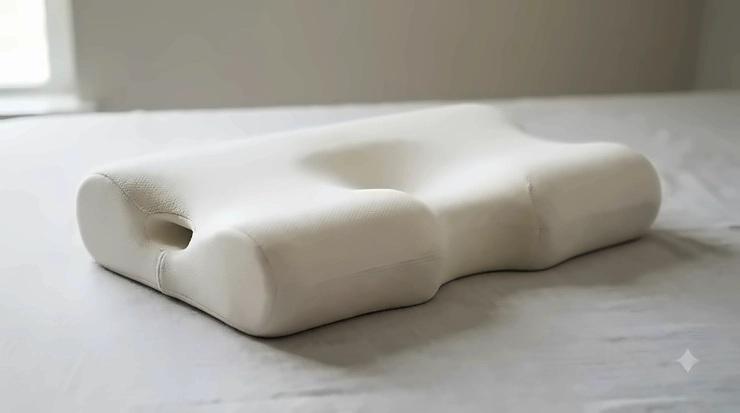
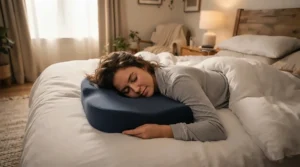
Here’s a confession nobody puts on a mattress commercial: stomach sleeping and CPAP therapy were never designed to get along. A CPAP pillow for stomach sleepers is a specialty pillow with a lower loft and mask-friendly cutouts or a recessed center, built to keep a mask seal intact while you sleep face-down instead of forcing your neck into an unnatural twist. If you’ve ever woken up at 3 a.m. tangled in tubing with air hissing out the side of your mask, you already know why this niche category exists. Stomach sleeping presses your mask flat against whatever is underneath your face, and a standard bed pillow — thick, springy, unforgiving — is basically designed to fight that seal all night long.

According to sleep-health researchers who review CPAP pillow designs each year, stomach sleepers are consistently the hardest sleep-position group to fit, since most cutout designs are built with side sleepers in mind first. The frustrating part is that most “CPAP pillow” marketing is written for side sleepers, with big dramatic cutouts that do nothing for you if you’re lying flat on your stomach. What actually helps is loft you can strip down to almost nothing, foam or fill that compresses instead of pushing back, and a shape that doesn’t trap your mask’s exhaust vents against the fabric. We dug through real product listings, verified specs, and aggregated customer sentiment across seven genuinely different pillows — budget, mid-range, and premium — so you’re not guessing which one will actually let you breathe (and sleep) easier tonight.
Quick Comparison Table
Before the deep dive, here’s the fast version for anyone skimming on a phone at 11 p.m., mask already half-strapped on.
| Pillow | Profile Style | Mask Compatibility | Best For |
|---|---|---|---|
| Contour CPAPMax Pillow 2.0 | Adjustable, 2.25″-5.25″ | All mask types | Combo sleepers who want precise loft control |
| Lunderg Parkin CPAP Pillow | Shredded down-alternative, moldable | All mask types | True stomach sleepers who want near-zero loft |
| Elviros CPAP Pillow | 4 height options | All mask types | Budget shoppers, HSA/FSA spenders |
| EnduriMed CPAP Pillow | Medium, fixed | Full-face optimized | Full-face mask users leaning back-sleep |
| DMI CPAP Fiber Filled Pillow | Ultra low, fiber-filled | All mask types | Tightest budget, minimal loft |
Looking at this lineup, the pattern is pretty clear: the pillows that actually serve stomach sleepers well are the ones you can flatten or reshape, not the ones with the deepest side cutouts. Lunderg Parkin CPAP Pillow and DMI CPAP Fiber Filled Pillow both lean into moldable, low-profile fill rather than a fixed foam block, which matters enormously once your face is pointed straight down into the pillow. Meanwhile, Contour CPAPMax Pillow 2.0 and Elviros CPAP Pillow hedge their bets with removable layers, so the same pillow can flex between stomach, back, and combination sleeping as your night goes on.
💬 Already have a favorite forming? Bookmark this page so you don’t lose your spot while you compare specs below.😊
Top 7 CPAP Pillows for Stomach Sleepers: Expert Analysis
We picked these seven with one rule in mind: every single one had to have a real, verifiable presence in the market, not a rebranded knockoff with a suspiciously perfect five-star average. Here’s the honest breakdown, standout feature first.
1. Contour CPAPMax Pillow 2.0 — most adjustable orthopedic loft control
The standout here is genuinely useful: you can remove or add foam, support, and charcoal-infused layers to dial the height anywhere from 2.25 to 5.25 inches, which is a wider range than almost anything else on this list. That matters for stomach sleepers because the “right” loft for face-down sleeping is often closer to zero than you’d think, and this is one of the few pillows built to actually get there instead of bottoming out at “still kind of thick.”
Additionally, the precision-molded core holds its shape instead of collapsing unevenly the way looser foam blends can, and the dual cutout design is engineered to work with nasal, full-face, and nasal-pillow masks alike, so switching mask styles later doesn’t mean buying a new pillow. Based on the spec comparison with softer alternatives, this is the pick for people who want to fine-tune rather than accept a fixed shape.
Reviewers commonly cite the built-in hose tether — a small clip that keeps the tubing from tugging the mask loose if you roll over — as an underrated feature that full-face mask wearers in particular appreciate, since a dislodged tether often means a 3 a.m. leak alarm. Real buyer feedback flags a learning curve of a few nights before the firmer molded foam feels natural, and a handful of buyers wished the plush cover shed heat a little faster.
Pros:
- ✅ Widest adjustable height range in this lineup
- ✅ Works with nasal, full-face, and pillow-style masks
- ✅ Hose tether reduces mid-night mask tugging
Cons:
- ❌ Firmer molded foam needs a short break-in period
- ❌ Plush cover retains some heat versus mesh designs
At around $55-$65 depending on the retailer, this sits mid-pack in price but earns it back in flexibility — if you’re not sure whether you’re a true stomach sleeper or a combo sleeper, this is the safer bet of the seven.

2. Lunderg CPAP Pillow — best-selling firm memory foam pick
The standout is popularity backed by numbers: this is one of the more widely reviewed CPAP pillows on the market, and it earns that volume with a firm memory foam core and two sizes of shoulder cutouts you can size down for a flatter profile. The firm feel is the headline spec, and here’s what it means in practice — firmer foam resists the sinking that pushes a mask sideways, which is exactly the failure mode that wakes stomach sleepers up with a leaking seal.
What most buyers overlook about this model is that the removable layer isn’t just a comfort perk; it’s the actual mechanism that makes it usable face-down, since pulling it out drops the loft closer to what stomach sleeping needs. Aggregated shopper ratings across major retailers cluster in the low-to-mid 4-star range from dozens of reviews, with recurring praise for the two included pillowcases (handy since CPAP pillows get more face-oil contact than average) and recurring criticism that the firmness feels too dense for people who prefer a plush, sink-in pillow. It’s a pillow built for people who already know they like firmer support, not a universal crowd-pleaser.
Pros:
- ✅ Removable layer lowers loft for face-down sleeping
- ✅ Two pillowcases included, useful for frequent washing
- ✅ Firm foam resists mask-shifting sink
Cons:
- ❌ Too firm for sleepers who prefer plush pillows
- ❌ Shoulder cutouts add little value once flattened
Priced in the $75-$85 range, it’s on the higher end for what’s still fundamentally a foam block, but the review volume behind it gives buyers unusually good confidence in what they’re getting.
3. Lunderg Parkin CPAP Pillow — softest down-alternative for stomach sleeping
The standout feature is the fill itself: this is a down-alternative, shredded-style pillow rather than a solid foam block, and that distinction matters more for stomach sleepers than almost any spec on this list. Solid foam resists your face; shredded fill redistributes around it, which is precisely the give-and-take stomach sleepers need to keep a mask seal from getting pried loose by pillow pressure. The adjustable filling means you can literally pull fill out through a zipper to flatten the loft further, something a molded foam pillow physically cannot do.
On paper this means a pillow that behaves less like “a CPAP pillow” and more like a favorite old pillow that happens to be CPAP-friendly, which is exactly the compliment aggregated reviews keep circling back to — buyers consistently describe it as noticeably softer and more “normal-feeling” than foam-cutout designs, with a 100% cotton case that several reviewers note breathes cooler than synthetic covers. The tradeoff worth flagging honestly: shredded fill needs occasional fluffing and redistribution, and it won’t hold a sculpted shape the way molded foam does if that’s what you’re used to.
Pros:
- ✅ Adjustable shredded fill flattens further than foam
- ✅ Softer, more traditional pillow feel reported by buyers
- ✅ Breathable 100% cotton cover runs cooler
Cons:
- ❌ Needs periodic fluffing to redistribute fill evenly
- ❌ Won’t hold a sculpted shape like molded foam
Typically priced in the $65-$75 range, this is arguably the most purpose-built option here for genuine, committed stomach sleepers rather than combo sleepers who occasionally roll over.
4. Elviros CPAP Pillow for Side, Back & Stomach Sleepers — best budget pick with 4 height options
The standout is versatility at a lower price point: four height options and adjustable firmness mean this pillow tries to do what the pricier Contour and Lunderg models do, at a noticeably gentler cost. The ergonomic memory foam core is contoured for cervical support, and here’s the real-world payoff — a properly supported neck matters even face-down, because a hyperextended or overly compressed neck at 2 a.m. is how people wake up with a stiff shoulder and blame the mattress instead of the pillow.
Furthermore, it’s HSA/FSA eligible, which quietly saves buyers real money if their plan covers sleep-apnea accessories, something shoppers often forget to check before paying out of pocket. Aggregated customer sentiment (including detailed buyer feedback shared through Elviros’s own verified review channels) consistently mentions reduced neck pain after switching from a bulkier shredded-foam pillow, alongside relief that the redesigned cover sleeps cooler than expected for a memory foam product — a common worry with foam pillows.
On the honest downside, buyers report it runs firmer than a traditional bed pillow even at its lowest height setting, and the cutout shaping is still visibly side-sleeper-first even though the brand markets it for all positions.
Pros:
- ✅ Four height settings for meaningful loft control
- ✅ HSA/FSA eligible, lowering effective cost
- ✅ Reviewers report noticeable neck-pain relief
Cons:
- ❌ Firmer feel even at lowest adjustable setting
- ❌ Cutout shaping still favors side sleepers visually
At around $35-$45, this is the value leader of the group — not the softest or most stomach-optimized, but hard to beat if budget is the deciding factor.
5. EnduriMed CPAP Pillow — top choice for full-face mask users
The standout feature is fit with full-face masks specifically: the pillowcase design uses a plush sleep surface paired with breathable, quilted fabric right at the mask cutouts, a detail aimed squarely at the bulkier profile of full-face hardware. Here’s the honest analytical take, because this one needs a caveat most affiliate posts skip: independent sleep-product reviewers note the shape isn’t the strongest match for people who sleep purely on their back or stomach with broader shoulders, since the medium-firm memory foam core is tuned more toward general comfort than aggressive loft reduction.
What that means in practice is that EnduriMed earns its spot here for a specific buyer — someone who’s mostly a back sleeper who drifts onto their stomach, using a full-face mask, rather than someone who sleeps face-down all night long. Reviewers consistently describe the medium feel as approachable for people who find pure memory foam too dense, and the quilted mask-cutout fabric gets specific praise for reducing the squeaky, sweaty friction some full-face users get against firmer foam edges.
If you’re searching for a CPAP pillow for full face mask compatibility above all else, this is one of the two or three genuinely purpose-built options worth shortlisting. But if you’re a dedicated stomach sleeper first and full-face mask wearer second, weigh this against the Lunderg Parkin instead.
Pros:
- ✅ Quilted cutout fabric designed for full-face masks
- ✅ Medium feel suits buyers who dislike dense foam
- ✅ Plush surface reduces friction against mask edges
Cons:
- ❌ Less effective for broad-shouldered back/stomach sleepers
- ❌ Fixed loft with no removable layers
Generally priced in the $40-$50 range, it’s a smart pick specifically for the full-face-mask-plus-occasional-stomach-sleeper crowd rather than a universal recommendation.
6. IKSTAR 3.0 Memory Foam Pillow — best butterfly contour for combo sleepers
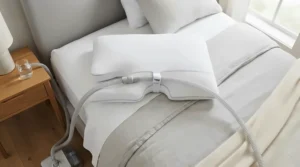
The standout is the butterfly-shaped central contour, a design meant to keep the neck and spine aligned no matter which of the three major sleep positions you land in overnight. Adaptive memory foam responds to input pressure rather than resisting it outright, and the practical upshot is a pillow that self-adjusts a little as you shift positions instead of demanding you remove layers by hand every time you roll over. That’s a real advantage for combination sleepers who start the night on their stomach and finish it on their side.
Based on the spec sheet, the central contour also carves out passive space for mask and hose routing without needing an aggressive cutout carved into the foam itself, which keeps more of the surface intact and supportive. Aggregated reviews highlight this pillow as a strong entry point for CPAP users who haven’t committed to one sleep position yet and don’t want to buy three different specialty pillows to find out. The honest tradeoff: the central contour is a fixed shape, so unlike the Contour or Elviros models, there’s no way to physically lower the loft further if you decide you need an even flatter profile.
Pros:
- ✅ Butterfly contour adapts across multiple sleep positions
- ✅ Adaptive foam self-adjusts without manual layer swaps
- ✅ Central design routes mask and hose passively
Cons:
- ❌ Fixed shape offers no manual loft adjustment
- ❌ Less specialized than dedicated stomach-sleeper designs
Priced around $30-$40, it’s a smart middle-ground purchase for anyone still figuring out their preferred CPAP sleep position.
7. DMI CPAP Fiber Filled Sleep Apnea Pillow — lowest price, lowest profile
The standout is straightforward: this is a fiber-filled pillow rather than foam, and fiber fill compresses more readily under sustained face-down pressure than any memory foam on this list, which naturally produces one of the lowest working profiles here without you needing to remove a single layer. What that means practically is less resistance pushing back against your mask seal through the night — the exact mechanical problem stomach sleepers are usually fighting. It’s marketed as suitable for all CPAP mask types, and the polyester fiber fill with a cotton cover keeps the price genuinely low compared to memory foam competitors.
Here’s where honesty matters most: aggregated review data for this model runs more mixed than the others on this list, with a meaningfully lower average rating and a smaller review pool, so treat it as an accessible entry point rather than a guaranteed upgrade. Buyers who like it tend to already prefer traditional fiber-fill pillows over memory foam generally; buyers who dislike it tend to report the fill shifting unevenly over time, which fiber pillows are prone to compared with molded foam.
Pros:
- ✅ Naturally low profile without removing layers
- ✅ Lowest price point in this comparison
- ✅ Familiar fiber-fill feel for foam skeptics
Cons:
- ❌ Mixed aggregated review ratings versus foam competitors
- ❌ Fill can shift unevenly with extended use
At roughly $25-$35, it’s the entry-level option — reasonable for testing whether a low-profile approach solves your leak problem before spending more on a premium pick.
Top 7 Products: Full Spec & Value Comparison
| Pillow | Fill Type | Adjustability | Price Range | Best For |
|---|---|---|---|---|
| Contour CPAPMax Pillow 2.0 | Molded memory foam | High (removable layers) | $55-$65 | Combo sleepers wanting precise loft |
| Lunderg CPAP Pillow | Firm memory foam | Medium (one removable layer) | $75-$85 | Buyers who like firmer support |
| Lunderg Parkin CPAP Pillow | Shredded down-alternative | High (adjustable fill) | $65-$75 | Dedicated stomach sleepers |
| Elviros CPAP Pillow | Memory foam | High (4 heights) | $35-$45 | Budget/HSA-FSA shoppers |
| EnduriMed CPAP Pillow | Medium memory foam | Low (fixed) | $40-$50 | Full-face mask, back-leaning sleepers |
| IKSTAR 3.0 Memory Foam Pillow | Adaptive memory foam | Low (fixed contour) | $30-$40 | Combo/undecided sleepers |
| DMI CPAP Fiber Filled Pillow | Polyester fiber | Medium (compresses naturally) | $25-$35 | Tightest budgets, lowest profile |
Reading across this table, the split is really between “fixed-shape” pillows (EnduriMed, IKSTAR) that trade adjustability for simplicity, and “adjustable” pillows (Contour, Lunderg Parkin, Elviros) that ask a little more setup effort in exchange for a loft you can actually dial in over time. If you’re only going to buy one pillow and don’t want to guess wrong, the adjustable category is the safer investment even at a higher price range, since it can follow you if your sleep position changes next year.
Benefits vs Traditional Bed Pillows
| Factor | Traditional Bed Pillow | CPAP Pillow for Stomach Sleepers |
|---|---|---|
| Mask seal stability | Frequently disrupted by bulk | Designed to minimize pillow-mask contact |
| Loft control | Fixed, non-adjustable | Often removable/adjustable layers |
| Hose management | No accommodation | Cutouts, tethers, or routing channels |
| Face-down pressure | Pushes mask off-angle | Compresses or contours around mask |
| Cost | Lower upfront | Moderate premium for CPAP-specific design |
The upfront cost difference is real, but it’s worth weighing against what a leaking mask actually costs you — restarted sleep cycles, dry-eye irritation from stray airflow, and lower overall CPAP adherence, which is the outcome every sleep clinician actually cares about. A traditional pillow isn’t “wrong,” it’s just not engineered for the one job that matters most here: staying out of the way of your seal.
Practical Usage Guide: Setting Up Your CPAP Pillow the Right Way
Getting a new CPAP pillow for stomach sleepers is only half the job — how you set it up in the first week determines whether it actually solves your leak problem or just becomes an expensive paperweight on your nightstand. Start by removing more layers than you think you need on night one; most people overestimate how much loft they want and end up fighting the same pressure problem they were trying to escape. Route your hose over the pillow, not under it, so the weight of the tubing doesn’t tug your mask sideways mid-turn — this single adjustment fixes a surprising number of “my pillow doesn’t work” complaints that are actually hose-management problems. Give any new foam or fill pillow three to five nights before judging it; memory foam in particular needs to “break in” as the cells compress under repeated use, and shredded-fill pillows need a night or two of fluffing to settle into their natural shape. A common first-30-days mistake is washing a foam-core pillow’s inner layer directly instead of just the removable cover, which can damage the foam’s structure — always check whether the core itself is washable before it goes anywhere near water. Finally, keep your CPAP mask’s cushion clean; a grimy cushion seal will leak regardless of pillow quality, so pillow and mask maintenance work as a pair, not separately.
Real-World Scenarios: Which CPAP Pillow Fits Your Life
Picture three different people reaching for a pillow tonight. First, there’s a 34-year-old graphic designer who was just diagnosed and sleeps almost exclusively on her stomach with a nasal mask — for her, the Lunderg Parkin CPAP Pillow‘s adjustable shredded fill is the natural fit, since it flattens further than any foam option here and won’t fight her established sleep habit. Second, a 58-year-old man managing moderate sleep apnea with a full-face mask, who mostly sleeps on his back but drifts face-down for an hour or two before waking — the EnduriMed CPAP Pillow‘s quilted, full-face-optimized cutouts solve his specific problem without overcorrecting for a stomach-sleeping habit he doesn’t fully have. Third, a college student on a tight budget who just started therapy and genuinely doesn’t know yet which position she’ll settle into — the IKSTAR 3.0 Memory Foam Pillow‘s adaptive butterfly contour lets her test multiple positions on one pillow before investing in something more specialized. None of these people are wrong to want different things; the mistake would be all three buying the same generic “best-seller” pillow without matching it to how they actually sleep.
How to Choose a CPAP Pillow for Stomach Sleepers
Cutting through the marketing, here’s the actual decision process worth following, in order of importance.
- Confirm your real sleep position first. Most people are combo sleepers, not purists — if you spend meaningful time on your back too, prioritize adjustability over a pillow built exclusively for one position.
- Prioritize loft reduction over cutout depth. Stomach sleepers need thinness more than side-sleeper-style carved-out pockets, so check the minimum achievable height, not just the maximum.
- Match the pillow to your mask style. A bulky full-face mask needs more clearance around the cheeks than a slim nasal-pillow mask, so re-check compatibility even if a listing says “works with all masks.”
- Check the fill type against your temperature preference. Memory foam traps more heat than shredded fill or fiber fill, which matters if you already sleep hot.
- Factor in HSA/FSA eligibility. Several CPAP pillows qualify as reimbursable medical expenses, effectively lowering the real price if your plan covers sleep-apnea accessories.
- Read aggregated review themes, not star averages alone. A 4.2-star pillow with consistent praise for a specific feature you need beats a 4.6-star pillow with vague, generic praise. Patient-advocacy groups like the American Sleep Apnea Association publish independent buying criteria worth cross-checking against any single retailer’s star rating.
- Give it a real trial window before judging. Most sleep-product return policies allow 30 to 100 nights specifically because foam and fill need a genuine break-in period.
CPAP Pillow for Stomach Sleepers vs CPAP Pillow for Back Sleepers
These two categories get lumped together constantly, but the underlying engineering problem is actually different. A CPAP pillow for back sleepers is mostly solving for cervical alignment — keeping the chin from tucking too far toward the chest, which can itself narrow the airway and work against the whole point of CPAP therapy. That’s why back-sleeper-oriented pillows, including a properly sized Contour CPAPMax Pillow 2.0 with more layers left in, tend to favor a contoured center over deep side cutouts. A CPAP pillow for stomach sleepers, by contrast, is mostly solving for pressure distribution and loft reduction, since there’s no neck-alignment benefit to chase and every bit of extra height just shoves the mask further off-angle. The practical overlap is real, though: several pillows on this list, notably the Elviros CPAP Pillow and Contour CPAPMax Pillow 2.0, are adjustable enough to serve as both a CPAP pillow for back sleepers and a stomach-sleeping option on the same night, depending on how many layers are in or out. If you’re a strict combo sleeper who alternates between the two positions, that dual-purpose adjustability should outweigh a pillow that’s purpose-built for only one position.
Low-Profile Foam vs Shredded Fill: What Actually Matters
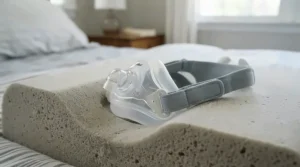
This is the comparison most buying guides skip entirely, and it’s arguably the single most important spec decision on this whole list. Low-profile foam — the approach used by Contour CPAPMax Pillow 2.0, Elviros CPAP Pillow, and IKSTAR 3.0 Memory Foam Pillow — holds a consistent, predictable shape night after night, which means the loft you measure on day one is roughly the loft you’ll still have on night ninety. The tradeoff is that foam resists your face rather than yielding to it, so if you sleep with real weight pressed face-down, even “low-profile” foam can push back more than shredded fill under the same pressure. Shredded fill, used in the Lunderg Parkin CPAP Pillow, redistributes around pressure points instead of resisting them, which is why dedicated stomach sleepers often prefer it once they’ve tried both — it simply gets out of the way more effectively. What the spec sheet won’t tell you, but aggregated reviewer experience suggests, is that shredded fill needs more manual maintenance (occasional fluffing, redistribution) to keep performing consistently, while foam needs none of that but can’t be reshaped once you’ve settled on a layer count. Neither approach is objectively better; foam suits people who want consistency and don’t mind occasional maintenance-free firmness, while shredded fill suits people who want maximum give and don’t mind fluffing a pillow now and then.
Mask Compatibility Guide: Nasal, Full Face & Nasal Pillow Masks
Mask compatibility is where a lot of otherwise-great CPAP pillows quietly fail stomach sleepers, because a cutout designed around a slim nasal-pillow mask can be almost useless for someone wearing a bulkier full-face mask, and vice versa. If you’re shopping specifically for a CPAP pillow for full face mask use, prioritize models with wider, quilted, or fabric-lined cutout zones — the EnduriMed CPAP Pillow‘s quilted mask-cutout fabric and the Contour CPAPMax Pillow 2.0‘s dual cutout design both explicitly account for the larger surface area a full-face cushion needs to seal properly without pillow interference. Nasal and nasal-pillow mask wearers generally have more flexibility, since the smaller mask footprint fits comfortably into almost any of the seven pillows here, including the fixed-contour IKSTAR 3.0 Memory Foam Pillow. The practical rule worth remembering: mask compatibility isn’t just about whether a cutout exists, it’s about whether the cutout’s fabric and depth match your specific mask’s bulk and vent placement, since a mask’s exhaust vents pointed straight into unventilated foam can trap warm, humid air against your face overnight. When in doubt, measure your mask’s widest point at the cheek and compare it against a pillow’s stated cutout dimensions before buying, rather than trusting a generic “works with all masks” claim at face value. Health publishers who cover pillow ergonomics for stomach sleepers in depth note the same principle applies to standard pillows too — shape has to match how you actually sleep, not just a marketing label.
Common Mistakes When Buying a CPAP Pillow for Stomach Sleepers
The single most common mistake is buying a pillow marketed primarily for side sleepers and expecting it to work equally well face-down — those deep, dramatic cutouts that look so impressive in product photos are frequently irrelevant, or even counterproductive, once you’re lying flat on your stomach. A close second is ignoring loft entirely and shopping on brand name or star rating alone; a beautifully reviewed pillow that can’t get thin enough for your body type will disappoint you regardless of its overall reputation. Buyers also frequently skip checking mask compatibility against their specific mask model, assuming “universal fit” claims apply evenly to a slim nasal-pillow mask and a bulky full-face mask, when in practice they rarely do. Another overlooked pitfall: washing instructions. Several buyers report accidentally damaging memory foam cores by machine-washing the entire pillow instead of just the removable cover, effectively voiding both the pillow’s structure and, often, its warranty. Finally, many shoppers underestimate the adjustment period — judging a pillow after one uncomfortable night, when foam and fill genuinely need several nights to settle and for your body to adapt to a new sleep surface.
Long-Term Cost & Maintenance
Thinking beyond the sticker price changes the math on several of these picks. A $75 firm memory foam pillow like the Lunderg CPAP Pillow that lasts three-plus years without losing shape works out to roughly $25 a year, while a $30 fiber-filled pillow like the DMI CPAP Fiber Filled Sleep Apnea Pillow that needs replacing after twelve to eighteen months due to fill compression can end up costing more over the same stretch. Memory foam pillows generally need less active maintenance — mostly just washing a removable cover every few weeks — while shredded-fill and fiber-fill pillows require periodic manual fluffing to maintain even loft distribution, a small recurring time cost that’s easy to forget about when comparing sticker prices alone. HSA/FSA eligibility, offered on models like the Elviros CPAP Pillow, effectively discounts the real out-of-pocket cost for anyone with an eligible plan, which is worth confirming before assuming the cheapest listed price is actually the cheapest real cost. The honest total-cost-of-ownership takeaway: a slightly pricier, more durable, adjustable pillow frequently beats a cheaper fixed pillow over a two-to-three-year window, especially once you factor in the hidden cost of disrupted sleep from a pillow that stops performing halfway through its expected lifespan.
Safety Considerations for Stomach Sleeping With CPAP
It’s worth saying plainly: stomach sleeping isn’t automatically the ideal position for everyone with obstructive sleep apnea, and pillow choice doesn’t override that conversation with your sleep provider. Positional therapy research has found that keeping patients off their backs can meaningfully reduce apnea events for people whose sleep apnea is worse in the supine position, though a Cochrane systematic review on positional therapy for sleep apnea found that CPAP still produced a greater reduction in apnea-hypopnea index scores than positional therapy alone across the studies analyzed. That doesn’t mean stomach sleeping is unsafe for most CPAP users — it generally isn’t — but it does mean pillow selection should support, not replace, whatever position your clinician has actually recommended for your specific diagnosis. If you have neck, back, or shoulder conditions, a lower-loft stomach-sleeping setup can sometimes aggravate cervical strain over a full night, so it’s worth mentioning any new stomach-sleeping CPAP comfort setup to your care team, especially in the first few weeks. The practical safety takeaway for pillow shopping specifically: prioritize a pillow that keeps your mask’s exhaust vents unobstructed, since blocked vents can affect both comfort and the therapy’s intended pressure delivery.

Frequently Asked Questions
❓ What is the best CPAP pillow for stomach sleepers?
❓ Can you sleep on your stomach with a CPAP mask?
❓ Do CPAP pillows really work for stomach sleepers?
❓ What is the best pillow height for stomach sleeping with CPAP?
❓ Are CPAP pillows worth the money?
Conclusion
If there’s one theme running through every pillow on this list, it’s that adjustability beats novelty every time for stomach sleepers. The dramatic side-cutout designs that dominate CPAP pillow marketing are solving a different problem than the one you actually have face-down at 2 a.m. What matters is loft you can genuinely reduce, fill that either compresses or resists predictably depending on your preference, and cutout shaping that actually matches your specific mask’s bulk. The Lunderg Parkin CPAP Pillow earns its spot as the most purpose-built pick for committed stomach sleepers, while the Contour CPAPMax Pillow 2.0 and Elviros CPAP Pillow give combo sleepers the flexibility to adjust as their habits shift. Budget-conscious shoppers aren’t left out either — the DMI CPAP Fiber Filled Sleep Apnea Pillow and IKSTAR 3.0 Memory Foam Pillow both offer legitimate entry points without demanding premium pricing. Whichever you choose, give it a genuine week-long trial, adjust the loft aggressively on night one, and pair it with proper hose management before deciding whether it’s the pillow, the mask, or something else entirely that’s been disrupting your sleep.
Recommended for You
- Pillow For CPAP Mask Side Sleepers: 7 Comfortable Picks (2026)
- Cooling Pillowcase And Insert Combo: 7 Best Picks For 2026
- 7 Best Cooling Pillow Under $50 Picks For Hot Sleepers (2026)
Disclaimer: This article contains affiliate links. As an Amazon Associate, I earn from qualifying purchases. If you purchase products through these links, we may earn a small commission at no additional cost to you.
✨ Found this helpful? Share it with your friends! 💬🤗
