
In This Article
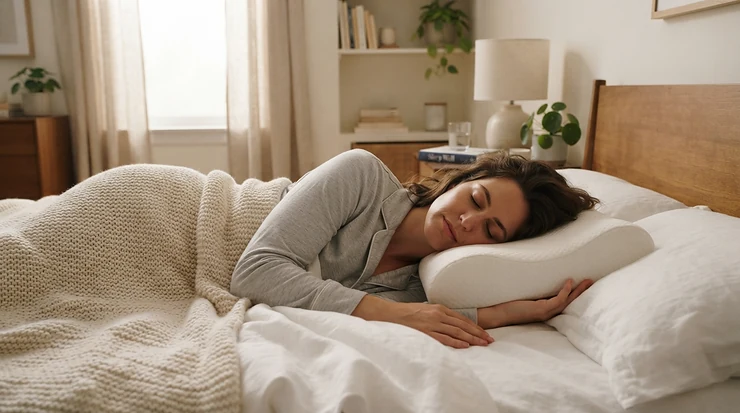
If you’ve ever rolled onto your side at 2 a.m. and felt your mask hiss like a punctured tire, you already know the problem isn’t your CPAP machine. It’s what’s underneath your head. A regular bed pillow was built for regular sleepers — nobody at the pillow factory was thinking about a hose, a hard plastic frame, or a cushion that needs to keep its seal all night long. The right pillow for CPAP mask side sleepers changes that equation by carving out literal breathing room for your mask, so the foam supports your neck instead of shoving your mask into your cheek.
This guide walks through seven real, currently available options — from $40 budget foam to a $150 fully-customizable build — with honest analysis of what each one actually solves and where it falls short. According to the research on sleep positions and mask leaks, sleeping on your side or stomach is associated with more frequent mask leaks, likely because pressure on the side of the mask affects how well it seals, which is exactly why this category of pillow exists in the first place. We’ll also cover cutout foam design, contour shapes, mask seal mechanics, and the buying mistakes that waste people’s money every year. For background on the condition these pillows support, the NHLBI’s overview of sleep apnea treatment is a solid, plain-language starting point.
Every price below is listed as a range because Amazon pricing shifts constantly — always check the current price before buying.
What Is a Pillow for CPAP Mask Side Sleepers?
A pillow for CPAP mask side sleepers is a specialty pillow with cutouts, carved contours, or sloped edges that create open space for a CPAP mask and hose. Instead of pressing the mask flat against a solid pillow surface, the design lets the mask sit in open air, which reduces shifting, facial pressure, and the air leaks that come from a disrupted seal.
Most of these pillows fall into two design families: cutout foam pillows (solid blocks with carved-out sections) and adjustable layered pillows (stackable foam that you customize for height and firmness). Neither is objectively “better” — the right pick depends on your mask style, your body size, and how much you move at night.
Quick Comparison Table
| Pillow | Category | Height Range | Best For |
|---|---|---|---|
| Lunderg CPAP Pillow | Budget | 4.4″–5.5″ | Best overall value |
| IKSTAR 3.0 Memory Foam Pillow | Budget | 3.74″–3.93″ | Lowest price point |
| Contour CPAPmax Pillow 2.0 | Mid-range | 2.25″–5.25″ | Most adjustable |
| EnduriMed CPAP Pillow | Mid-range | 3.9″–6″ | Full-face mask users |
| Luxome LAYR Customizable Pillow | Premium | Fully custom | Pickiest sleepers |
Looking at this lineup, the spread in height range tells you most of what you need to know before you even read a full review. The Lunderg CPAP Pillow and Contour CPAPmax Pillow 2.0 win on flexibility because they let you physically remove foam layers rather than locking you into one loft. Meanwhile, the Luxome LAYR Customizable Pillow sits in its own category — it isn’t a cutout pillow at all, so it earns its spot through sheer adjustability rather than mask-specific engineering.
Top 7 Pillows for CPAP Mask Side Sleepers: Expert Analysis
1. Lunderg CPAP Pillow — best all-around value for side sleepers
The Lunderg CPAP Pillow built its reputation on doing the basics extremely well, and it shows the moment you unbox it. Its memory foam core includes a removable bottom layer, giving you 5.5 inches of height with the layer in place or 4.4 inches without it — practical for side sleepers who need more loft under the ear than back sleepers do. The patented two-neck-size design places cutouts at slightly different depths on each side, which matters in practice: a shallow cutout works for nasal pillow masks, while the deeper one accommodates bulkier full-face frames without direct contact.
Based on the spec comparison, what stands out about the Lunderg CPAP Pillow is the inclusion of two pillowcases (a standard comfort case and a cooling case) rather than the single case most competitors ship with — a small detail that solves the “one pillow, one dirty cover” laundry problem. Reviewers consistently report that the foam feels firmer than a typical bed pillow and takes roughly a week to adjust to, but that side-sleeping leak complaints largely disappear once broken in.
Pros:
- ✅ Adjustable height with a simple removable foam layer
- ✅ Two pillowcases included, unlike most competitors
- ✅ Compatible with nasal, full-face, hybrid, and pillow masks
Cons:
- ❌ Firm memory foam needs about a week to break in
- ❌ Only two height configurations versus four on pricier models
At around $65-$80, the Lunderg CPAP Pillow delivers the strongest dollar-for-dollar case in this roundup — it’s the pillow most people should try first.
2. IKSTAR 3.0 Memory Foam Pillow — most affordable true cutout design
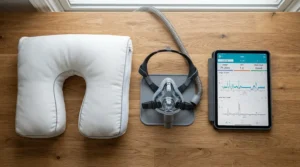
The IKSTAR 3.0 Memory Foam Pillow takes a butterfly-shaped approach: a central contour cradles your head while both wings taper outward into open cutout zones. Dimensions run roughly 22.83″ x 14.96″ x 3.93″/3.74″, giving it two subtly different loft options depending on which side faces up. What most buyers overlook about this shape is that the central dip does double duty — it keeps your head from sliding toward the mask side when you roll over, which is a smaller but real contributor to overnight mask drift.
Here’s what to weigh: this is a budget entry, and it reads like one in a good way — it doesn’t oversell itself with cooling gel or patented anything. It’s a straightforward foam block with sensible cutouts, and that simplicity is honestly the appeal for a first-time buyer who isn’t sure whether a CPAP pillow will even help them. Aggregated marketplace listings show generally positive sentiment around comfort and fit, though the review pool on this specific model is smaller than better-known brands, so treat early impressions as a reasonable but not exhaustive signal.
Pros:
- ✅ One of the lowest entry prices in the CPAP pillow category
- ✅ Dual-height sides for side, back, or stomach positions
- ✅ Universal compatibility with major mask types
Cons:
- ❌ Smaller, less established review base than major brands
- ❌ Lower maximum loft may feel thin for larger-framed sleepers
In the $35-$50 range, the IKSTAR 3.0 Memory Foam Pillow is the lowest-risk way to test whether a cutout design solves your leak problem before spending more.
3. Elviros CPAP Pillow — best for side sleepers managing neck pain
The Elviros CPAP Pillow approaches the category from a cervical-support angle first and a CPAP angle second, and that ordering actually works in its favor for many side sleepers. The pillow ships with a flip-to-switch design offering two firm height levels (commonly 3.54″ and 4.33″), plus a removable insert that unlocks two more configurations — four total heights from one pillow. The foam itself is CertiPUR-US certified and Oeko-Tex approved, meaning it’s been tested for low volatile organic compound emissions, a detail that matters if you’re sensitive to the “new foam smell” that off-brand pillows sometimes carry.
What the spec sheet won’t tell you, but user reports suggest, is that the ergonomic curve takes real adjustment time — Elviros itself notes it can take two to four weeks for your neck to settle into the shape. That’s a longer runway than most competitors admit to, and it’s honest information buyers deserve before purchase. Once broken in, aggregated reviews lean positive specifically on neck and shoulder pain relief, which is a narrower but valuable use case than pure mask-leak prevention.
Pros:
- ✅ CertiPUR-US certified, low-VOC memory foam
- ✅ Four height configurations from one pillow
- ✅ Cooling 3D mesh cover is fully machine washable
Cons:
- ❌ Two-to-four week adjustment period, longer than most rivals
- ❌ Narrower profile may feel tight for broader-shouldered sleepers
Priced around $45-$60, the Elviros CPAP Pillow is the pick for side sleepers whose real complaint is neck stiffness as much as mask leaks.
4. EnduriMed CPAP Pillow — best for full-face mask users
The EnduriMed CPAP Pillow takes a dual-loft approach: one long edge sits around 6 inches for side sleeping, the opposite edge around 5 inches for back sleeping, and you can strip out an internal insert to drop those numbers further to roughly 4.9″ and 3.9″. Four diagonal cutouts — placed at an angle rather than cut straight across — are worth calling out specifically, because a diagonal cut follows the natural angle a full-face mask sits at when your head tilts to the side, reducing the edge-contact that straight cutouts sometimes still allow.
Based on the spec comparison, this diagonal-cutout detail is why the EnduriMed CPAP Pillow was recognized as Forbes’ “Best Sleep Apnea Ergonomic Pillow,” and why SleepApnea.org specifically flags it as well-suited to full-face mask users. Aggregated review data compiled by ReviewMeta across roughly 1,136 ratings puts the brand average around 4.2 out of 5, with about 16% of reviews flagged as potentially unnatural and excluded — a level of transparency worth noting rather than a red flag on its own. Common feedback themes center on strong side-sleeper comfort, with some reviewers noting it suits back and stomach sleepers less well due to its shape.
Pros:
- ✅ Patented ergonomic design (US Patent No. D856,707)
- ✅ Dual-loft edges plus a removable insert for four total heights
- ✅ Diagonal cutouts specifically tuned for full-face masks
Cons:
- ❌ Less suited to dedicated back or stomach sleepers
- ❌ May feel tight for people with very broad shoulders
Expect to pay in the $70-$90 range for the EnduriMed CPAP Pillow, a fair mid-tier ask given the diagonal-cutout engineering you’re getting.
5. Contour CPAPmax Pillow 2.0 — most adjustable mid-range pick
The Contour CPAPmax Pillow 2.0 is arguably the most mechanically clever pillow in this roundup. Color-coded foam layers let you dial in four distinct heights between 2.25″ and 5.25″, and the pillow reverses between a 3D cooling mesh surface and a plush fiber-fill surface depending on your temperature preference that night. An 18-inch hose tether attaches to the cover, physically anchoring your CPAP tubing so it can’t tug your mask sideways as you shift position — a small mechanical fix for a complaint side sleepers raise constantly.
What most buyers overlook about the Contour CPAPmax Pillow 2.0 is that the adjustability isn’t just about comfort — it’s about long-term value. As your mask changes (many CPAP users switch mask styles over the years), you can reconfigure the same pillow rather than buying a new one. On cpap.com, the pillow holds a 4.3 out of 5 rating across 69 verified reviews, with one reviewer specifically praising the hose tether for keeping the tube from “falling down the side of my bed and pulling on the mask” — exactly the failure mode this pillow was engineered to prevent.
Pros:
- ✅ Four adjustable heights via color-coded foam layers
- ✅ Reversible cooling-mesh and fiber-fill surfaces
- ✅ Built-in hose tether reduces tube-pull mask shifting
Cons:
- ❌ Bulkier and heavier at maximum height setting
- ❌ Replacement covers are sold separately
At roughly $50-$65, the Contour CPAPmax Pillow 2.0 is the smartest buy for anyone who expects their mask setup to evolve over time.

6. Borden Textile CPAP Pillow — best for side sleepers who run hot
The Borden Textile CPAP Pillow earned its top ranking from Sleep Foundation testers largely on the strength of its temperature management, which is an underrated pain point for side sleepers pressing half their face into foam all night. A charcoal-infused base layer is designed to help pull heat away from the head and neck, while mesh side panels around the cutout zones keep air moving specifically where your mask sits. You can also remove internal foam layers to lower the overall profile, adapting the pillow as your sleep position or mask changes.
Here’s what to weigh: Sleep Foundation’s own testers found it well suited to side sleepers, since the cutout shape on the bottom allows space for the shoulder while maintaining support for the neck and head, and noted that back and combination sleepers benefit from the same cutout logic. This is honest, tester-verified feedback rather than a marketing claim, which is precisely the kind of sourcing this guide aims to rely on. The tradeoff is cost and a small flat shipping fee when purchased directly through the manufacturer’s site.
Pros:
- ✅ Charcoal-infused base layer targets heat buildup
- ✅ Removable foam layers customize the profile
- ✅ Independently tested and ranked by Sleep Foundation
Cons:
- ❌ Sits at the premium end of the price range
- ❌ Small flat shipping fee applies on direct-site orders
Priced around $90-$120, the Borden Textile CPAP Pillow is worth the premium specifically if overheating — not just leaking — is your main nightly complaint.
7. Luxome LAYR Customizable Pillow — best for sleepers who haven’t found their fit yet
The Luxome LAYR Customizable Pillow is the outlier in this list: it isn’t a dedicated CPAP cutout pillow at all. Instead, it ships with three removable inserts — a soft down-alternative layer, a medium gel-infused shredded-foam layer, and a firm solid CertiPUR-US foam layer — that you mix, match, and stack to build your own firmness and loft from scratch. For side sleepers, testers at NCOA found that combinations using the firm insert under a softer top layer tend to work best, since a lower, denser profile under the mask side naturally reduces contact pressure even without a carved-out cutout.
On paper this means the Luxome LAYR Customizable Pillow trades mask-specific engineering for total user control, and that’s an honest tradeoff worth stating plainly: if you use a large full-face mask, you may still feel more contact than a true cutout pillow provides. Reviewers who’ve tested it call the customization genuinely useful, though a few noted that reassembling the inserts after washing the cover is a mildly fiddly process. At $150 per pillow, it’s also the priciest single item here.
Pros:
- ✅ Fully customizable firmness and loft via three inserts
- ✅ CertiPUR-US certified, low-VOC memory foam
- ✅ Machine-washable bamboo viscose cover
Cons:
- ❌ No dedicated mask cutout, less ideal for large full-face masks
- ❌ Priciest option in this roundup at around $140-$160
If you’ve cycled through two or three cutout pillows without success, the Luxome LAYR Customizable Pillow is the logical next experiment before giving up on pillows altogether.
Practical Usage Guide: Setting Up and Breaking In Your CPAP Pillow
Getting a new pillow for CPAP mask side sleepers to actually perform takes a little more than unboxing it. First, put your mask on and lie down in your normal sleep position before running your CPAP machine — this lets you check, while the air is flowing, whether the cutout actually clears your specific mask model. Reviewers who skip this step and judge fit lying flat without a mask often end up disappointed later.
For the first week, expect an adjustment period. Memory foam is denser than a standard pillow, and reviewers across nearly every product in this guide — the Lunderg CPAP Pillow, the Elviros CPAP Pillow, and the EnduriMed CPAP Pillow alike — mention a settling-in phase before the shape feels natural. A common mistake in the first 30 days is switching back to an old pillow the moment the new one feels unfamiliar, which resets the adjustment clock entirely. Give it at least seven consecutive nights before judging.
Maintenance is simple but easy to forget. Wash the removable cover every one to two weeks, more often if you sleep hot, and check foam cutouts monthly for compression that might be narrowing your mask clearance. If you’re using a hose tether like the one on the Contour CPAPmax Pillow 2.0, re-secure it after every wash — it’s a small step people forget until the hose starts pulling again.

Real-World Scenarios: Which CPAP Pillow Fits Your Sleep Style?
Picture a college student commuting to early classes after a rough night’s sleep from a leaking mask — budget matters more than bells and whistles, and a dorm room doesn’t have space for a bulky pillow. For that profile, the IKSTAR 3.0 Memory Foam Pillow or the Lunderg CPAP Pillow make the most sense: low upfront cost, straightforward cutout design, and enough compatibility to work with whatever entry-level mask came with a first CPAP prescription.
Now picture a long-haul truck driver in his fifties, six months into CPAP therapy, dealing with chronic neck stiffness on top of mask leaks. Comfort and orthopedic support outweigh price here. The Elviros CPAP Pillow, with its cervical-specific curve and four height options, or the Contour CPAPmax Pillow 2.0, with its hose tether solving the exact mid-drive leak problem long shifts create, both fit this use case better than a bargain option would.
Finally, consider a graphic designer who runs hot at night, has tried two CPAP pillows already, and still wakes up sweaty and readjusting her mask. Temperature and total customization matter more than price at this point. The Borden Textile CPAP Pillow, with its charcoal cooling layer, or the Luxome LAYR Customizable Pillow, with its build-your-own firmness system, are worth the premium because they’re solving a problem the cheaper options already failed to fix.
CPAP Pillow With Cutouts: Common Problems Side Sleepers Face (and How to Fix Them)
A CPAP pillow with cutouts solves a lot, but it doesn’t solve everything on its own — pairing the right pillow with the right habits matters just as much.
Problem: The mask still shifts even with a cutout pillow. This often comes down to headgear tension rather than the pillow itself. Recheck your straps lying down, with the mask on and air running, and tighten the bottom straps first — that’s typically where the primary seal is set.
Problem: You wake up with the hose tangled or pulling your mask. Look for a pillow with an integrated hose tether, like the Contour CPAPmax Pillow 2.0, or route your existing hose over the top of the headboard rather than along the mattress.
Problem: The cutout doesn’t fully clear your specific mask model. Not every cutout is sized the same. Full-face masks generally need a deeper, wider cutout than nasal pillow masks — this is why the EnduriMed CPAP Pillow‘s diagonal cutouts specifically target full-face compatibility while a lower-profile design like the IKSTAR 3.0 Memory Foam Pillow may feel tighter for bulkier frames.
Problem: The pillow feels great the first night, then flattens within weeks. Cheaper foams compress faster under nightly pressure. If you notice thinning, an adjustable pillow with add-back layers, like the Lunderg CPAP Pillow or Contour CPAPmax Pillow 2.0, lets you restore loft without buying a whole new pillow.
How to Choose a Pillow for CPAP Mask Side Sleepers
- Identify your mask type first. Full-face masks need deeper, wider cutouts than nasal pillow masks — check compatibility before comparing anything else.
- Measure your current sleep loft. If your regular pillow height works for your neck, look for a CPAP pillow with a similar or adjustable range rather than guessing.
- Decide if adjustability matters to you. Pillows like the Contour CPAPmax Pillow 2.0 and Elviros CPAP Pillow let you change height later; fixed-loft designs are simpler but less forgiving if you guess wrong.
- Weigh cooling needs honestly. If you already sleep hot, prioritize mesh panels or charcoal infusion, as seen in the Borden Textile CPAP Pillow, rather than treating it as a nice-to-have.
- Set a realistic budget band. Budget options like the IKSTAR 3.0 Memory Foam Pillow solve the core cutout problem; premium options like the Luxome LAYR Customizable Pillow add customization most people don’t strictly need.
- Read the adjustment-period expectations. Some pillows, like the Elviros CPAP Pillow, openly state a multi-week break-in period — factor that into your return-window planning.
- Confirm the return policy before buying. CPAP pillows are a personal-fit product; a 30-day return window, common across most brands here, protects you if the shape doesn’t work for your face.
CPAP Contour Pillow Review: Contour Curve vs. Flat Memory Foam
A CPAP contour pillow uses a curved, often orthopedic-style shape rather than a flat rectangular surface, and the difference matters more than it might seem on a product photo. A flat memory foam pillow with side cutouts, like the IKSTAR 3.0 Memory Foam Pillow, supports the head evenly but leaves the neck to find its own alignment. A true contour design, like the Contour CPAPmax Pillow 2.0, sculpts a dip for the head and a raised ridge for the neck, actively holding cervical alignment rather than passively allowing it.
The tradeoff is adaptability versus targeted support. Flat cutout pillows tend to suit a wider range of body types and mask positions because there’s no fixed curve to fight against. Contour designs, by comparison, can feel remarkably supportive for the right neck shape and oddly restrictive for the wrong one — which is why Elviros itself warns of a multi-week adjustment period for its cervical-curved design. If you’ve never had neck pain with CPAP therapy, a flat cutout pillow is the lower-risk starting point; if neck stiffness is already part of your complaint, a contour design is worth the adjustment curve.

Cutout Foam Design: The Engineering Behind Mask-Friendly Pillows
Not all cutouts are engineered equally, and this is genuinely the detail Amazon listing photos gloss over. A straight-cut cutout — a simple rectangular notch carved into the foam — works fine when your head stays roughly centered all night. A diagonal cutout, like the one on the EnduriMed CPAP Pillow, follows the angle your mask naturally sits at when your head tilts toward the pillow, which reduces the edge-contact that straight cuts still allow once you’re fully rolled onto your side.
Depth matters just as much as shape. A cutout that’s too shallow still lets the mask cushion brush foam at full side-lying pressure, which is functionally no better than no cutout at all. This is why dual-depth designs — the Lunderg CPAP Pillow‘s “two neck sizes,” for example — exist: a nasal pillow mask needs less clearance than a bulky full-face frame, and a single fixed depth can’t serve both well. Reviewers consistently note that cutout depth, more than foam density, is the single biggest predictor of whether a CPAP pillow actually stops nighttime leaks.
Mask Seal and Side-Sleeper CPAP Comfort: What the Research Actually Shows
The mechanics behind mask seal failure during side sleeping are well documented in clinical literature, not just anecdotal complaints. A 2024 study on air leak patterns during CPAP therapy found that leaks are often attributed to improperly sealed masks, though mouth openings and jaw movement can independently trigger similar leak signatures — meaning a pillow alone won’t fix every leak, but it removes one major variable. Separately, a large real-world study of over 1,400 long-term CPAP patients found that leak-related side-effects were the most prevalent complaint reported, affecting more than 75% of respondents, underlining just how widespread this specific problem is across the CPAP-using population.
For side-sleeper CPAP comfort specifically, the fix a cutout pillow provides is mechanical, not medical: it removes the physical pressure that pushes a mask cushion out of its molded shape. According to SleepApnea.org’s breakdown of mask leak causes, sleeping position is one of the most commonly cited leak triggers precisely because side pressure on the mask distorts the seal in ways a back-sleeping position doesn’t. What most buyers overlook is that comfort and compliance are linked — the American Academy of Sleep Medicine and multiple adherence studies consistently associate reduced physical discomfort with longer nightly CPAP usage, which is the actual health outcome all of this is in service of.
Common Mistakes When Buying a CPAP Pillow for Side Sleepers
One frequent mistake is buying based on price alone without checking mask compatibility first — a $35 pillow with a shallow cutout that doesn’t clear your specific full-face mask is a worse deal than a $70 pillow that fits correctly the first night. Another common misstep is judging fit in a showroom or from a photo rather than lying down with your actual mask running before your return window closes.
People also frequently underestimate the break-in period and return a perfectly good pillow within the first few nights, before memory foam has had a chance to soften into its intended shape. On the flip side, some buyers overcorrect and choose the priciest, most customizable option — like the Luxome LAYR Customizable Pillow — when a simpler cutout pillow like the Lunderg CPAP Pillow would have solved their specific leak problem for less money. Matching the fix to the actual complaint, rather than assuming more features always means a better result, is the single biggest money-saver in this category.
Long-Term Cost & Maintenance: Is a CPAP Pillow Worth the Investment?
Run the numbers honestly and a CPAP pillow is a modest cost relative to the therapy it supports. A budget pick like the IKSTAR 3.0 Memory Foam Pillow at under $45 works out to roughly a dollar a week over a single year of nightly use, assuming average foam longevity of 12-18 months before flattening. Mid-range adjustable pillows like the Contour CPAPmax Pillow 2.0 cost more upfront but extend usable life by letting you swap foam layers rather than replace the whole unit — a real total-cost-of-ownership advantage if your mask or sleep position changes over a few years of therapy.
Maintenance costs are minor but real: replacement pillowcases run roughly $15-$25 depending on brand, and most manufacturers recommend washing covers every one to two weeks. Compared with the cost of interrupted therapy — including the healthcare costs tied to inconsistent CPAP use — a $50-$90 pillow that meaningfully reduces nightly leaks and improves compliance is a reasonable investment for most side sleepers managing sleep apnea.

Frequently Asked Questions
❓ Do CPAP pillows actually reduce mask leaks for side sleepers?
❓ How long does it take to adjust to a CPAP pillow?
❓ Can I use a regular pillow with a CPAP mask?
❓ What height CPAP pillow is best for side sleepers?
❓ Are CPAP pillows covered by FSA or HSA?
Conclusion
The right pillow for CPAP mask side sleepers won’t fix every leak or every night of poor sleep, but for most people it removes one of the biggest mechanical causes of both. Whether you land on the budget-friendly IKSTAR 3.0 Memory Foam Pillow, the balanced Lunderg CPAP Pillow, or a fully customizable build like the Luxome LAYR Customizable Pillow, the goal is the same: stop fighting your pillow for space your mask needs to work properly. For more background on why leaks happen in the first place, Sleep Foundation’s tested roundup of CPAP pillows is a useful next read.
Match the pick to your actual complaint — leaks, neck pain, heat, or all three — rather than chasing the priciest option, and give whatever you choose a full week before deciding it isn’t working.
Recommended for You
- Cooling Pillowcase And Insert Combo: 7 Best Picks For 2026
- 7 Best Cooling Pillow Under $50 Picks For Hot Sleepers (2026)
- Best Cooling Pillow For Menopause: 7 Picks For Hot Flashes (2026)
Affiliate disclosure: This article contains affiliate links. As an Amazon Associate, I earn from qualifying purchases. If you purchase products through these links, we may earn a small commission at no additional cost to you. This content is informational and not a substitute for medical advice — talk to your sleep physician before changing your CPAP therapy, mask, or pressure settings.
💬 Just one click — help others make better buying decisions too!😊
