
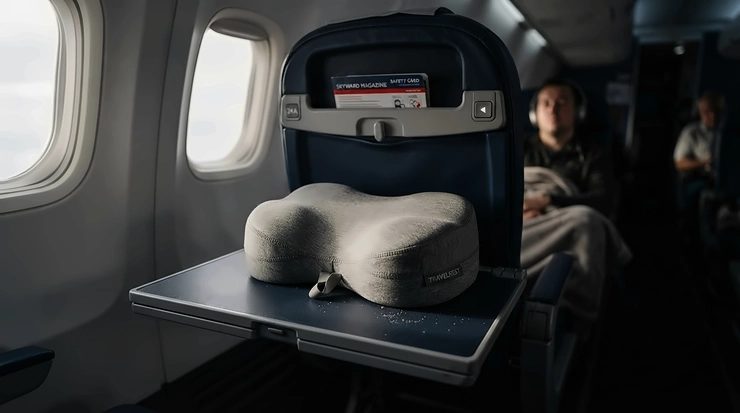
In This Article
Anyone who’s ever wedged a full-size CPAP pillow into an already-bursting suitcase knows the specific kind of dread we’re talking about. A travel CPAP pillow is a smaller, contoured sleep pillow built with cutouts or recesses so a CPAP mask and hose can sit without pressure, leaks, or that 2 a.m. shuffle to reposition everything. Unlike your bedroom pillow, it’s designed to compress down, survive a suitcase, and still keep your mask seal intact on night one of a work trip or a week at the lake.

Here’s the thing nobody tells you when you first get diagnosed: therapy compliance doesn’t take a vacation just because you do. Skip a few nights of CPAP on the road and you’re paying for it with grogginess, a foggy brain, and a partner who definitely noticed the snoring came back. According to the Sleep Apnea Association, consistent nightly use is what actually delivers the treatment benefit — and the pillow you sleep on has a lot to do with whether that’s realistic when you’re away from home.
We dug into real product listings, verified specs, and aggregated review sentiment across the current travel CPAP pillow market to put together this guide. No invented testimonials, no fluff — just honest analysis of which compact pillows are worth your suitcase space in 2026, whether you care most about a cooling CPAP pillow build, a genuinely portable CPAP setup, compact foam that won’t collapse after three flights, or general travel bedding accessories that round out the kit.
Quick Comparison Table
Short on time? Here’s the fast version before we get into the weeds.
| Pillow | Best For | Fill Type | Price Range |
|---|---|---|---|
| Lunderg CPAP Pillow | Best overall travel pick | Adjustable memory foam | $70-$110 range |
| EnduriMed CPAP Pillow | Adjustable firmness | Customizable foam/fill | $60-$90 range |
| Contour CPAPmax 2.0 | Cooling & 2-in-1 flip design | Memory foam + fiberfill | $60-$100 range |
| Elviros Portable CPAP Pillow | Budget travel bundle | Memory foam | $30-$80 range |
| Putnams Travel CPAP Pillow | Lightest packable option | Flexi-polyurethane foam | $45-$65 range |
Looking at this lineup, there’s no single “best” pillow so much as a best match for how you actually travel. The Lunderg CPAP Pillow earns its spot through sheer versatility across sleep positions, while the Putnams Travel CPAP Pillow wins on raw packability if suitcase space is your only real constraint. Budget-conscious flyers should note that the Elviros Portable CPAP Pillow undercuts most of this list while still including a dedicated carrying bag — a detail that matters more than it sounds like it should at 5 a.m. in a hotel room.
💬 Just one click — help others make better buying decisions too!😊
Top 7 Travel CPAP Pillows: Expert Analysis
We picked these seven specifically to cover budget, mid-range, and premium price points, plus a genuine range of shapes — crescent, butterfly, adjustable-layer, and dedicated travel-only designs. Every product here is real, currently sold, and cross-referenced against aggregated customer sentiment rather than a single retailer’s marketing copy.
1. Lunderg CPAP Pillow — best all-around pick for side and back sleepers
The Lunderg CPAP Pillow built its reputation by refusing to specialize in just one sleep position, and that flexibility shows the moment you unbox it. It’s a medium-firm memory foam pillow measuring roughly 21.65 by 13.78 inches, with a removable foam insert that lets you drop the loft for back sleeping or keep it full for side sleeping. Based on the spec comparison against competitors in this price tier, that adjustable layer is genuinely rare — most rivals lock you into one height.
Who should care: anyone who switches positions mid-night, which, if you’re honest with yourself, is most people wearing a mask. Reviewers consistently report that the contoured cutouts keep mask pressure off the cheek and reduce those middle-of-the-night leak-and-readjust cycles that wreck sleep architecture. It ships with two pillowcases, including a cooling variant, which matters more on a stuffy hotel mattress than you’d expect.
Pros:
- ✅ Removable foam layer adjusts to three sleep positions
- ✅ Ships with two pillowcases, one cooling-fabric option
- ✅ CertiPUR-US certified foam for material transparency
Cons:
- ❌ Bulkier in a suitcase than dedicated ultralight travel picks
- ❌ Cover is listed as hand-wash-only, which slows trip laundry
Expect to see the Lunderg CPAP Pillow listed in the $70-$110 range depending on bundle, and given the adjustability and two-position versatility, it holds up as a strong value pick for anyone who travels more than occasionally rather than once a year.
2. EnduriMed CPAP Pillow — most adjustable for dialing in exact firmness
Forbes Vetted named the EnduriMed CPAP Pillow its top overall pick for 2026, and the reasoning tracks with what the spec sheet shows: zippers on both sides let you physically add or remove fill to change firmness, not just flip a preset layer like most competitors. What most buyers overlook about this design is that it solves a problem specific to CPAP users — mask seal depends on consistent head position, and a pillow that won’t hold its shape after a few weeks of compression undermines that.
This is the pick for people who’ve tried two or three “one-size-fits-all” CPAP pillows and been disappointed by all of them. Based on aggregated buyer feedback, the zip-and-adjust mechanism takes a night or two to dial in correctly, but once set, it stays put far better than fixed-foam alternatives.
Pros:
- ✅ Zippered sides let you dial in loft precisely
- ✅ Add-or-remove fill customizes firmness over time
- ✅ Rated a top overall pick by independent reviewers
Cons:
- ❌ Learning curve to find your ideal fill level
- ❌ Cooling cover variant sold as a separate accessory
Prices for the EnduriMed CPAP Pillow typically sit in the $60-$90 range, and for anyone who’s cycled through cheaper pillows that went flat within a season, the adjustability alone justifies the mid-tier spend.
3. Contour CPAPmax 2.0 — best cooling CPAP pillow with a 2-in-1 flip design
If a cooling CPAP pillow is specifically what you’re after, the Contour CPAPmax 2.0 is the one worth reading closely. It’s built with a memory foam side finished in a “Cool 3D Mesh” air-flow panel, and a fiberfill side for sleepers who find dense foam too warm regardless of ventilation. You flip the whole pillow over depending on the night, the season, or honestly your mood — which is a more elegant solution to overheating than most brands bother building.
The included hose tether is the detail that separates this from a generic contoured pillow: it clips your CPAP tubing so it can’t yank the mask off-seal when you roll over, something reviewers repeatedly single out as solving a genuinely annoying problem. It’s also compact enough that it shows up regularly on “best for travel” shortlists specifically because of its smaller footprint compared to full-size therapeutic pillows.
Pros:
- ✅ Flips between memory foam and fiberfill sides
- ✅ Cool 3D mesh panel actively fights overnight heat buildup
- ✅ Hose tether stops tubing from tugging the mask
Cons:
- ❌ Memory foam side needs a short break-in period
- ❌ Multiple internal foam layers add some packed bulk
The Contour CPAPmax 2.0 generally lands in the $60-$100 range across retailers, and given that it’s effectively two pillows in one, the value case is straightforward for anyone who runs hot at night.
4. Elviros Portable CPAP Pillow — best budget travel bundle with a carrying bag
Here’s what the spec sheet won’t tell you outright, but the product bundling does: the Elviros Portable CPAP Pillow ships with its own travel bag specifically because the brand is positioning it for camping and hotel stays, not bedside nightstands. It offers two adjustable height settings (roughly 3.5 and 4.3 inches), dual-side cutouts for mask and hose clearance, and a cooling-adjacent breathable cover on several variants.
Reviewers consistently note a mild new-foam odor for the first few days, which is standard for memory foam shipped compressed and not something to be alarmed by. Where this pillow earns its spot on the list is the price-to-inclusion ratio — a dedicated bag alone typically costs extra with competitors, and here it’s bundled in from the start.
Pros:
- ✅ Ships with a dedicated travel carrying bag included
- ✅ Two adjustable height settings in one pillow
- ✅ Noticeably budget-friendly for a travel-ready design
Cons:
- ❌ Temporary off-gassing odor reported during initial use
- ❌ Cover isn’t machine washable on every listed variant
Depending on the exact bundle and size selected, the Elviros Portable CPAP Pillow spans a $30-$80 range, making it one of the more accessible entries here for anyone testing whether a dedicated travel pillow is even worth the switch.
5. Core Products Mini CPAP Pillow — lightest simple design for frequent flyers
Where most CPAP pillows lean hard into visible cutouts and structured foam, the Core Products Mini CPAP Pillow goes the other direction entirely: a down-alternative fill inside a simple crescent shape, with no rigid foam core at all. That’s a deliberate trade-off, and based on the spec comparison, it’s the right one specifically for people who dislike the firmer feel of memory foam but still need mask clearance.
Its lightweight build is repeatedly flagged by reviewers as ideal for air travel, where every ounce in a carry-on counts. The crescent shape hugs the body without excess material, leaving room for essentially any mask type, though it does require more precise positioning than boxier designs — active side sleepers who toss around a lot may find themselves nudging it back into place more than once a night.
Pros:
- ✅ Down-alternative fill feels closer to a standard pillow
- ✅ Crescent shape trims meaningful weight and bulk
- ✅ Simple, low-profile design fits nearly any mask
Cons:
- ❌ Fixed cover can’t be removed for machine washing
- ❌ Requires precise positioning for restless side sleepers
Typically priced in the $30-$50 range, the Core Products Mini CPAP Pillow is best understood as a secondary, travel-only purchase rather than a full-time replacement for your nightly setup.

6. Putnams Travel CPAP Pillow — lightest packable option on the market
Manufactured in Devon, UK from flexi-polyurethane foam, the Putnams Travel CPAP Pillow was purpose-built for exactly one job: packing flat and disappearing into a suitcase. At roughly 0.4 kilograms, it’s meaningfully lighter than most of this list, with an ear recess for side sleeping, a curved shoulder recess, and a zippered, washable Coolmax cover that helps with heat dissipation on its own.
It carries an endorsement from the British Snoring & Sleep Apnoea Association, which is worth something as a third-party signal rather than manufacturer marketing. What’s genuinely uncertain here, and worth saying plainly rather than glossing over: as a UK import, US buyers should expect longer shipping windows and should check current availability and total landed cost, including shipping, before assuming it undercuts domestic options.
Pros:
- ✅ One of the lightest CPAP-ready pillows available anywhere
- ✅ Zippered Coolmax cover is machine washable and swappable
- ✅ Backed by a sleep-apnoea association endorsement
Cons:
- ❌ Imported from the UK, so shipping can add real cost
- ❌ Smaller footprint suits solo travel more than shared beds
Converted pricing puts the Putnams Travel CPAP Pillow in roughly a $45-$65 range before shipping, and for minimalist packers who prioritize weight over adjustability, it’s hard to beat on paper.
7. IKSTAR 3.0 Memory Foam Pillow — best budget pick with universal mask fit
Rounding out the list at the most accessible price point, the IKSTAR 3.0 Memory Foam Pillow uses a butterfly shape with a central contour designed to work across back, side, and stomach sleeping. Based on aggregated buyer feedback, its main strength is genuinely universal mask compatibility — it doesn’t try to fit one mask brand better than another, which matters if your household has more than one CPAP user or you’ve switched mask styles recently.
Reviewers who are budget-conscious and mostly back sleepers report solid satisfaction, though heavier or broader-framed side sleepers note the foam compresses more than they’d like for sustained support. It’s a reasonable first CPAP pillow for someone who isn’t sure yet whether a dedicated travel pillow is worth a bigger spend.
Pros:
- ✅ Budget price point with genuinely universal mask fit
- ✅ Butterfly contour supports back and stomach sleepers well
- ✅ Large volume of verified buyer feedback available online
Cons:
- ❌ Foam compresses quickly under broader shoulders
- ❌ Fixed cutout positions frustrate frequent position-shifters
At a $25-$45 range, the IKSTAR 3.0 Memory Foam Pillow is the low-risk entry point on this list — not the most durable pick long-term, but a sensible way to test the category before committing to something like the Lunderg CPAP Pillow or Contour CPAPmax 2.0.
Practical Usage Guide: Building a Portable CPAP Setup That Actually Works
A pillow alone doesn’t solve travel CPAP therapy — it’s one piece of a portable CPAP setup that needs to survive flights, hotel outlets, and the occasional gate-check nightmare. Start by packing your pillow inside its travel bag if it came with one (the Elviros Portable CPAP Pillow and Putnams Travel CPAP Pillow both include this), rolled rather than folded to reduce foam stress over repeated trips.
For the first 30 days with any new travel CPAP pillow, expect a short break-in period — foam pillows especially need a few nights to lose their factory firmness. A common mistake is judging comfort on night one and returning a perfectly good pillow before it’s had a chance to soften. Maintenance-wise, rotate pillowcases every few days on the road, air out foam inserts in open room air whenever possible, and avoid direct sunlight, which accelerates foam breakdown. If your model has a removable layer, like the Lunderg CPAP Pillow, pack it separately in a compression bag to save real suitcase volume.
One optimization trick most listings skip: pack your pillow directly beside your CPAP machine in the same bag. Airlines and the Department of Transportation classify CPAP machines as assistive medical devices, which keeps that combined bag out of your regular carry-on count — so there’s little downside to consolidating your whole portable CPAP setup into one dedicated pouch.

Real-World Scenarios: Matching a Travel CPAP Pillow to How You Actually Travel
If you’re a college student commuting home on weekends with a backpack and no checked luggage, weight is your entire decision. The Putnams Travel CPAP Pillow or Core Products Mini CPAP Pillow both compress small enough to ride in a backpack’s main compartment without eating into space needed for textbooks or a laptop.
If you’re a business traveler doing three one-night hotel stays a month, durability and consistency matter more than sheer lightness — you want a pillow that performs the same on trip twelve as it did on trip one. The EnduriMed CPAP Pillow‘s adjustable fill holds its shape better under repeated compression than fixed-foam alternatives, which is worth the modest weight trade-off.
If you’re a family camping trip organizer packing gear for two CPAP users, budget and simplicity win. Pairing two IKSTAR 3.0 Memory Foam Pillow units costs less combined than a single premium pick, and the universal mask compatibility means it doesn’t matter that you and your partner use different mask styles.
Problem → Solution: Fixing the Most Common Travel CPAP Pillow Headaches
Problem: The pillow flattens out mid-trip. Foam fatigue is real, especially with cheaper fills compressed repeatedly in a suitcase. Solution: rotate which side faces up nightly, and consider a model like the Contour CPAPmax 2.0 that offers two distinct sleeping surfaces to alternate between.
Problem: Mask leaks return the moment you’re off your normal pillow. This usually traces back to cutout size mismatch with your specific mask. Solution: check your mask’s footprint against the pillow’s cutout dimensions before buying, and favor universal designs like the IKSTAR 3.0 Memory Foam Pillow if you own more than one mask style.
Problem: The pillow takes up too much suitcase space. Solution: prioritize weight and packed volume over loft adjustability — the Putnams Travel CPAP Pillow and Core Products Mini CPAP Pillow are purpose-built for exactly this constraint.
Problem: Overheating on warmer trips or in un-air-conditioned rooms. Solution: a genuine cooling CPAP pillow with mesh or gel-infused surfaces, like the Contour CPAPmax 2.0, addresses this directly rather than relying on a thin cooling pillowcase alone.
Problem: New-foam odor on arrival. Solution: unbox and air out the pillow for 24-48 hours before your trip whenever possible; reviewers of the Elviros Portable CPAP Pillow note this resolves within a few days on its own.
How to Choose a Travel CPAP Pillow
Picking the right one comes down to weighing five or six practical factors against your own travel habits, rather than chasing whichever pillow tops a generic “best of” list.
- Mask compatibility first. Measure your mask’s frame before assuming any cutout will fit — nasal pillow masks and full-face masks need different clearance.
- Packed size versus loft. Decide honestly whether you value compressibility (favoring foam-free or ultralight builds) or full support (favoring adjustable memory foam).
- Temperature regulation. If you run hot, a cooling CPAP pillow with mesh or gel elements should outrank raw softness on your priority list.
- Break-in tolerance. New memory foam needs a few nights; if you’re traveling in 48 hours, a pre-softened fill pillow may serve you better on trip one.
- Washability on the road. Removable, machine-washable covers matter more on longer trips than most buyers initially assume.
- Included accessories. A bundled travel bag, as seen with the Elviros Portable CPAP Pillow, can offset a slightly higher sticker price by removing a separate purchase.
- Budget versus trip frequency. Occasional travelers are usually well served by a budget pick like the IKSTAR 3.0 Memory Foam Pillow; frequent flyers get more lifetime value from a durable mid-tier or premium option.
Common Mistakes When Buying a Travel CPAP Pillow
The single most common mistake is buying based on your home CPAP pillow’s brand loyalty alone, without checking whether that brand even makes a genuinely compact travel variant — some “travel” labels on listings describe marketing language rather than actual reduced dimensions. Reviewers frequently flag this gap between expectation and delivered size.
A second frequent misstep is ignoring foam certification. Materials matter for anyone with sensitivities, and looking for CertiPUR-US certified foam, as verified with the CertiPUR-US program, is a quick way to sidestep low-quality or off-gassing-heavy foam entirely. Third, buyers often skip checking whether a pillow’s cutouts suit their specific mask style before purchasing, then discover a mismatch on the first night away from home — a problem entirely avoidable with five minutes of measuring beforehand.
Travel CPAP Pillow vs Standard CPAP Pillow
| Factor | Travel CPAP Pillow | Standard CPAP Pillow |
|---|---|---|
| Best For | Frequent flyers, compact packing | Nightly home use, max support |
| Packed Size | Small, often compressible | Bulky, not designed to travel |
| Loft Adjustability | Limited on ultralight models | Often multi-layer and adjustable |
| Typical Price Range | $25-$110 range | $40-$150 range |
| Durability Under Compression | Built to survive repeated packing | Not tested for suitcase stress |
The core trade-off here is straightforward: standard CPAP pillows like a full-size Lunderg CPAP Pillow setup optimize for nightly support and rarely consider packed volume, while dedicated travel models such as the Putnams Travel CPAP Pillow sacrifice some loft and adjustability specifically to survive being crushed in a suitcase over and over. Neither category is objectively “better” — the right call depends entirely on whether the pillow’s primary job is your bedroom or your backpack.

What to Expect: Real-World Performance
On paper, most travel CPAP pillows look similar — foam, cutouts, a washable cover. In practice, the difference shows up around night three of a trip, when factory firmness has softened and you can actually tell whether the cutout geometry matches your mask. Reviewers across the models covered here consistently note that the adjustment period matters more than the marketing copy suggests; a pillow that feels too firm on night one, like the EnduriMed CPAP Pillow, often becomes the most comfortable option in the group by night four.
Temperature is the other variable that only shows up in real conditions rather than spec sheets. A hotel room without functioning air conditioning turns a non-cooling foam pillow uncomfortable fast, which is exactly the scenario the Contour CPAPmax 2.0‘s mesh panel is built to solve. Expect any new travel pillow to need a short adaptation window before you can fairly judge whether it beats your setup at home.
Cooling CPAP Pillow: Why Temperature Regulation Matters on the Road
Memory foam traps heat by nature — it’s dense, it molds to your body, and that same responsiveness that makes it supportive also makes it insulating. For CPAP users specifically, heat buildup around the face compounds an already uncomfortable mask seal, which is why a genuine cooling CPAP pillow matters more here than it might for a standard bedroom pillow.
What separates a real cooling design from a marketing label is the actual mechanism: gel infusion, open-cell foam structure, or a mesh airflow panel like the one on the Contour CPAPmax 2.0, versus simply a “cooling” printed pillowcase draped over standard foam. Reviewers who’ve compared both consistently report that mesh or gel-based cooling holds up through a full night, while cooling-branded covers alone lose their effect within an hour or two of body heat exposure. If overheating is your specific complaint with past CPAP pillows, prioritize the underlying material over the cover fabric when comparing listings.
Compact Foam vs Traditional Fill: What’s Actually Inside Your Pillow
“Compact foam” gets thrown around loosely in product listings, but it typically refers to either high-density memory foam engineered to compress without permanently losing shape, or a lower-density open-cell foam designed specifically to pack flat, like the material used in the Putnams Travel CPAP Pillow. Traditional down-alternative or fiberfill, as seen in the Core Products Mini CPAP Pillow, compresses even further but recovers loft more slowly and can flatten permanently with repeated heavy compression over years of travel.
| Fill Type | Packs Down | Recovers Shape | Support Level |
|---|---|---|---|
| High-density compact foam | Moderate | Fast | High |
| Open-cell travel foam | Excellent | Moderate | Medium |
| Down-alternative / fiberfill | Excellent | Slow | Medium-low |
Based on the comparison above, high-density compact foam is the better long-term investment for frequent travelers who need consistent nightly support, while down-alternative fill suits occasional travelers who value initial softness over years of repeated compression cycles. If your trips are measured in single digits per year, the durability gap matters far less.
Travel Bedding Accessories Worth Packing Alongside Your Pillow
A travel CPAP pillow works best as part of a small kit of travel bedding accessories rather than a standalone purchase. A compact, quick-dry pillowcase — ideally a spare beyond whatever ships with your pillow — means you’re never stuck airing out a damp cover before a flight the next morning. A lightweight mattress topper strip or foam wedge can help replicate your home sleep angle on unfamiliar hotel mattresses, which indirectly supports mask seal consistency.
A dedicated compression sack, separate from your pillow’s included bag if it has one, protects foam from unrelated luggage crushing it at odd angles. Finally, a spare mask cushion and a small bottle of CPAP-safe wipes round out the kit — none of these directly involve the pillow, but all of them protect the investment you’ve made in finding a travel CPAP pillow that actually fits your mask and sleep position.
Safety, TSA Rules & Compliance for Flying with CPAP Gear
CPAP machines are classified as assistive medical devices in the United States, and the Transportation Security Administration confirms that nebulizers, CPAP, BiPAP, and APAP devices must be removed from their carrying case for X-ray screening, though masks and tubing can typically stay packed. Your CPAP pillow itself draws no special security scrutiny, but packing it in the same bag as your machine keeps your whole portable CPAP setup consolidated and easy to explain at a checkpoint if asked.
A few practical habits reduce friction: label your CPAP bag as medical equipment, keep a copy of your prescription or a doctor’s note handy for international travel, and avoid checking your machine as luggage given the risk of loss or damage — a rule that extends sensibly to your travel pillow as well, since replacing both mid-trip is far harder than replacing either alone.
✨ Don’t Miss These Exclusive Deals!
🔍 Take your travel CPAP pillow search to the next level with these carefully selected picks. Click on any highlighted product to check current pricing and availability, and build a portable CPAP setup that actually survives your next trip!

Frequently Asked Questions
❓ Is a travel CPAP pillow different from a regular CPAP pillow?
❓ Can I bring a CPAP pillow in a carry-on bag?
❓ How do I stop my travel CPAP pillow from smelling like new foam?
❓ What's the best cooling CPAP pillow for hot climates?
❓ Do travel CPAP pillows work with all mask types?
Conclusion
There’s no universal “best” travel CPAP pillow, and honestly, anyone claiming otherwise is skipping the part where your mask type, sleep position, and trip frequency all pull the decision in different directions. What the research does make clear is that this category has matured well past “shrink a regular pillow and call it travel-ready” — models like the Lunderg CPAP Pillow and EnduriMed CPAP Pillow genuinely rethink adjustability for life on the road, while the Putnams Travel CPAP Pillow and Core Products Mini CPAP Pillow solve for pure packed size with real conviction.
If you take one thing from this guide, let it be this: measure your mask, be honest about how you actually pack a suitcase, and don’t assume the priciest option is automatically the right fit for your travel style. A thoughtful $30 budget pick that matches your mask perfectly beats a $100 premium pillow that doesn’t.
Recommended for You
- CPAP Pillow For Stomach Sleepers: 7 Picks That Stop Leaks (2026)
- Pillow For CPAP Mask Side Sleepers: 7 Comfortable Picks (2026)
- Cooling Pillowcase And Insert Combo: 7 Best Picks For 2026
Disclaimer: This article contains affiliate links. As an Amazon Associate, I earn from qualifying purchases. If you purchase products through these links, we may earn a small commission at no additional cost to you.
✨ Found this helpful? Share it with your friends! 💬🤗
