

In This Article
Three a.m. heartburn has a very specific kind of cruelty. You’re not even eating anything weird — maybe just pasta, maybe just existing — and suddenly you’re bolt upright, throat burning, wondering if this is the night you finally cave and sleep sitting in a recliner. If that sounds familiar, you’ve probably already Googled a wedge pillow for acid reflux at some point during one of those 3 a.m. spirals.

Here’s the short version: gravity is either your best friend or your worst enemy when you have GERD, and which one depends entirely on the angle of your torso. Lying flat lets stomach acid drift up toward your esophagus with zero resistance. Elevating your upper body — even by a modest 6 to 8 inches — changes the physics enough that a systematic review of GERD lifestyle interventions found that head-of-bed elevation meaningfully reduced esophageal acid exposure time during sleep. That’s not marketing copy. That’s the actual mechanism behind every wedge pillow on this list.
This guide walks through seven real products — spanning budget foam wedges to clinical-grade systems — with honest analysis of who each one actually suits, what the aggregated review sentiment says, and where the marketing outpaces reality. We researched real specs, real pricing patterns, and real owner feedback so you don’t have to sift through a hundred nearly-identical Amazon listings at midnight while your chest is on fire.
What follows isn’t a spec dump. Every product below gets an honest, use-case-driven take — because a wedge pillow for acid reflux is a genuinely personal purchase, and the “best” one depends heavily on how you sleep, how severe your reflux is, and how much you’re willing to spend on better sleep.
Quick Comparison Table
| Pillow | Incline | Best For | Price Range |
|---|---|---|---|
| MedCline Reflux Relief System | 15–20° full torso | Chronic, severe nighttime GERD | $250–$350 range |
| Avana Kind Bed Orthopedic Support Wedge Pillow | Adjustable, modular | Reflux + back pain combo | Around $130 |
| Helix Wedge Pillow | 10″ | Hot sleepers wanting pressure relief | Around $110 |
| InteVision Foam Bed Wedge Pillow | 7.5″ + adjustable headrest | Neck support alongside incline | $90–$110 range |
| Brentwood Home Zuma Foam Wedge Pillow | 7″, 10″, or 12″ | Best overall value | $55–$70 range |
| Kolbs Bed Wedge Pillow | 7.5″ or 12″ | First-time buyers, back sleepers | $40–$60 range |
| Xtra-Comfort Folding Wedge Pillow | Foldable, multi-angle | Travel and tight budgets | Under $50 |
Looking at the spread here, there’s a clear split between clinical-grade systems built specifically around reflux mechanics and general-purpose foam wedges that happen to help with it too. If your reflux is occasional and mild, a mid-range foam wedge like the Brentwood Home Zuma Foam Wedge Pillow or Kolbs Bed Wedge Pillow will likely do the job without straining your budget. If you’ve been diagnosed with GERD and nothing else has worked, the MedCline Reflux Relief System and Avana Kind Bed Orthopedic Support Wedge Pillow justify their higher price tags with design specifically engineered around the problem.
💬 Already have a favorite in mind? Skip ahead — or keep reading, because the “right” pillow for your neighbor’s reflux might be the wrong one for yours.
Top 7 Wedge Pillows for Acid Reflux: Expert Analysis
We picked these seven after comparing real Amazon and manufacturer listings across incline height, foam density, cover materials, and — critically — what actual owners report after weeks of nightly use, not just the unboxing honeymoon period.
1. MedCline Reflux Relief System — clinical-grade, side-sleeping specific design
What immediately sets the MedCline Reflux Relief System apart is that it isn’t really “a wedge pillow” in the traditional sense — it’s a three-piece positioning system built around a documented clinical mechanism, not a repurposed backrest.
The system elevates your entire torso to roughly 15–20 degrees rather than just propping up your head, and it’s constructed from multiple layers of CertiPUR-US certified foam, including a gel-infused layer for temperature regulation. That distinction matters more than it sounds: propping your head alone bends your neck without changing the angle between your stomach and esophagus, which does very little for reflux. Full-torso elevation is what actually keeps acid down.
Based on the spec comparison against every other product on this list, the MedCline Reflux Relief System is the only one explicitly designed to also enforce left-side sleeping via a built-in arm pocket — a position research associates with fewer reflux episodes than back or right-side sleeping. It’s a strong fit for people with diagnosed GERD who’ve already tried a basic wedge and found it insufficient, and a poor fit for stomach or back sleepers, who’ll likely find the shape restrictive.
Reviewers consistently report that the arm pocket genuinely solves the “dead arm” problem that plagues side-sleeping on a flat wedge, though several also note a noticeable break-in period and some initial off-gassing smell common to dense CertiPUR-US foam.
Pros:
- ✅ Full-torso 15–20° incline, not just head elevation
- ✅ Built-in arm pocket solves side-sleeper shoulder pressure
- ✅ Backed by clinical positioning research, not just marketing
Cons:
- ❌ Significant price jump over standard foam wedges
- ❌ Bulky shape makes it a poor fit for back or stomach sleepers
At the premium end of the range, the MedCline Reflux Relief System is a genuine investment rather than an impulse buy — but for chronic, doctor-diagnosed GERD sufferers who’ve struck out with cheaper options, it’s arguably the most purpose-built product on this list.
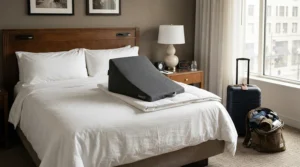
2. Avana Kind Bed Orthopedic Support Wedge Pillow — modular system for reflux plus back pain
The Avana Kind Bed Orthopedic Support Wedge Pillow takes a completely different approach: instead of one solid foam triangle, it’s a four-piece system — a curved back wedge, a sliding lumbar scoop, a leg wedge, and a Velcro-adjustable headrest.
That curved (not flat-angled) back piece is the standout feature, since it follows the natural curve of your spine rather than forcing your back into a straight ramp. In practice, this means the elevation you get for reflux control doesn’t come at the cost of lower-back strain, which is a common complaint with rigid foam wedges after a few weeks of nightly use.
What most buyers overlook about modular systems like this is that the pieces can be rearranged for different needs — propped up for reading, flattened for sleep, or reconfigured entirely if you’re recovering from surgery rather than managing reflux. Reviewers who also deal with chronic back or hip pain rate this system unusually highly, and it’s frequently recommended for pregnant users because the leg wedge takes pressure off the hips. The tradeoff is nighttime stability: because it’s modular, pieces can separate if you’re a restless sleeper, which undercuts consistency for pure reflux control.
Pros:
- ✅ Curved back wedge follows natural spine alignment
- ✅ Modular pieces adapt to back pain, legs, or reading needs
- ✅ Frequently recommended for pregnancy-related discomfort
Cons:
- ❌ Pieces can shift or separate during restless sleep
- ❌ Less clinically documented for reflux specifically than MedCline
If your reflux comes bundled with back pain or you need flexible positioning options, the Avana Kind Bed Orthopedic Support Wedge Pillow offers versatility that single-piece wedges simply can’t match, even if it sacrifices a bit of nighttime reliability to get there.
3. Helix Wedge Pillow — best all-around comfort with cooling gel foam
The Helix Wedge Pillow earns its “best overall” reputation from sleep review sites largely because of its 10-inch incline paired with a genuinely comfortable layer of gel-infused memory foam over a firmer polyfoam base.
That gel layer isn’t just a marketing checkbox — gel-infused foam actively pulls heat away from your body, which matters because standard memory foam has a well-documented tendency to trap warmth against your skin overnight. Combined with a rayon-polyester blend cover that’s breathable and machine washable, this is one of the more temperature-neutral options in this roundup. The 10-inch height sits at the upper end of the clinically useful range for reflux, which is enough elevation for most moderate GERD cases without tipping into “sleeping in a recliner” territory.
Here’s what the spec sheet won’t tell you, but user reports suggest: the firmness is best described as medium-firm rather than plush, which suits back and side sleepers well but can feel too rigid for people who prefer sinking into their pillows. A handful of reviewers also mention a stronger-than-average new-foam smell in the first few days, which is standard for gel memory foam but worth knowing before you unbox it in the bedroom.
Pros:
- ✅ Gel-infused foam actively resists heat buildup
- ✅ 10-inch incline hits the clinically useful elevation range
- ✅ Breathable, machine-washable rayon-blend cover
Cons:
- ❌ Medium-firm feel may be too rigid for plush-pillow fans
- ❌ Notable off-gassing smell reported during initial use
Positioned in the mid-tier price range, the Helix Wedge Pillow is the pick for anyone who wants strong reflux-relief elevation without sacrificing comfort to get it — particularly hot sleepers who’ve struggled with standard foam wedges overheating them by 2 a.m.
4. InteVision Foam Bed Wedge Pillow — the headrest-equipped option for neck support
What most competitors skip entirely, the InteVision Foam Bed Wedge Pillow builds in directly: a height-adjustable, separately-attached gel memory foam headrest sitting on top of its main wedge base.
The main wedge measures a generously sized 33 inches wide by roughly 7.5 inches tall — noticeably larger than the standard 24-inch width most wedges use — which means side sleepers won’t feel like they’re about to roll off the edge mid-turn. The two-layer construction pairs a 2-inch cooling gel memory foam top layer over a firmer support base, giving you contouring comfort without the whole pillow collapsing under your weight overnight.
Based on the spec comparison, this design solves a specific complaint that plagues flat-topped wedges: neck strain from your head tipping backward at an awkward angle relative to your elevated torso. The detachable headrest lets you fine-tune that angle independently, which is genuinely useful if you’ve tried a basic wedge before and woken up with a stiff neck rather than reflux relief. What buyers overlook here is that the extra width also makes this one of the better options for couples sharing a bed who both want elevation without a queen-sized wedge taking over the whole mattress.
Pros:
- ✅ Extra-wide 33-inch base accommodates side sleepers and couples
- ✅ Adjustable headrest solves neck-angle discomfort separately from incline
- ✅ Two-layer gel foam balances contouring with support
Cons:
- ❌ Larger footprint may not fit smaller beds or headboards
- ❌ Detachable headrest can shift out of position overnight
For anyone whose reflux relief attempts have been undermined by neck pain from a standard wedge, the InteVision Foam Bed Wedge Pillow directly addresses that gap — a smart mid-range pick that most one-piece wedges simply can’t replicate.
5. Brentwood Home Zuma Foam Wedge Pillow — best value with flexible incline options
The Brentwood Home Zuma Foam Wedge Pillow consistently shows up as a “best value” pick across sleep review sites, and the reasoning holds up: it’s made from CertiPUR-US certified therapeutic support foam and available in three incline heights — 7, 10, or 12 inches — at a price well below most competitors offering the same certification.
That three-height option matters more than it seems. A 7-inch incline suits mild, occasional reflux or leg elevation, while the 10- or 12-inch versions push into the range recommended for more persistent nighttime symptoms. Being able to choose your elevation rather than being locked into one height is a genuine advantage over fixed-incline competitors twice the price. The cover — a 4-way stretch bamboo-derived rayon knit — draws heat away from the body reasonably well, though not quite as effectively as true gel-infused foam.
Reviewers consistently report the firmness runs on the firm side, particularly at the higher inclines, which some find “too hard” after extended nightly use even though it holds its shape better over time than softer foams that flatten out. What most buyers overlook is that Brentwood Home manufactures domestically in Los Angeles and offsets its carbon footprint — a detail that won’t affect your reflux but matters if sustainability factors into your buying decision.
Pros:
- ✅ Three incline heights (7″, 10″, 12″) let you match severity
- ✅ CertiPUR-US certified foam at a below-average price point
- ✅ Cooling bamboo-rayon cover, removable and washable
Cons:
- ❌ Firmness skews hard, especially at taller inclines
- ❌ Some sizes go in and out of stock frequently
At a genuinely accessible price, the Brentwood Home Zuma Foam Wedge Pillow offers a rare combination: real certification, real incline flexibility, and a price that doesn’t require justifying to your budget spreadsheet.

6. Kolbs Bed Wedge Pillow — the reliable entry point with the biggest review base
If sheer popularity is any signal, the Kolbs Bed Wedge Pillow has earned its reputation — it’s accumulated tens of thousands of reviews with a strong average rating, making it one of the most tested-by-the-crowd wedges available.
Available in 7.5-inch and 12-inch heights, the Kolbs wedge uses a memory foam top layer over a firmer support core, wrapped in a jacquard-pattern cover that looks noticeably more like a designer pillowcase than the clinical white covers common at this price. The 7.5-inch model sits right at the lower threshold of clinically useful elevation, making it a sensible entry point for people who’ve never used a wedge before and aren’t sure how much incline they’ll tolerate.
Reviewers consistently note that the standard height works well for back sleepers with mild-to-moderate reflux, while taller users or those with more severe symptoms tend to graduate to the 12-inch version. What the spec sheet won’t tell you, but the review volume strongly suggests, is that this is a genuinely low-risk way to test whether wedge sleeping works for you at all before spending three times as much on a clinical system. On the downside, at 7.5 inches some users with more stubborn nighttime symptoms report needing to size up.
Pros:
- ✅ Massive real-world review base backs up reliability claims
- ✅ Jacquard cover feels notably nicer than typical medical fabric
- ✅ Two height options for mild vs. moderate reflux
Cons:
- ❌ 7.5″ height may be insufficient for severe nighttime GERD
- ❌ Firmer support layer takes some adjustment for side sleepers
Landing in the budget-to-mid range, the Kolbs Bed Wedge Pillow is the pick we’d point a first-time wedge buyer toward — enough real-world validation to feel confident, without the financial commitment of a clinical system.
7. Xtra-Comfort Folding Wedge Pillow — most portable and budget-friendly
Every list needs a genuinely low-commitment entry point, and the Xtra-Comfort Folding Wedge Pillow fills that role by folding into a compact, travel-friendly shape with a built-in carry handle — something none of the fixed-shape wedges above can offer.
Constructed from high-density memory foam with a removable, machine-washable polyester cover, its 3-in-1 folding design lets you use it under your head, your back, or your legs depending on the night. That versatility comes with a tradeoff: the incline is gentler than dedicated single-height wedges, which makes it better suited to mild or occasional reflux rather than chronic nighttime GERD.
Here’s the honest analysis: at this price point, you’re not getting clinical-grade elevation or premium cooling foam — you’re getting a legitimately useful, foldable introduction to incline sleeping that travels well for hotel stays or visiting family, situations where lugging a 24-inch foam triangle simply isn’t practical. Reviewers frequently mention using it as a secondary travel pillow after buying a firmer wedge for home use, rather than as their primary nightly solution.
Pros:
- ✅ Genuinely foldable and portable with a carry handle
- ✅ Versatile 3-in-1 use for head, back, or legs
- ✅ Lowest price point of any pillow on this list
Cons:
- ❌ Gentler incline may not suit moderate-to-severe reflux
- ❌ Softer foam compresses faster than firmer competitors
Under $50, the Xtra-Comfort Folding Wedge Pillow isn’t trying to be a clinical solution — it’s a low-risk, portable way to test incline therapy or supplement a firmer home setup when you’re traveling.
Top 7 Comparison: Specs at a Glance
| Pillow | Foam Type | Incline Height | Cover | Rating |
|---|---|---|---|---|
| MedCline Reflux Relief System | Multi-layer CertiPUR-US, gel | 15–20° torso | Removable velour-style | High |
| Avana Kind Bed Orthopedic Support Wedge Pillow | Standard + curved support foam | Adjustable/modular | Removable, washable | High |
| Helix Wedge Pillow | Gel memory foam + polyfoam | 10″ | Rayon-poly blend | High |
| InteVision Foam Bed Wedge Pillow | 2-layer gel memory foam | 7.5″ + headrest | Removable, washable | High |
| Brentwood Home Zuma Foam Wedge Pillow | CertiPUR-US solid memory foam | 7″/10″/12″ | Bamboo-rayon knit | High |
| Kolbs Bed Wedge Pillow | Memory foam top, firm core | 7.5″/12″ | Jacquard | High |
| Xtra-Comfort Folding Wedge Pillow | High-density memory foam | Foldable, multi-position | Polyester | Moderate-High |
The pattern across this table is worth calling out directly: gel-infused foam appears almost exclusively in the mid-to-premium tier, which tracks with its higher manufacturing cost compared to standard memory foam. If cooling matters as much to you as incline does, that pushes you toward the Helix Wedge Pillow or InteVision Foam Bed Wedge Pillow rather than the budget end of this list.

Benefits of a Wedge Pillow vs. Traditional Alternatives
| Approach | Effectiveness for GERD | Convenience | Cost |
|---|---|---|---|
| Stacked regular pillows | Low — bends neck, not torso | High | Free–low |
| Bed risers / wood blocks | Moderate — whole-bed elevation | Low — awkward setup | Low |
| Wedge pillow | Moderate–high — targeted torso elevation | High | Low–moderate |
| Adjustable bed base | High — precise, repeatable angle | High (once installed) | High |
Stacking regular pillows is the instinctive first move most people try, but it mostly just bends your neck without changing the angle between your stomach and esophagus — the actual mechanism that matters for reflux. Bed risers elevate the whole mattress, which works but permanently tilts your entire sleep surface, which partners or pets sharing the bed may not appreciate. A dedicated wedge pillow for acid reflux hits a practical middle ground: targeted elevation, no permanent bed modification, and a price point that’s a fraction of an adjustable base.
✨ Ready to stop stacking pillows at 2 a.m.? Scroll back up and pick the option that matches your sleep style — your esophagus will thank you.
What Is a Wedge Pillow for Acid Reflux?
A wedge pillow for acid reflux is a firm, triangular foam cushion that elevates your upper torso — not just your head — at roughly a 30 to 45 degree incline while you sleep, using gravity to help keep stomach acid from traveling back up into the esophagus overnight.
Research on GERD elevation therapy has found that raising the head of the bed reduced the percentage of time stomach pH stayed abnormally acidic during sleep compared to lying flat, which is essentially the clinical basis every wedge pillow on the market is built around. The key distinction from a regular pillow is the shape: a true incline pillow for GERD supports your entire back and shoulders on a continuous slope, rather than just propping your head at an angle your neck has to compensate for.
How to Choose a Wedge Pillow for Acid Reflux
- Start with your incline height. Six to eight inches is the generally cited minimum for meaningful reflux benefit; anything shallower functions more as a comfort pillow than positional therapy.
- Match the foam firmness to your sleep position. Back sleepers generally tolerate firmer memory foam wedges well, while side sleepers often need either a softer top layer or a system with a dedicated arm pocket.
- Check the width, not just the height. A standard 24-inch-wide wedge can feel narrow for side sleepers who shift positions overnight — wider designs reduce the risk of rolling off.
- Consider cooling properties if you sleep hot. Gel-infused memory foam and breathable rayon covers meaningfully outperform standard foam and polyester on heat retention.
- Decide between a single wedge and a full system. Chronic, diagnosed GERD often benefits from a multi-piece positioning system; occasional or mild reflux is usually well served by a single foam wedge.
- Factor in your budget realistically. Clinical-grade systems can cost several times more than a solid CertiPUR-US foam wedge, and the incremental benefit isn’t always proportional to the price for milder symptoms.
- Read the cover care instructions before buying. A removable, machine-washable cover matters more over months of nightly use than it seems like it will on day one.
For a deeper dive into how sleep researchers evaluate these products, the Sleep Foundation’s wedge pillow testing methodology is worth a read if you want the full breakdown behind incline and firmness recommendations.
Memory Foam Wedge Pillow for Reflux vs. Standard Foam Wedge
Not every wedge pillow uses the same foam, and the difference shows up more in month three than in week one. A memory foam wedge pillow for reflux — like the Helix Wedge Pillow or InteVision Foam Bed Wedge Pillow — uses a viscoelastic top layer that slowly contours to your body weight and shape, distributing pressure more evenly across your shoulders and back.
Standard polyfoam wedges, by contrast, tend to hold a fixed shape without contouring, which some firm-support seekers actually prefer since it won’t develop a body-shaped dip over time the way softer memory foam can. What most buyers overlook is that pure memory foam also traps more body heat than polyfoam by default, which is exactly why gel-infusion has become the standard workaround in mid-to-premium wedges. If you run warm at night, prioritizing a gel-infused memory foam wedge over a standard foam one is a small spec-sheet detail with an outsized effect on how well you actually sleep through the incline.
Incline Therapy for GERD: What the Research Says About Esophageal Reflux
Incline therapy isn’t a wellness trend — it’s one of the more consistently validated non-drug interventions for nocturnal GERD. A clinical trial on bed elevation found it reduced total esophageal acid exposure time by roughly two-thirds and significantly cut the number of reflux episodes per night compared to sleeping flat. That’s a meaningful data point, because a lot of sleep-product marketing throws around “clinically proven” loosely — this particular mechanism actually has decades of gastroenterology research behind it.
The nuance worth understanding is that elevation angle and body position work together, not separately. Combining left-side sleeping with head-of-bed elevation of roughly six to eight inches is described as providing the strongest protection against nighttime acid reflux in sleep-medicine guidance, which is precisely why systems like the MedCline Reflux Relief System build side-positioning directly into their design rather than treating incline as the whole solution. If you’ve tried a wedge before and found the relief only partial, checking whether you’re actually maintaining a side-sleeping position on it overnight is worth investigating before writing off wedge pillows entirely.
For a closer look at the underlying clinical research, the ongoing trial registered on ClinicalTrials.gov examining head-of-bed elevation for GERD offers useful context on how researchers are still refining these recommendations.
Practical Usage Guide: Getting the Most from Your Incline Pillow for GERD
Buying the right wedge is only half the equation — how you actually use it in the first 30 days determines whether it becomes a permanent fixture or a closet decoration.
Week one: expect an adjustment period. Your body has to relearn how to settle into an inclined position, and it’s completely normal to slide down slightly overnight until your muscles adapt. Placing a folded towel or grippy shelf liner under the wedge can reduce mattress slide on smoother sheets.
Air it out before first use. New memory foam, especially CertiPUR-US certified foam like that used in the Brentwood Home Zuma Foam Wedge Pillow, often carries a mild off-gassing smell for the first 24 to 48 hours. Unbox it in a well-ventilated room a day or two before your first night with it.
Maintain a consistent angle rather than experimenting nightly. Switching between incline heights night to night makes it harder to tell whether the elevation itself is working. Commit to one height for at least a week before adjusting.
Wash the cover regularly, not the foam. Covers are machine washable on most models in this guide; the foam itself should only ever be spot-cleaned and fully air-dried to avoid trapping moisture that can degrade it over time.
Common first-month mistake: placing a standard pillow on top of the wedge for “extra height.” This reintroduces the neck-bend problem the wedge was designed to eliminate — if you need more elevation, size up to a taller wedge instead of stacking.

Real-World Scenarios: Matching the Right Wedge Pillow to Your Life
The chronic GERD patient who’s tried everything. If you’ve already cut back on trigger foods, adjusted your dinner timing, and a basic wedge still isn’t cutting it, the MedCline Reflux Relief System or Avana Kind Bed Orthopedic Support Wedge Pillow address the mechanism more thoroughly than a single foam triangle can.
The occasional heartburn sufferer on a budget. If reflux shows up a few nights a month rather than nightly, the Kolbs Bed Wedge Pillow or Xtra-Comfort Folding Wedge Pillow offers a low-risk way to test whether elevation helps before investing in anything pricier.
The hot sleeper who also has reflux. Reflux relief that comes at the cost of waking up drenched in sweat isn’t much of a win. The Helix Wedge Pillow‘s gel-infused foam and breathable cover specifically target this overlap, making it worth the mid-range price if temperature regulation is your dealbreaker.
The side sleeper with neck pain. Standard flat-topped wedges often leave side sleepers with an awkward head angle. The InteVision Foam Bed Wedge Pillow‘s adjustable headrest solves that specific combination better than any single-piece wedge on this list.
Problem → Solution: Fixing Common Wedge Pillow Complaints
Problem: I keep sliding off the wedge during the night. Solution: add a non-slip pad or grippy sheet underneath, and confirm your mattress isn’t too soft — a plush mattress lets a wedge sink and shift more than a firmer one.
Problem: My neck hurts more than my reflux did. Solution: your head is likely angled too sharply relative to your torso. A model with an adjustable headrest, like the InteVision Foam Bed Wedge Pillow, or simply a lower incline, usually resolves this.
Problem: I still wake up with heartburn occasionally. Solution: check your sleep position — elevation without left-side sleeping is meaningfully less effective, according to sleep-medicine research. Also review evening eating habits, since a large or late meal can outpace even good positional therapy.
Problem: The foam feels too hot. Solution: switch to a gel-infused option like the Helix Wedge Pillow, or add a breathable cotton pillowcase over the standard cover for extra airflow.
Problem: My partner and I disagree on elevation needs. Solution: a modular system like the Avana Kind Bed Orthopedic Support Wedge Pillow allows independent adjustment per side, or consider individual wedges rather than a shared incline setup.
Common Mistakes When Buying a Wedge Pillow for Acid Reflux
The single biggest mistake is buying based on price alone without checking incline height — a $25 pillow with only a 4-inch rise won’t deliver meaningful reflux relief no matter how comfortable it feels. The second most common misstep is ignoring width: a narrow 20-inch wedge might look fine in photos but feels genuinely cramped for anyone who shifts position during the night.
Buyers also frequently underestimate break-in time, returning a perfectly good wedge within the first week because the adjustment period felt uncomfortable — most owners report the sliding and stiffness resolve within seven to ten nights. Finally, skipping the cover-care details is a quiet regret generator; a pillow with a sewn-in, non-removable cover becomes a hygiene headache within a few months of nightly use.
Long-Term Cost & Maintenance: Is a Wedge Pillow Worth It?
Run the numbers and a wedge pillow is one of the rare sleep products with genuinely strong long-term value. A mid-range option like the Brentwood Home Zuma Foam Wedge Pillow, at roughly $60, amortizes to well under a dollar a month over a typical two-to-three-year foam lifespan — cheaper than a single month of over-the-counter antacids for many chronic sufferers, and with none of the long-term acid-suppression concerns that come with daily medication reliance.
Even the premium MedCline Reflux Relief System, despite its higher upfront cost, compares favorably against ongoing costs like prescription proton pump inhibitors or repeated doctor visits for unmanaged nighttime symptoms. Maintenance costs are minimal across the board — replacement covers typically run $15 to $30 when the original wears out, extending the usable life of the foam core significantly beyond the cover’s lifespan.
Safety, Regulations & When to See a Doctor About GERD
Wedge pillows are unregulated as medical devices, which means claims like “clinically proven” should be read with a healthy dose of skepticism unless a brand cites specific, checkable research — which the MedCline Reflux Relief System notably does, given its patented design and referenced clinical positioning studies. CertiPUR-US certification, present on several pillows in this guide including the Brentwood Home Zuma Foam Wedge Pillow, is a genuinely meaningful safety marker, since it verifies the foam was made without certain ozone depleters, heavy metals, and formaldehyde.
Positional therapy is a supportive tool, not a replacement for medical care. If nighttime reflux is accompanied by difficulty swallowing, unintended weight loss, persistent chest pain, or symptoms that don’t improve after several weeks of consistent incline sleeping, that’s a signal to talk to a doctor rather than trying a taller wedge. Reflux disease is associated with reduced quality of life and, over time, increased risk of esophageal complications, so a wedge pillow works best as one piece of a broader management plan rather than a standalone fix.

Frequently Asked Questions
❓ Does a wedge pillow for acid reflux actually work?
❓ How high should an incline pillow for GERD be?
❓ Can a memory foam wedge pillow for reflux replace medication?
❓ Is sleeping on your side or back better with a wedge pillow?
❓ How long does it take to adjust to sleeping on a wedge pillow?
Conclusion
Nighttime acid reflux is exhausting in a way that’s hard to explain to anyone who hasn’t dealt with it — the constant low-grade anxiety about whether tonight’s the night you wake up gasping. The good news is that the fix, in a lot of cases, really is this straightforward: change the angle, and gravity starts working with you instead of against you.
Whether you land on the clinical-grade MedCline Reflux Relief System, the value-forward Brentwood Home Zuma Foam Wedge Pillow, or the budget-friendly Xtra-Comfort Folding Wedge Pillow for testing the waters, the underlying science holds across all seven picks in this guide: torso elevation, ideally paired with left-side sleeping, is one of the most well-supported non-medication approaches to managing GERD symptoms overnight. Start with your incline needs, factor in how you actually sleep, and pick the option that matches both — not just the one with the most five-star reviews.
Recommended for You
- Travel CPAP Pillow: 7 Compact Picks That Actually Work In 2026
- CPAP Pillow For Stomach Sleepers: 7 Picks That Stop Leaks (2026)
- Pillow For CPAP Mask Side Sleepers: 7 Comfortable Picks (2026)
Disclaimer: This article contains affiliate links. As an Amazon Associate, I earn from qualifying purchases. If you purchase products through these links, we may earn a small commission at no additional cost to you.
✨ Found this helpful? Share it with your friends! 💬🤗
