
In This Article
Somewhere around 2 a.m., most of us have had the same thought: this pillow is the problem. Not the mattress, not the room temperature, not the three cups of coffee at 4 p.m. — the pillow. A natural latex pillow gets recommended more than almost any other fix, and for good reason: latex is one of the few fill materials that manages to be supportive and breathable at the same time, instead of picking one and sacrificing the other.

So what is a natural latex pillow? It’s a pillow filled with latex foam tapped from rubber trees rather than synthetic petroleum-based foam, processed into either a solid molded core or shredded chunks, and typically wrapped in a breathable cotton cover. Unlike memory foam, it springs back instantly instead of slowly reshaping, which means less “sinking” and more consistent neck support night after night.
That responsiveness is exactly why natural latex has quietly become the material of choice for people who run hot, who have allergies, or who are just tired of replacing a flat, lumpy pillow every eight months. According to the Sleep Foundation, latex resists dust mites and mold far better than down or standard polyfill, which matters more than most shoppers realize until they’ve spent a summer sneezing into their pillowcase.
Below, I’ve pulled together seven real, currently available latex pillows — from budget-conscious Talalay options to a genuinely plush shredded latex pillow for side sleepers — and broken down what each one actually does well, where it falls short, and who should (and shouldn’t) buy it. Every price mentioned is a range, since exact Amazon pricing shifts by the week; check the current listing before you buy.
Quick Comparison Table: Natural Latex Pillow at a Glance
| Pillow | Latex Type | Fill Style | Best For | Price Range |
|---|---|---|---|---|
| Brooklyn Bedding Talalay Latex Pillow | Talalay | Solid | Budget hot sleepers | $100-$150 |
| Avocado Green Pillow | Blend | Shredded | Most sleep positions | $100-$150 |
| PlushBeds Organic Shredded Latex Pillow | Dunlop | Shredded | Custom loft/allergies | $120-$160 |
| PlushBeds Solid Latex Pillow | Talalay | Solid | Firm, no-fluff support | $120-$160 |
| Turmerry Organic Latex Pillow | Dunlop | Solid | Even, dense support | $100-$140 |
| Eli & Elm Cooling Side Sleeper Pillow | Talalay | Solid, contoured | Side sleepers | $70-$110 |
| Saatva Latex Pillow | Talalay | Shredded | Luxury/back sleepers | $150-$190 |
A quick scan of that table tells most of the story on its own: shredded latex dominates the “adjustable comfort” lane, while solid latex owns the “consistent, no-fluffing-needed” lane. Notice, too, that price doesn’t track neatly with quality here — the budget-friendly Brooklyn Bedding Talalay Latex Pillow uses the same latex-tapping process as the much pricier Saatva Latex Pillow, just without the multi-layer construction and brand markup. The real differentiator across this list is fill style and loft, not just dollars spent.
💬 Bookmark this table now — you’ll want to scroll back to it once you see what’s coming next.😊
Top 7 Natural Latex Pillows: Expert Analysis
1. Brooklyn Bedding Talalay Latex Pillow — best value for hot sleepers
The Brooklyn Bedding Talalay Latex Pillow proves you don’t need a three-digit splurge to get real Talalay latex under your head. Its solid Talalay core is wrapped in a moisture-wicking Tencel cover, and the brand offers two loft heights — a 4-inch profile for back and stomach sleepers, and a 5-inch option built for side sleepers. Talalay latex is manufactured with a flash-freezing step that creates a more uniform, open-cell structure than Dunlop, and that structure is what makes this pillow feel airy rather than dense. Based on the spec comparison with pricier latex pillows on this list, this one holds its own: the solid core means no fluffing, no clumping, and a full night of the same loft you started with.
Reviewers consistently report that the pillow stays notably cooler than memory-foam alternatives, and several note it eliminated recurring neck pain within the first couple of weeks. This is a strong pick for side-back sleepers who run warm and want responsive support without paying luxury prices, though dedicated stomach sleepers may still find even the low-loft version a touch too tall. In the mid-$100s range at the time of research, it’s one of the more reasonably priced entries into genuine Talalay latex, and the value holds up well against pillows costing 30-50% more.
Pros:
- ✅ Genuine Talalay latex at a below-average price point
- ✅ Two loft options for different sleep positions
- ✅ Machine-washable, moisture-wicking Tencel cover
Cons:
- ❌ Solid core can’t be adjusted or fluffed like shredded fill
- ❌ Low-loft version may sit too tall for strict stomach sleepers

2. Avocado Green Pillow — most adaptable shredded latex blend
The Avocado Green Pillow takes a different approach than a pure latex core: its fill blends roughly 95% organic shredded latex with about 5% kapok, a silky plant fiber that mimics the loft of down without the allergen baggage. What most buyers overlook about this blend is that it solves latex’s one real weakness — a lack of that fluffy, moldable feel — while keeping the bounce and breathability latex is known for. The zippered cover lets you add or remove fill to dial in your preferred height, which matters enormously for people who switch between side and back sleeping through the night.
Reviewers and independent testers frequently point to its GOTS- and GOLS-certified organic cotton cover as reassurance for anyone wary of synthetic off-gassing, and the shredded structure means it won’t develop the permanent body impressions that plague cheaper polyfill pillows. This pillow is well suited to combination sleepers and anyone with sensory sensitivities who wants a customizable loft without babysitting a solid foam block. It’s a poor match, though, for anyone who specifically wants the firmer, more structured feel of a solid latex core.
Pros:
- ✅ Fully adjustable loft via zippered fill access
- ✅ Kapok blend softens latex’s firmer edge
- ✅ GOTS/GOLS-certified organic materials throughout
Cons:
- ❌ Not machine washable in full (cover only)
- ❌ Softer blend feels less supportive than 100% latex to firm-preference sleepers
3. PlushBeds Organic Shredded Latex Pillow — best for custom firmness and allergy control
Where the Avocado pillow blends fibers, the PlushBeds Organic Shredded Latex Pillow goes all-in on 100% GOLS-certified shredded Dunlop latex. Dunlop latex is poured and set in a single process rather than Talalay’s flash-freezing method, which produces a denser, more consistent piece of foam — and shredding it keeps that density while adding the give of a traditional down pillow. Here’s what to weigh: shredded Dunlop won’t have the airy bounce of Talalay, but it compensates with a sturdier, longer-lasting feel that resists flattening even after years of nightly compression.
Aggregated reviewer sentiment on this pillow highlights its resistance to dust mites and mold as a standout for allergy sufferers, alongside praise for how easily the fill fluffs back into shape each morning. It’s a strong option for anyone who wants an organic, adjustable pillow but doesn’t want to compromise on latex’s natural durability. The main tradeoff is care: this one is spot-clean only, not machine washable, so it demands slightly more maintenance discipline than shredded pillows built around a fully washable design.
Pros:
- ✅ 100% GOLS-certified organic Dunlop latex fill
- ✅ Adjustable loft without losing latex’s durability
- ✅ Naturally resistant to dust mites, mold, and bacteria
Cons:
- ❌ Spot-clean only — not machine washable
- ❌ Denser Dunlop feel may surprise buyers expecting Talalay’s bounce
4. PlushBeds Solid Latex Pillow — best for consistent, no-maintenance support
If shredded fill sounds like a chore, the PlushBeds Solid Latex Pillow skips it entirely with a single molded Talalay latex core wrapped in a cotton sateen cover. On paper this means one thing above all: zero fluffing, ever. The pillow holds its exact shape from the first night to the thousandth, and its open-cell structure keeps airflow moving through the core so heat doesn’t build up the way it does in dense memory foam.
Based on the spec comparison with shredded competitors on this list, the tradeoff is customization — you can’t add or remove fill to change the loft, so getting the fit right up front matters more. Reviewers describe the feel as notably “springy” underfoot (or rather, under-head), with several noting it relieved shoulder pressure better than their previous down or poly pillow. This is a great match for back and side sleepers who know their preferred loft and want a pillow that simply performs the same way every single night without upkeep. Stomach sleepers and anyone who likes to fluff and reshape their pillow through the night should look elsewhere on this list.
Pros:
- ✅ Holds its exact shape indefinitely — no fluffing required
- ✅ Strong airflow keeps the core from trapping heat
- ✅ Responsive bounce relieves shoulder and neck pressure
Cons:
- ❌ Fixed loft can’t be adjusted after purchase
- ❌ Too tall and firm for most stomach sleepers
5. Turmerry Organic Latex Pillow — best dense, even support from a single core
The Turmerry Organic Latex Pillow uses a single piece of Dunlop latex rather than the layered or shredded approaches seen elsewhere on this list, and that construction shows up directly in how it feels: dense, even, and stable across the entire surface. Dunlop’s manufacturing process — pouring latex into a mold and letting sediment settle before curing — naturally produces a firmer bottom layer and slightly softer top, giving this pillow a gentle gradient of support that many all-latex cores lack.
What the spec sheet won’t tell you, but reviewer patterns suggest, is that this even density is exactly why back sleepers with chronic neck stiffness tend to gravitate toward it — there are no soft spots to sink into unevenly. The organic cotton cover is breathable and GOLS-certified, keeping the eco-conscious appeal intact without inflating the price the way some premium brands do. The obvious limitation is the same one facing every solid-core pillow here: no loft adjustability, so sizing up correctly matters before you commit.
Pros:
- ✅ Even, gradient support from a single Dunlop core
- ✅ GOLS-certified organic materials at a mid-range price
- ✅ Naturally firm without feeling harsh on pressure points
Cons:
- ❌ No adjustable loft or fill options
- ❌ Firmer feel won’t suit sleepers who prefer a plush, sinking sensation
6. Eli & Elm Cooling Side Sleeper Pillow — best for shoulder pressure relief
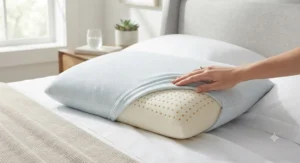
Most latex pillows are built as a generic rectangle and hope for the best; the Eli & Elm Cooling Side Sleeper Pillow actually solves a specific problem. Its Talalay latex core has a cutout on one edge shaped to accommodate a sleeper’s shoulder, which — based on the spec comparison with flat-profile pillows — matters enormously for anyone who wakes up with a compressed, aching shoulder after sleeping on their side all night. The organic cotton cover keeps the breathability advantage of latex intact while the U-shaped design does the structural work.
Reviewers frequently cite reduced shoulder and neck tension as the standout benefit, particularly compared to standard rectangular latex pillows that force the shoulder to either dig into the mattress or push the neck out of alignment. This is a purpose-built pick, so back and stomach sleepers likely won’t get much value from the shoulder cutout and should look at a standard-profile pillow instead. For side sleepers specifically, though, this is one of the more thoughtfully engineered options on the market.
Pros:
- ✅ Shoulder cutout specifically designed for side sleepers
- ✅ Talalay latex core stays breathable and responsive
- ✅ Organic cotton cover is hypoallergenic and washable
Cons:
- ❌ Specialized shape offers little benefit to back/stomach sleepers
- ❌ Smaller company means a thinner base of long-term reviews
7. Saatva Latex Pillow — best luxury pick for back sleepers
At the top of this list sits the Saatva Latex Pillow, which takes an unusual “pillow within a pillow” approach: a shredded natural latex core sits inside an outer layer of down-alternative microdenier fiber, all wrapped in an organic cotton sateen cover. Here’s what to weigh before paying the premium: that outer layer gives it a plush, hotel-bed look and feel that pure latex pillows can’t replicate, while the inner core still delivers latex’s signature support and cooling.
Aggregated reviews consistently describe it as supportive and notably cool-sleeping, with several testers noting the standard loft (roughly 4-5 inches, though it can measure taller unpacked) works best for back sleepers rather than stomach sleepers, who’d need to remove the inner core to flatten it out. One common complaint in user reviews is that the shredded core can develop some lumpiness over time and isn’t fully machine washable — only the cover and outer fiber layer are. Reviewers consistently note the two available loft heights and the brand’s above-average return window as reasons the higher price still feels justified for shoppers who prioritize a plush, adjustable-feeling luxury pillow.
Pros:
- ✅ Two loft heights for different sleep positions
- ✅ Down-alternative outer layer adds plush, hotel-quality feel
- ✅ Genuinely cool-sleeping shredded latex core
Cons:
- ❌ Premium price compared to single-material latex pillows
- ❌ Latex core can develop minor lumpiness and isn’t fully washable
Top 7 Latex Pillows: Full Spec Comparison
| Pillow | Loft Options | Cover Material | Adjustable? | Best For | Price Range |
|---|---|---|---|---|---|
| Brooklyn Bedding Talalay Latex Pillow | 4″ / 5″ | Tencel | No | Hot sleepers on a budget | $100-$150 |
| Avocado Green Pillow | Adjustable | Organic cotton | Yes | Combination sleepers | $100-$150 |
| PlushBeds Organic Shredded Latex Pillow | Adjustable | Organic cotton | Yes | Allergy-prone sleepers | $120-$160 |
| PlushBeds Solid Latex Pillow | Fixed | Cotton sateen | No | Back/side, no-maintenance | $120-$160 |
| Turmerry Organic Latex Pillow | Fixed | Organic cotton | No | Firm, even support | $100-$140 |
| Eli & Elm Cooling Side Sleeper Pillow | Fixed, contoured | Organic cotton | No | Side sleepers | $70-$110 |
| Saatva Latex Pillow | 4-5″ / 6-7″ | Cotton sateen | Partial | Luxury back sleepers | $150-$190 |
Laid out side by side, the pattern is clear: adjustability and price don’t move together in a straight line. The Avocado Green Pillow and PlushBeds Organic Shredded Latex Pillow both offer full loft control at a mid-range price, while the Saatva Latex Pillow commands a premium mostly for its layered construction rather than sheer material cost. If you’ve been burned by a flat pillow before, prioritize the adjustable rows in this table over anything else — the ability to add or remove fill solves more real-world sleep problems than a fancier cover ever will.
Practical Usage Guide: Setup, Break-In, and Maintenance
A latex pillow rewards a little patience up front. Fresh out of the box, most will have a faint rubbery smell — this is normal off-gassing from the manufacturing process, not a defect, and it typically fades within 24-72 hours of airing out in a ventilated room. Don’t judge the final feel until it’s had that window; latex also needs a night or two to fully decompress from its shipping vacuum-pack.
For shredded pillows like the Avocado Green Pillow or PlushBeds Organic Shredded Latex Pillow, the single most common first-30-days mistake is leaving the pillow at factory fill level instead of adjusting it. Unzip the cover and remove a handful of fill if it feels too tall for your sleep position — you can always add it back later, so store the extra in a sealed bag. Solid-core pillows like the PlushBeds Solid Latex Pillow and Turmerry Organic Latex Pillow skip this step entirely, but that also means getting the loft right at the point of purchase matters more, since there’s no adjusting after the fact.
Ongoing maintenance is refreshingly low-effort compared to down or poly pillows. Wash the cover every one to two weeks on a gentle cycle, and if your pillow’s core is machine washable — check the tag, since not all latex cores are — use cold water and low heat on the dryer to avoid degrading the latex over time. Never leave a latex pillow in direct sun for extended periods, as UV exposure accelerates the natural breakdown of rubber over the years. A latex pillow that’s cared for this way commonly lasts several years longer than a standard polyfill pillow before it needs replacing.
Real-World Scenarios: Which Latex Pillow Fits Your Sleep Life
Picture a college student in a cramped dorm room, budget tight, sharing a wall with someone who runs the space heater all winter. That’s the exact profile the Brooklyn Bedding Talalay Latex Pillow was built for — genuine Talalay cooling at a price that doesn’t wreck a semester budget, with a low-loft option that fits a typical dorm mattress setup fine.
Now picture a new parent, sleep-deprived and switching between back and side positions three times a night without ever fully waking up. An adjustable shredded latex pillow like the Avocado Green Pillow solves that instantly — no need to commit to one loft height when your sleep position changes hourly, and the kapok blend keeps it from feeling like a rigid foam brick during those 3 a.m. shifts.
Finally, consider someone in their 50s with a chronic, nagging shoulder issue from years of side sleeping, financially comfortable enough to prioritize sleep quality over price. The Eli & Elm Cooling Side Sleeper Pillow‘s shoulder cutout directly targets that pain point, while someone in the same position but wanting a more indulgent, hotel-like experience might lean toward the Saatva Latex Pillow instead, accepting the higher price for the plush outer layer.

How to Choose a Natural Latex Pillow
Choosing the right one comes down to a handful of decisions, not a dozen. Work through these in order:
- Identify your sleep position first. Side sleepers generally need more loft (5+ inches); back sleepers do best around 4 inches; stomach sleepers need the lowest profile you can find.
- Decide between shredded and solid. Shredded gives you adjustability; solid gives you permanent, no-maintenance shape.
- Check the latex type. Talalay tends to feel airier and more responsive; Dunlop tends to feel denser and more consistently supportive.
- Look for real certifications. GOLS (organic latex content) and GOTS (organic cotton cover) are the two marks worth actually checking for, not just marketing language.
- Match your budget to your priorities. Spend more for layered comfort (like Saatva’s design) or shape-specific engineering (like Eli & Elm’s cutout); spend less if you just want reliable Talalay or Dunlop support.
- Confirm the return window. Latex feel is genuinely hard to judge from a product photo, so a trial period of 30+ nights protects you from guessing wrong.
- Read the care instructions before buying, not after. Some cores are machine washable, some are spot-clean only — know which one you’re getting into.
Shredded Latex Pillow vs Solid: Which Should You Buy?
This is the single most consequential decision in latex pillow shopping, more so than brand or even price. Shredded latex pillow builds — like the Avocado Green Pillow and the PlushBeds Organic Shredded Latex Pillow — let you physically add or remove fill through a zippered opening, which means the loft can change as your needs change, whether that’s a new mattress, a shift in sleep position, or simply wanting it softer in summer. The tradeoff is a slightly less structured feel; shredded chunks, however well-packed, don’t hold quite the same uniform surface as a single molded piece.
Solid latex pillows, like the PlushBeds Solid Latex Pillow, Turmerry Organic Latex Pillow, and the core inside the Brooklyn Bedding Talalay Latex Pillow, go the opposite direction: one continuous piece of foam that never needs fluffing and never loses its shape, but also can’t be resized once you own it. Reviewers who prioritize a “set it and forget it” pillow tend to prefer solid cores, while reviewers who’ve been burned by guessing wrong on loft height tend to prefer the insurance policy that shredded fill provides.
| Factor | Shredded Latex | Solid Latex |
|---|---|---|
| Adjustability | Yes — add/remove fill | No — fixed loft |
| Shape consistency | Good, some settling possible | Excellent, no settling |
| Machine washable core | Sometimes | Rarely |
| Best for | Combination/uncertain sleepers | Decisive, single-position sleepers |
If you’ve never owned a latex pillow before and aren’t 100% sure what loft suits you, shredded is the safer first purchase — you can dial it in after the fact instead of hoping you guessed right.
Talalay Latex Pillow vs Dunlop Latex Foam: What’s the Real Difference?
Both Talalay and Dunlop start life the same way: as liquid latex sap tapped from rubber trees. Where they diverge is the curing process. Dunlop latex is poured into a mold, allowed to settle, and then baked, which lets denser latex particles sink toward the bottom — the result is a firmer, more consistent foam with a slight density gradient, seen in pillows like the Turmerry Organic Latex Pillow. Talalay latex, used in the Brooklyn Bedding Talalay Latex Pillow and the PlushBeds Solid Latex Pillow, is instead flash-frozen and vacuum-sealed mid-process, which distributes air bubbles more evenly and produces a lighter, more uniformly springy foam.
In practice, that translates to Dunlop feeling denser and more grounded underhead, while Talalay feels airier with a quicker, more pronounced bounce-back. Neither is objectively “better” — it comes down to preference. Reviewers who describe wanting a pillow that “cradles” tend to prefer Talalay’s responsiveness, while reviewers describing a preference for “solid, doesn’t budge” support tend to gravitate toward Dunlop. Both processes, when GOLS-certified, meet the same organic material standards; the certification, detailed by the standard’s administering body at Control Union, focuses on the purity of the raw latex rather than which curing method was used.
Natural Latex Pillow for Side Sleepers
Side sleeping puts more pressure on a single shoulder and creates a wider gap between the mattress and the ear than any other sleep position, which is exactly why loft height matters most here. A pillow under 4 inches will leave the neck unsupported and tilted downward; anything without enough structure will collapse under the weight of a head turned fully to one side for hours.
The Eli & Elm Cooling Side Sleeper Pillow was purpose-built around this exact problem, with a cutout that lets the shoulder settle in rather than fight the pillow for space. For side sleepers who’d rather stick with a standard shape, the higher-loft configurations of the Brooklyn Bedding Talalay Latex Pillow (5 inches) or the Saatva Latex Pillow‘s taller loft option both provide the height side sleeping demands, while the adjustable Avocado Green Pillow lets you add fill until the gap between shoulder and ear is fully supported. Whichever route you take, the goal is the same: keep the spine in a straight, neutral line from the top of the head down through the shoulders.
Common Mistakes When Buying a Latex Foam Pillow
The most frequent misstep in latex foam pillow shopping is buying based on brand reputation for mattresses rather than the specific pillow’s construction — a company can make an excellent mattress and a mediocre pillow, since the engineering challenges aren’t identical. A second common mistake is ignoring the return window entirely; latex pillows feel genuinely different in person than described, and skipping a trial period is how people end up stuck with a pillow that’s technically great but wrong for them.
A third mistake: assuming “natural latex” automatically means 100% latex. Many listings blend latex with polyfill or synthetic foam to cut costs, and the percentage matters — a pillow that’s 30% latex won’t perform anything like the fully latex-core options on this list. Always check the fill breakdown in the listing, not just the headline material claim. Finally, buyers frequently skip checking loft height against their sleep position entirely, buying whatever loft looks visually appealing in product photos rather than the one their neck actually needs.
Long-Term Cost & Maintenance: Is a Latex Pillow Worth It?
A quality latex pillow commonly holds its shape and support for 5-10 years with reasonable care — several multiples longer than the 12-18 month lifespan typical of a basic polyfill pillow. Run the math on cost-per-year rather than sticker price: a $130 latex pillow lasting seven years works out to roughly $18-19 per year, while a $25 polyfill pillow replaced every 15 months costs about $20 per year and delivers noticeably worse support the entire time. The latex pillow isn’t just more durable — it’s frequently the cheaper option once you account for replacement frequency.
Maintenance costs stay low too: a washable cover, occasional gentle spot-cleaning of the core, and avoiding direct sunlight are the entire care routine. There’s no fluffing schedule to maintain (for solid cores) and no special detergents required. The main upfront cost consideration is that latex pillows sit well above the price of synthetic alternatives, so the value case depends on actually keeping the pillow long enough to amortize that cost — which, given latex’s durability, most buyers do without even trying.
Safety, Certifications & Allergy Considerations
Natural latex is derived from the sap of the rubber tree (Hevea brasiliensis), and while it’s naturally resistant to dust mites and mold, it is a genuine allergen for a subset of the population. Anyone with a diagnosed latex allergy, or a history of reacting to items like rubber gloves or balloons, should approach latex bedding cautiously and consult an allergist before purchasing; clinical research on natural rubber latex sensitization, summarized in findings published via the National Center for Biotechnology Information, notes that repeated exposure is a known risk factor for developing reactions over time, particularly in people with existing atopic conditions.
For everyone else, the two certifications worth actually verifying are GOLS (Global Organic Latex Standard), which confirms a minimum organic latex content and restricts harmful chemical additives, and GOTS (Global Organic Textile Standard), which covers the cotton cover. Products like the PlushBeds Organic Shredded Latex Pillow and Turmerry Organic Latex Pillow list GOLS certification directly, which is a meaningfully stronger claim than a generic “eco-friendly” label with no certifying body behind it.
Buying a Natural Latex Pillow on Amazon: What to Check
Amazon makes latex pillow shopping fast, but the sheer number of similar-sounding listings makes it easy to end up with a lower-quality blend instead of the genuine article. Before adding to cart, check three things: the fill percentage breakdown (100% latex versus a latex-poly blend), whether the listing specifies Talalay or Dunlop by name (vague listings that just say “latex foam” without specifying the process are a mild red flag), and the seller’s return policy, since Amazon’s standard return window may differ from a manufacturer’s direct-site trial period.
✨ Don’t Miss These Exclusive Deals!
🔍 Take your sleep setup to the next level with these carefully researched natural latex pillow picks. Click through on any highlighted product above to check current pricing and availability before it changes. A properly matched latex pillow is one of the simplest upgrades you can make to actually wake up without a stiff neck.
Features That Actually Matter (And Those That Don’t)
Loft height, latex type, and adjustability are the three features that genuinely change your sleep experience — everything else is largely marketing polish. A fancy embossed cover pattern doesn’t affect support. “Infused with cooling gel” claims on latex pillows are frequently redundant marketing, since latex is already naturally breathable from its open-cell structure; the added gel rarely changes real-world temperature regulation in any measurable way.
What does matter, and gets underweighted by shoppers, is the cover’s breathability independent of the core — a thick, non-breathable cover can trap heat even over the most breathable latex fill, undermining the entire point of buying latex in the first place. Organic cotton and Tencel covers, used across most of the pillows on this list, consistently outperform synthetic covers on this front.

FAQ
❓ What is the difference between a natural latex pillow and a memory foam pillow?
❓ How long does a natural latex pillow last?
❓ Is a shredded latex pillow better than a solid one?
❓ Can you machine wash a natural latex pillow?
❓ Are natural latex pillows safe for people with allergies?
Conclusion
A natural latex pillow isn’t a magic fix for every sleep complaint, but it solves a specific, common one: the cycle of buying a cheap pillow, watching it flatten within a year, and repeating the purchase. Whether you land on the budget-friendly bounce of the Brooklyn Bedding Talalay Latex Pillow, the fully adjustable comfort of the Avocado Green Pillow, or the shoulder-specific engineering of the Eli & Elm Cooling Side Sleeper Pillow, the underlying material is doing real, measurable work — breathability, responsiveness, and a lifespan that make the higher upfront cost make sense over time.
If there’s one takeaway from all seven picks here, it’s that the “best” latex pillow is entirely dependent on your sleep position and your tolerance for maintenance, not on which brand has the flashiest packaging. According to independent testing roundups like the one from Forbes, the strongest picks in this category consistently share two traits: verified organic certifications and a loft that matches real sleep positions — exactly the two factors this guide walked through above.
Recommended for You
- Hypoallergenic Pillow for Allergies: 7 Proven Picks for 2026
- Down Alternative Pillow Guide: 7 Fluffiest Picks for 2026
- Hotel Quality Down Pillow: 7 Picks That Beat the Marriott (2026)
Disclaimer: This article contains affiliate links. As an Amazon Associate, I earn from qualifying purchases. If you purchase products through these links, we may earn a small commission at no additional cost to you.
✨ Found this helpful? Share it with your friends! 💬🤗
