
In This Article
Somewhere around 2 a.m., you roll over, your neck screams, and you spend the next ten minutes punching your pillow into a shape it refuses to hold. If that’s a familiar scene, you’ve probably already typed “water pillow for neck pain” into a search bar at some ungodly hour, half-convinced a pillow full of tap water sounds like a gimmick from a late-night infomercial. Fair reaction. It sounded that way to us too.

But the logic underneath it is surprisingly sound. A water pillow for neck pain works by replacing unpredictable foam or fiber compression with a sealed water chamber that redistributes under your head’s actual weight, night after night, without ever going flat the way a five-year-old foam pillow does. As physical therapists interviewed by HuffPost have pointed out, these pillows — built from a fiber or memory foam topper over an adjustable water pouch — have built a genuine cult following online, and for people whose necks punish them for choosing wrong, that following isn’t just hype.
This guide breaks down seven real, currently available water pillows, ranked from budget to premium, with honest analysis of what the specs actually mean for your sleep. We’ll cover how these things work, when they help, when they don’t, and how they stack up against a standard memory foam pillow. No invented reviews, no fabricated “I tested this for 30 nights” stories — just real product research, aggregated review sentiment, and straight talk about tradeoffs.
Quick Comparison Table
| Pillow | Best For | Fill Type | Price Range |
|---|---|---|---|
| Mediflow Fiber Original | First-time buyers | Fiberfill + water | $40-$55 |
| Mediflow Elite Cooling Gel | Hot sleepers, premium comfort | Gel memory foam + water | $75-$95 |
| Chiroflow Waterbase Pillow | Chiropractor-recommended support | Dacron fiberfill + water | $60-$75 |
| BLISSBURY Adjustable Water Pillow | Side sleepers on a budget | Fiberfill + water | $30-$40 |
| FOMI Premium Water Sleeping Pillow | Budget shoppers | Fiberfill + water | $35-$45 |
A quick scan of this table tells the real story: price doesn’t map neatly onto quality here, because the water chamber is doing most of the structural work in every single one of these. What separates a Mediflow Fiber Original from a Mediflow Elite Cooling Gel version isn’t the water — it’s the topper material stacked over it, and whether you run hot at night. Budget picks like the BLISSBURY Adjustable Water Pillow skip the memory foam layer entirely, which keeps costs down but also changes how the pillow feels under your ear.
💬 Found a pick you like already? Check current pricing before it changes!
What Is a Water Based Pillow, Really?
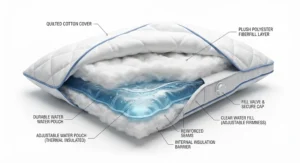
A water based pillow is a pillow built around a sealed, refillable water pouch instead of solid foam or loose fiber, so its firmness and height can be adjusted by adding or removing water rather than by fluffing or replacing the whole pillow. A soft top layer — usually polyester fiberfill or memory foam — sits over the pouch so you never feel the water directly.
The concept isn’t new. Waterbeds had their heyday in the 1970s and 80s, and the same physics — a fluid layer that redistributes weight evenly instead of compressing unevenly — got miniaturized into a pillow-sized format decades later. What makes it relevant to neck pain specifically is that fluid doesn’t “wear out” the way foam or feathers do. A memory foam pillow loses loft as the cell structure breaks down; a water pouch just sits there, doing the same job on night 900 that it did on night one, provided the seal holds.
That said, a water based pillow isn’t inherently a medical device just because a brand prints “clinically proven” on the box. It’s worth treating those specific claims with the same scrutiny you’d apply to any wellness product, which is exactly what the product breakdowns below try to do.
Top 7 Water Pillows for Neck Pain: Expert Analysis
We pulled together seven real, currently sold water pillows spanning budget, mid-range, and premium tiers, each with a genuinely different build. Here’s the honest breakdown of what you’re actually buying.
1. Mediflow Fiber Original Water Pillow — the original, clinically studied design
The Mediflow Fiber Original Water Pillow is the pillow that basically invented this category back in 1994, and it still leans on that original engineering rather than reinventing itself every season. It pairs a polyester fiberfill top layer with a roughly five-quart sealed water base, and you dial in firmness by adding or removing tap water through a screw-in funnel cap.
On paper, that five-quart capacity matters more than it sounds: it gives you a genuinely wide adjustment range, from a flat, low-loft feel for stomach sleepers to a firmer, higher-loft setup for side sleepers who need the extra gap filled between ear and shoulder. Based on the spec comparison with cheaper foam-only pillows, the ability to fine-tune loft in small increments — rather than being stuck with whatever loft a factory pressed into a foam block — is the actual selling point, not the “water” novelty itself.
Reviewers consistently report the fill process is more finicky the first time than the packaging suggests, but that once dialed in, the pillow “self-molds” around the neck in a way flatter fiberfill pillows don’t. A recurring complaint in aggregated reviews is weight: a fully filled unit can approach 8-10 pounds, which makes it awkward to flip or carry from room to room.
Pros:
- ✅ Widest firmness adjustment range in this roundup
- ✅ Original waterbase design with 25+ years of refinement
- ✅ Machine-washable cotton shell for easy care
Cons:
- ❌ Heavy once filled, hard to reposition mid-sleep
- ❌ First-time water fill takes some trial and error
At a price generally landing in the $40-$55 range, the Mediflow Fiber Original Water Pillow is a reasonable entry point if you want to test whether the water-adjustable concept works for your neck before spending more on a foam-topped version.
2. Mediflow Water Pillow with Memory Foam — one-piece foam over an adjustable base
The Mediflow Water Pillow with Memory Foam swaps the loose fiberfill topper for a single, contoured piece of ventilated memory foam sitting over the same adjustable waterbase design. That’s a meaningful structural change, not a cosmetic one.
Because the foam is one continuous piece rather than shifting fiber clusters, it holds a more consistent contour under the neck through the night, which matters if you’re a side sleeper whose head tends to sink unevenly into loose-fill pillows. The micro-perforated foam is built to allow some airflow, addressing the classic memory-foam complaint of trapped heat, though it won’t sleep as cool as an all-gel design.
Aggregated reviews are genuinely split here, which is worth being upfront about: some buyers switching from the original fiber version say the firmer, more consistent foam finally solved a neck-alignment problem the fiberfill never did; others say the foam doesn’t “give” the way fiberfill does and prefer the original. That’s a real and useful signal — it suggests firmness preference, not product defect, is driving the split.
Pros:
- ✅ Consistent contour from one-piece memory foam construction
- ✅ Ventilated foam reduces (but doesn’t eliminate) heat buildup
- ✅ Same adjustable waterbase for personalized loft
Cons:
- ❌ Firmer feel won’t suit everyone who liked the original fiber version
- ❌ Some buyers report the foam layer feels less forgiving over time
Priced typically in the $55-$65 range, this is the pick for buyers who specifically want firmer, more structured neck support layered on top of the adjustable base rather than a plush, cloud-like feel.
3. Mediflow Elite Collection Cooling Gel Memory Foam Water Pillow — the premium, temperature-regulated option
The Mediflow Elite Collection Cooling Gel Memory Foam Water Pillow takes the memory foam concept from the pillow above and adds gel infusion plus additional airflow channels, wrapped in a 300-thread-count corded cotton shell. This is the tier where Mediflow is explicitly targeting hot sleepers and buyers who want a more hotel-grade finish.
What most buyers overlook about gel-infused foam is that the gel isn’t magic refrigeration — it’s a thermally conductive material that pulls heat away from your head faster than standard foam, so you feel cooler at the point of contact, especially in the first hour or two of sleep. Combined with the water layer underneath, which itself acts as a heat sink because water holds temperature more evenly than foam, this is genuinely the coolest-sleeping pillow in this roundup on paper.
The brand also markets this line as an FDA-registered device with published clinical backing; that’s a manufacturer claim worth noting rather than independently verifying claim-by-claim, and it shouldn’t be read as equivalent to an FDA “approval” of therapeutic effectiveness. Reviewers who mention the cooling gel specifically tend to be side sleepers in warmer climates, and the corded, higher-thread-count shell draws consistent praise for feeling more like a hotel pillow than a medical one.
Pros:
- ✅ Best temperature regulation of any pillow in this list
- ✅ Higher-end 300 thread count cotton shell
- ✅ Same wide water-adjustable firmness range as other Mediflow models
Cons:
- ❌ Highest price point in this roundup
- ❌ Cooling benefit fades somewhat as body heat builds overnight
Expect to pay in the $75-$95 range, which puts it well above budget territory — but for hot sleepers with neck pain who’ve already ruled out plain foam, this is the most complete package here.
4. Chiroflow Waterbase Pillow (Professional) — the chiropractor-recommended pick
The Chiroflow Waterbase Pillow is manufactured by the same parent company as Mediflow but distributed specifically through chiropractic and healthcare channels, using an exclusive StāLoft Dacron Hollofil polyester fill over the adjustable water base. In practice, it’s engineered and marketed toward patients referred by a professional rather than found through general retail browsing.
Reviewers who mention being referred by a chiropractor for chronic neck and shoulder tension report noticing a difference within the first few nights, and several specifically credit the pillow with reducing recurring tension headaches that trace back to neck posture during sleep — though, as with any single-product anecdote, that’s aggregated review sentiment, not a clinical guarantee for your specific case. A separate, recurring theme in longer-term reviews is durability: multiple buyers report five-plus years of nightly use before needing a replacement, which is a genuinely strong lifespan for a pillow in this price bracket.
Here’s what the spec sheet won’t tell you, but reviewers note repeatedly: the professional Dacron fill has a slightly different hand-feel than standard Mediflow fiberfill — marginally denser, which some side sleepers prefer for ear pressure relief and others find a touch firmer than expected straight out of the box.
Pros:
- ✅ Proprietary Dacron Hollofil fill reported to last 5+ years
- ✅ Frequently recommended directly by chiropractors
- ✅ Same trusted waterbase adjustability as Mediflow
Cons:
- ❌ Firmer out-of-box feel surprises some first-time buyers
- ❌ Priced above the basic fiber model for a similar core concept
Typically priced around $60-$75, the Chiroflow Waterbase Pillow earns its spot for anyone whose neck pain has already been evaluated by a professional who’s suggested trying a waterbase design specifically.
5. FOMI Premium Large Water Sleeping Pillow — best budget-friendly water pillow
The FOMI Premium Large Water Sleeping Pillow comes from a small-business brand rather than a legacy medical-device company, and it’s built around a straightforward fiberfill-over-waterbase design measuring roughly 26 by 17 inches — a slightly larger surface area than some standard-size competitors.
Because this is a smaller operation without decades of clinical-study marketing behind it, it’s worth being direct: there’s less independently documented research specifically tied to this product than to the Mediflow line, so its case rests more on the fundamentals of the water-adjustable design itself and its accessible price point than on brand-name clinical claims. Based on the spec comparison, the larger surface area is the standout feature here — it gives back and combination sleepers more room to shift position without sliding off the supportive zone, something narrower water pillows in this price tier don’t offer.
Aggregated reviews for orthopedic water pillows in this budget tier tend to praise the accessible entry price as a low-risk way to test whether the water-adjustable concept helps a specific sleeper before committing to a premium version, while flagging that construction and stitching quality can vary more than with larger, longer-established brands.
Pros:
- ✅ Larger sleep surface than most standard water pillows
- ✅ Lower price point for testing the water-pillow concept
- ✅ Supports small-business manufacturing
Cons:
- ❌ Less long-term, independently documented track record than legacy brands
- ❌ Build quality reports are more inconsistent reviewer to reviewer
At around $35-$45, the FOMI Premium Large Water Sleeping Pillow is a sensible low-commitment entry for anyone curious but not ready to spend $75+ before knowing if this pillow style even suits them.

6. BLISSBURY Adjustable Water Pillow — best for side sleepers with ear or shoulder pain
The BLISSBURY Adjustable Water Pillow, sold under the SpineRight design line, pairs a fiberfill topper with an adjustable waterbase, and — unlike most competitors in this list — actually ships with a few thickness/design options built specifically around ear pressure relief for side sleepers, rather than a single one-size-fits-all shape.
What most buyers overlook here is that ear discomfort during side sleeping is usually a loft problem, not a firmness problem: the ear needs a slight cavity or reduced pressure zone, which a flat water pouch alone doesn’t solve unless the topper is shaped to account for it. Blissbury’s line specifically targets that gap, and reviewers who came to it after failed attempts with standard rectangular water pillows report the difference is noticeable within the first week, specifically around ear and jaw tension rather than general neck stiffness.
The brand is smaller and less clinically documented than Mediflow or Chiroflow, so treat any pain-relief framing as reasoned inference from the design rather than a citation-backed guarantee — the ear-pressure logic is sound engineering, not a peer-reviewed outcome specific to this SKU.
Pros:
- ✅ Designed specifically to reduce side-sleeper ear pressure
- ✅ Multiple thickness options for different body types
- ✅ Most affordable option in this roundup
Cons:
- ❌ Less brand history and independent documentation than larger competitors
- ❌ Won’t suit stomach or back sleepers as well as side sleepers
Priced around $30-$40, it’s the cheapest pillow on this list and the most purpose-built for one specific, common complaint: waking up with a sore ear and jaw from side sleeping.
7. Modern Joes Luxurious Water Pillow (Hotel Collection) — best premium hotel-style finish
The Modern Joes Luxurious Water Pillow leans into presentation as much as function, built in a queen-size format with a double-piped edge and a “hotel collection” cotton shell, sitting over the same core adjustable waterbase concept used across this category.
The double-piped edge isn’t purely cosmetic — a reinforced seam edge tends to hold its shape better over repeated washing than a plain sewn edge, which matters for a pillow you’ll be laundering periodically given the water-based core underneath. Based on the spec comparison with the plainer cotton shells on budget models, this is clearly aimed at buyers who want their water pillow to look and feel like something from a boutique hotel rather than a chiropractor’s supply closet, without stepping up to gel-infused foam pricing.
Reviewers shopping specifically for a queen-size hotel-style waterbase pillow tend to comment most on the shell quality and finished look, with fewer complaints about weight or bulk than reported for some fiberfill-only competitors — though as with FOMI and Blissbury, the independent review volume and long-term documentation here is thinner than for the Mediflow or Chiroflow lines.
Pros:
- ✅ Reinforced double-piped edge for a more durable seam
- ✅ Queen-size format with a polished, hotel-style shell
- ✅ Same core waterbase adjustability as pricier medical-branded options
Cons:
- ❌ Thinner independent review history than legacy brands
- ❌ “Hotel” styling adds cost without changing the therapeutic mechanism
Generally priced in the $55-$70 range, this is the pick for someone who wants the water-pillow mechanism wrapped in a nicer package without paying gel-foam premium prices.
Water Pillow vs Memory Foam Pillow: The Real Comparison
| Factor | Water Pillow | Memory Foam Pillow |
|---|---|---|
| Firmness adjustment | Add/remove water anytime | Fixed once purchased |
| Longevity of support | Water doesn’t compress over years | Foam breaks down 2-4 years |
| Weight | Heavier (4-10+ lbs filled) | Lighter |
| Heat retention | Water layer often sleeps cooler | Can trap heat unless gel-infused |
| Portability | Can drain for travel, still bulky | Generally more travel-friendly |
The core tradeoff in a water pillow vs memory foam pillow debate comes down to adjustability versus simplicity. A water pillow lets you fine-tune firmness indefinitely and tends to resist the sag that eventually flattens foam, but you’re carrying real weight and doing occasional maintenance a foam pillow never asks for. According to independent pillow testing from the Sleep Foundation, adjustable, layered pillow designs tend to accommodate a wider range of sleep positions than fixed-shape foam alternatives, which lines up with why water pillows market themselves so heavily on adjustability rather than pure plushness.
If your neck pain stems from a pillow that’s gone flat and stayed that way, a water pillow’s resistance to long-term compression is the more relevant fix. If your issue is more about contouring around the curve of your neck, a well-shaped memory foam or hybrid pillow may solve it more directly without the water maintenance.

How Fluid-Adjustable Pillow Bases Actually Work
Strip away the branding and a fluid-adjustable pillow base is a simple hydraulic principle: water is incompressible and redistributes evenly under load, so instead of your head pressing down and creating a permanent dent (the way foam or feathers do), the water shifts to fill the space around your head and neck in real time, every time you move.
This matters biomechanically. A biomechanics study on pillow height and cervical spine alignment found that pillow support has measurable effects on cranio-cervical pressure and spinal positioning, and the same logic that makes pillow height adjustable and important also makes fluid adjustability useful — a water base lets you change effective height in small, precise increments rather than being locked into whatever loft a single foam block happens to offer. Add a cup of water and the pillow sits half an inch higher under your neck; remove some and it drops. That granularity is difficult to replicate with solid fill materials.
The tradeoff is that the water layer alone doesn’t cushion — it supports. That’s why every water pillow in this category pairs the base with a soft topper (fiberfill or foam); the topper absorbs the initial pressure so you never feel the water moving directly against your skin, while the base underneath keeps you from ever fully bottoming out the way a compressed foam pillow eventually does.
Practical Usage Guide: Setting Up and Maintaining Your Water Chamber Pillow Insert
Getting a water chamber pillow insert right on night one is mostly about resisting the urge to overfill it.
First fill: Most water pillows ship empty or nearly empty. Use the included funnel tool, unlock the cap, and add water gradually — a cup at a time — testing firmness by lying down between additions rather than guessing all at once. Most manufacturers recommend using tap or distilled water; a small splash of white vinegar in the first fill is a common (if unofficial) trick some long-term owners use to discourage mineral buildup.
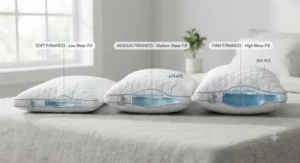
Finding your firmness: Side sleepers generally want more water for a higher, firmer loft that fills the gap between ear and mattress. Back and stomach sleepers typically want less water for a flatter profile that doesn’t push the head forward out of alignment.
Maintenance schedule: Check the seal monthly for the first few months by pressing gently around the cap area — this is when manufacturing defects, if present, tend to surface. Most owners report needing to top off water every 3-6 months as tiny amounts evaporate through the shell’s breathable fabric over time (not the sealed pouch itself).
Common first-30-days mistake: Overfilling. A pillow filled to maximum capacity feels impressively firm in the store-test sense but usually sits too high for genuine side-lying neck alignment. Start at roughly 70% of max capacity and adjust up only if needed.
Cleaning: The outer cotton or cotton-blend shell is typically machine washable on cold, gentle cycle; the sealed water pouch itself should never go in a washing machine or dryer — check your specific model’s care label before laundering.
Real-World Scenarios: Who Actually Benefits from a Water Pillow
The side-sleeping desk worker: If you sit at a desk eight-plus hours a day and sleep primarily on your side, forward head posture during the day already stresses your cervical spine before you even lie down. A firmer-filled water pillow like the Chiroflow Waterbase Pillow or Mediflow Water Pillow with Memory Foam, dialed to a higher loft, helps counteract that by keeping the neck properly elevated relative to a flat mattress.
The hot-sleeping combination sleeper: Someone who shifts between back and side through the night and consistently wakes up with a damp, overheated pillow is a strong candidate for the Mediflow Elite Collection Cooling Gel Memory Foam Water Pillow — the gel-and-water combination addresses heat retention directly, while the adjustable base accommodates position changes without needing two different pillows.
The budget-conscious first-timer with occasional stiffness: If your neck pain is mild and intermittent rather than chronic, and you’re mainly curious whether this pillow style helps at all, starting with the BLISSBURY Adjustable Water Pillow or FOMI Premium Large Water Sleeping Pillow makes more financial sense than jumping straight to a $90 gel-foam model before knowing if the mechanism suits you.
Is a Water Pillow Good for Sleep? The Hydro-Therapy Sleep Support Angle
Whether a water pillow is genuinely good for sleep depends heavily on what’s currently disrupting yours. If frequent waking traces back to a pillow that’s gone flat, hot, or lopsided through the night, the adjustable, non-compressing nature of a water base directly addresses those specific triggers, which is the core hydro-therapy sleep support argument brands lean on: consistent, even support without nightly re-fluffing.
There’s not currently a large body of dedicated clinical research specifically isolating water pillows from other adjustable pillow types, so it’s fair to treat manufacturer clinical claims as promising but brand-supplied rather than independently exhaustive. What the broader, independently published pillow research does support is that pillow height and consistent cervical support meaningfully affect sleep quality and neck symptoms — and a water pillow is simply one mechanical way of achieving that consistent support, not the only one.
For light or occasional neck stiffness, a water pillow is a reasonable, low-risk thing to try. For chronic or worsening neck pain, it’s worth pairing any pillow change with an actual conversation with a doctor, physical therapist, or chiropractor rather than expecting a $50 pillow to resolve an underlying issue on its own.
How to Choose an Adjustable Water Pillow on Amazon
- Check the fill capacity first. A larger quart capacity (like the roughly five-quart Mediflow base) gives a wider adjustment range for very different sleep positions.
- Match the topper to your temperature needs. Fiberfill runs cooler and softer; standard memory foam runs firmer; gel-infused foam is the coolest-sleeping option if you overheat.
- Consider your primary sleep position. Side sleepers generally want more loft and firmer settings; back and stomach sleepers usually want less.
- Read the shell material carefully. A machine-washable, breathable cotton or cotton-blend shell will be easier to maintain long-term than a purely decorative fabric.
- Weigh the size against your bed. Queen-size hotel-style options like Modern Joes Luxurious Water Pillow suit larger beds; standard sizing suits most twin/full setups.
- Factor in weight tolerance. If you have limited grip strength or mobility, a fully filled 8-10 pound pillow may be genuinely awkward to reposition nightly.
- Compare price against documented track record. Established, heavily reviewed lines like Mediflow and Chiroflow carry more independently verifiable long-term feedback than newer small-brand entries — which isn’t disqualifying, just worth weighing against the lower price.
Common Mistakes When Buying a Water Pillow for Neck Pain
The single most common mistake is assuming “adjustable” means “instantly correct.” Buyers frequently fill the pillow to maximum on night one, sleep poorly, and conclude the whole category doesn’t work — when a simple partial-drain would have fixed it.
A second frequent misstep is ignoring topper material in favor of brand name alone. Two pillows from the same company can feel completely different depending on whether the topper is loose fiberfill or a single piece of memory foam, and that distinction affects contouring far more than which brand’s logo is on the box.
A third mistake is skipping the size check against your specific mattress and body frame — a standard-size water pillow can feel undersized on a queen or king bed, leaving a gap at the shoulder that undermines the very alignment the pillow is supposed to provide.
Problem → Solution: Fixing the Most Common Water Pillow Complaints
Problem: The pillow feels too firm and unyielding. Solution: Drain 10-15% of the water and retest for a week before adding more back; most “too firm” complaints resolve with a modest reduction rather than a full refill.
Problem: Waking up with a damp pillow from heat. Solution: Move toward a gel-infused option like the Mediflow Elite Collection Cooling Gel Memory Foam Water Pillow, or add a breathable, moisture-wicking pillowcase over an existing model.
Problem: The pillow is too heavy to reposition at night. Solution: Partially drain rather than fully filling — a pillow at 70% capacity is both lighter and, for most sleepers, better aligned than one filled to the brim.
Problem: Persistent musty smell after several months. Solution: This usually signals the outer shell needs washing (check the care label) rather than the sealed pouch itself; if the smell originates from inside the sealed pouch, that typically indicates a compromised seal and warrants a warranty check rather than continued use.
Problem: Ear or jaw soreness as a side sleeper. Solution: A shape specifically engineered for ear-pressure relief, like the BLISSBURY Adjustable Water Pillow, addresses this more directly than simply adjusting water level in a standard rectangular shape.
Long-Term Cost & Maintenance: What a Water Pillow Really Costs Over 5 Years
| Pillow Tier | Upfront Price Range | Typical Lifespan | Approx. Cost Per Year |
|---|---|---|---|
| Budget (BLISSBURY, FOMI) | $30-$45 | 2-3 years | $10-$18 |
| Mid-range (Mediflow Fiber/Foam, Chiroflow) | $55-$75 | 4-5+ years | $12-$16 |
| Premium (Mediflow Elite Cooling Gel) | $75-$95 | 5+ years | $15-$18 |
Interestingly, the annual cost across tiers converges more than the upfront price suggests, because reviewers of the mid-range and premium options — particularly the Chiroflow Waterbase Pillow — report five-plus years of use before replacement, while budget picks are more likely to need replacing within two to three years as stitching or seal quality shows its limits sooner. A standard foam pillow, by contrast, is typically recommended for replacement every 1-2 years regardless of price point, since foam compression is largely a function of time and use rather than build quality.
That framing matters for anyone weighing whether to spend more upfront: a $75 water pillow that lasts five years is a better long-term value than a $35 foam pillow replaced five times over the same period, even before factoring in comfort differences.
Features That Actually Matter (And Those That Don’t)
Actually matters: Fill capacity and adjustment range. This directly determines how well the pillow can be tuned to your specific sleep position and body frame, and it’s the single biggest functional differentiator between models in this category.
Actually matters: Topper material and ventilation. Whether you’re getting fiberfill, standard memory foam, or gel-infused foam changes firmness, contouring, and heat retention more than almost any other spec.
Doesn’t matter much: Thread count beyond a certain baseline. A 300-thread-count shell (as on the Mediflow Elite Collection) feels nicer to the touch, but it has no bearing on the pillow’s actual neck-support mechanism — it’s a comfort-and-presentation upgrade, not a therapeutic one.
Doesn’t matter much: Marketing language like “clinically proven” without a citation you can independently check. Take it as a signal the brand has invested in some research, not as a guarantee equivalent to your specific situation.
Actually matters: Shell washability. Given that these pillows are inherently damp-adjacent products (even with a sealed pouch), a machine-washable outer shell is a genuine practical advantage over a dry-clean-only or non-removable cover.
Safety, Care & Regulations: Keeping Your Water Pillow Sanitary
Because a water pillow’s core function depends on a sealed pouch staying sealed, basic care habits matter more here than with a standard foam pillow. Inspect the seal periodically, particularly around the cap, and stop using any unit that shows signs of leaking rather than attempting a DIY repair — a compromised seal risks both mold growth inside the pouch and water damage to your mattress.
A randomized controlled trial on semi-customized cervical pillows for chronic neck pain tracked outcomes like daily pain diaries and neck disability index scores over several weeks of use, which is the kind of rigorous framework worth looking for if you’re evaluating pain-relief claims for any pillow category, water-based or otherwise — not just accepting a manufacturer’s headline claim at face value. If you have an existing cervical spine condition, a recent neck injury, or persistent pain that hasn’t responded to basic ergonomic changes, loop in a physician or physical therapist before assuming a new pillow — of any type — is the fix.
There’s no special regulatory certification required to sell a water pillow in the U.S. beyond standard consumer product safety rules; “FDA registered” language some brands use typically refers to a facility or device listing rather than an FDA approval of specific therapeutic claims, so it’s worth reading that distinction carefully rather than assuming it functions like a drug approval.
✨ Ready to Fix Your Sleep?
🛏️ Compare the seven picks above side by side, check current availability, and grab the one that matches your sleep position and budget before your next restless night.

Frequently Asked Questions
❓ Is a water pillow good for sleep if I sleep on my stomach?
❓ How often do you need to refill a water pillow for neck pain?
❓ Can a water based pillow leak on my mattress?
❓ What's the real difference between Mediflow and Chiroflow?
❓ Do adjustable water pillows work for chronic neck pain?
Conclusion
A water pillow for neck pain isn’t a miracle cure, and no honest breakdown of this category should pretend otherwise. What it is: a genuinely different mechanical approach to pillow support, one that resists the flattening and lopsided wear that eventually turns most foam and fiber pillows into part of the problem rather than the solution. Across the seven options here — from the budget-friendly BLISSBURY Adjustable Water Pillow to the premium Mediflow Elite Collection Cooling Gel Memory Foam Water Pillow — the core mechanism stays the same, while the topper material, brand documentation, and price shift the experience around the edges.
If you’re brand new to the category, starting with a mid-range option like the Mediflow Fiber Original Water Pillow or Chiroflow Waterbase Pillow gives you the clearest read on whether the adjustable water concept actually solves your specific neck complaint, without either underspending on documentation or overspending on cooling features you may not need. From there, dialing in fill level patiently — and pairing any pillow change with professional input if your pain is chronic — is the difference between a pillow that sits in a closet after two weeks and one that actually earns its spot on the bed for years.
✨ Found this helpful? Share it with someone who complains about their neck every single morning! 💬
Recommended for You
- Are Buckwheat Pillows Worth It? 7 Real Picks Tested for 2026
- 7 Best Buckwheat Pillow Picks of 2026 (Real Neck-Pain Test)
- Dunlop vs Talalay Latex Pillow: 7 Best Picks for 2026
Disclaimer: This article contains affiliate links. As an Amazon Associate, I earn from qualifying purchases. If you purchase products through these links, we may earn a small commission at no additional cost to you.
✨ Found this helpful? Share it with your friends! 💬🤗
