
In This Article
If you sleep on your side — and statistically, you probably do — your pillow is doing more structural work than almost any other object in your bedroom. It’s holding your skull (which weighs roughly as much as a bowling ball) at the exact height needed to keep your neck level with your spine, for seven or eight hours, without you noticing. Most pillows fail at this quietly. You don’t realize your pillow is wrong until you’ve spent a month waking up with a neck that crackles like a bowl of cereal.

A good memory foam pillow for side sleepers does one specific job: it fills the gap between your ear and your mattress so your head doesn’t tip down toward the bed or get shoved up toward the ceiling. Sleep experts generally agree that side sleepers should choose pillows that keep the head in a neutral position, and memory foam happens to be unusually good at this because it holds its shape under sustained pressure instead of collapsing flat by 2 a.m. the way a feather pillow might.
I went looking for real, current options — not theoretical “best of” picks, but pillows you can actually order from Amazon this week — and landed on seven that span everything from a $20-ish basic foam rectangle to a patented ergonomic design with sculpted bolsters. Below, you’ll find what each one actually does well, who it’s wrong for, and a buying framework so you’re not just trusting my word for it.
Quick Comparison: 7 Memory Foam Pillows for Side Sleepers
Before the deep dive, here’s the lay of the land.
| Pillow | Best For | Adjustable? | Price Range |
|---|---|---|---|
| Weekender Gel Memory Foam Pillow | Tightest budget | No | Under $35 |
| Sweetnight Adjustable Loft Pillow | Budget + customization | Yes | $35–$50 |
| EPABO Contour Memory Foam Pillow | Shoulder-pain side sleepers | Partial | $30–$45 |
| ZAMAT Adjustable Cervical Pillow | Combo side/back sleepers | Yes (2 heights) | $35–$55 |
| Coop Home Goods Original Adjustable Pillow | Dial-in-your-own loft | Yes (fully) | $70–$100 |
| Cushion Lab Deep Sleep Pillow | Set-it-and-forget-it ergonomics | No | $80–$100 |
| Tempur-Pedic TEMPUR-Neck Pillow | Long-term shape retention | No (sized) | $70–$130 |
A pattern jumps out fast: the cheaper pillows are fixed-loft slabs, while the $70-and-up tier either lets you customize the fill yourself or has already done the sculpting for you. Neither approach is objectively better — it depends on whether you’d rather spend five minutes adjusting foam by hand or pay a premium for someone else to have solved that problem in the factory.
Top 7 Memory Foam Pillows for Side Sleepers: Expert Analysis
1. Weekender Gel Memory Foam Pillow
The budget anchor of this list, and there’s no shame in that — a lot of side sleepers genuinely don’t need a $90 pillow to sleep well. This pillow is a single piece of memory foam infused with cooling gel and dotted with ventilation holes, designed to contour to your head, neck, and shoulders. The practical translation: that single-piece construction means the loft is fixed from the day it arrives — there’s no unzipping it to fluff or flatten it, so you’re committed to whatever height it ships at.
What most buyers overlook here is that “gel-infused” doesn’t mean cold-to-the-touch forever; it means the foam sheds heat a bit faster than plain memory foam, which matters most in the first hour of sleep, not the whole night. It’s CertiPUR-US certified and comes with a removable, machine-washable polyester cover, which is the bare-minimum safety and hygiene box I’d want any foam pillow to check.
✅ Genuinely inexpensive
✅ CertiPUR-US certified foam
✅ Available in standard, queen, and king
❌ Loft isn’t adjustable
❌ No sleep trial mentioned
Value verdict: Solid for lighter-framed side sleepers or as a backup pillow. Broad-shouldered sleepers may find the loft a touch shallow.
2.Sweetnight Adjustable Loft Pillow
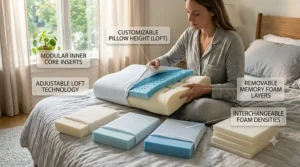
This is where “budget” and “customizable” actually overlap, which is rarer than you’d think. It’s built from shredded gel memory foam that you can add or remove through a zippered cover to dial in your preferred loft — meaning instead of hoping the factory guessed your shoulder width correctly, you get to guess it yourself, with an extra fill bag included for the attempt.
In my experience comparing adjustable shredded-foam pillows, the shredded format trades a little bit of “slow-sink memory foam feel” for noticeably better airflow than a solid slab — there’s literally more space between the foam pieces for air to move. Sweetnight backs the pillow with a 3-year warranty, which is generous for something at this price point.
✅ Adjustable loft via zipper
✅ Cooling, washable cover
✅ 3-year warranty
❌ Some buyers report a brief off-gassing smell out of the box
❌ Shredded fill feels less “structured” than solid foam
Value verdict: A smart pick for anyone who’s never tried an adjustable pillow and wants to test the concept without a big spend.
3. EPABO Contour Memory Foam Pillow
Contour pillows look strange in product photos — that wavy, two-humped silhouette — but the shape exists for a specific reason: it carves out a literal trench for your shoulder so the pillow isn’t fighting your anatomy for space. The design is built around supporting the head, neck, and shoulder alignment, with a removable foam piece at the bottom so back and stomach sleepers can lower the loft if needed.
Here’s the part most listings won’t tell you plainly: the contour shape is polarizing. In customer Q&A, side sleepers report split experiences — some find the firm version transformative for neck pain, while others say it simply didn’t work for their specific neck angle. That’s not a flaw unique to EPABO; it’s true of contour pillows generally, which is why I’d treat the 30-day window as essential rather than optional.
✅ Purpose-built shoulder cutout
✅ Comes in soft and firm feels
✅ 30-day money-back guarantee
❌ Mixed results for some side sleepers with neck pain
❌ Firm version needs a break-in period
Value verdict: Best for side sleepers who specifically want a contoured (not rectangular) pillow and are willing to use the return window if the angle’s wrong.
4. ZAMAT Adjustable Cervical Memory Foam Pillow
The clever trick on this one is the rotation. The butterfly-shaped design includes a central cavity for the head and a removable insert in the bottom that lets you adjust height — and rotating the pillow 360 degrees gives you access to two different loft levels on opposite sides. So instead of owning two pillows for two different needs, you flip the same one.
What that means in practice: if you’re a side sleeper most nights but roll onto your back sometimes, you get a taller side-sleeping height and a shorter back-sleeping height without buying a second pillow. The foam is also marketed as odorless and CertiPUR-US certified, which addresses the new-memory-foam-smell complaint that trips up a lot of first-time buyers.
✅ Two loft heights in one pillow
✅ Odorless, CertiPUR-US certified foam
✅ Satisfaction guarantee from the brand
❌ Central cavity reduces total sleeping surface
❌ Butterfly shape takes getting used to visually and physically
Value verdict: Particularly good for combination sleepers who refuse to sleep on a “neck pillow” that looks too medical — this one at least functions like a regular pillow at a glance.
5. Coop Home Goods Original Adjustable Pillow
If the EPABO and ZAMAT are pre-shaped solutions, the Coop Original is the opposite philosophy entirely: it hands you the raw materials and lets you build your own pillow. It ships with extra fill included specifically so you can customize the loft and firmness, and it’s both CertiPUR-US and GREENGUARD Gold certified — two separate certifications, which is a meaningfully higher bar than foam safety alone.
What most reviews undersell is who this customization actually benefits most. Average-weight side sleepers get the most out of the adjustability, since they can fine-tune loft to their exact shoulder width, while lightweight stomach sleepers tend to need to remove a large amount of fill to get comfortable. In other words: this is a side-sleeper-first pillow that happens to tolerate other positions, not a true universal pillow. It also comes with a 100-night sleep trial and a 5-year warranty, which is enough runway to actually find your ideal fill level without rushing the decision.
✅ Fully adjustable fill, extra bag included
✅ Dual certification (CertiPUR-US + GREENGUARD Gold)
✅ 100-night trial, 5-year warranty
❌ Less ideal for stomach sleepers
❌ Bulkier feel than slab-style pillows
Value verdict: My pick for side sleepers who’ve never found “the one” and suspect the problem has always been a fixed loft they couldn’t tune.

6. Cushion Lab Deep Sleep Pillow
This is the Coop’s philosophical opposite — instead of giving you raw foam to shape yourself, Cushion Lab pre-sculpted the shape for you. It uses a dual-density memory foam core with a soft top layer over a denser support base, and a patented design with sculpted side bolsters specifically built for side-sleeping support. Those bolsters are the whole pitch: they’re raised sections that sit under your neck so the pillow doesn’t sink flat exactly where you need the most lift.
What the spec sheet doesn’t communicate is how this changes the feel of switching positions mid-night. The design lets the contours gently cradle your head while the raised bolsters maintain neck support to reduce tossing and turning — so rather than re-fluffing a pillow every time you roll over, the shape is already waiting on both relevant zones. The cover is a cooling nylon-spandex blend, which keeps the whole thing from feeling like a hot brick against your face.
✅ Patented ergonomic side-sleeper bolsters
✅ Dual-density foam (soft top, firm base)
✅ Cooling, anti-wrinkle pillowcase
❌ Premium price for a non-adjustable design
❌ Fixed shape may not suit very narrow or very broad shoulders
Value verdict: Excellent for side/back combination sleepers who want the engineering done for them and don’t mind paying for it.
7. Tempur-Pedic TEMPUR-Neck Pillow
Tempur-Pedic invented the category most of this list is competing in, and the Neck Pillow is their most direct answer to “what does a side sleeper actually need.” It’s a single piece of TEMPUR-Material in an extra-firm feel, contoured to follow the natural curve of the head, neck, and shoulders, and built specifically for side and back sleepers.
The thing worth understanding about TEMPUR-Material specifically — and this is the detail most comparisons skip — is its recovery speed. It’s engineered to respond to body heat and pressure slowly, which means it keeps pushing back against your neck all night instead of compressing once and staying flat, the way cheaper foams tend to by 4 a.m. The brand reports more than 10 million pillows sold and 15,000 five-star reviews, and it comes in three profile sizes — small, medium, and large — so you pick your loft once at checkout rather than adjusting it after the fact. It carries a 5-year limited warranty and a removable, washable cover.
✅ Slow-recovery foam holds shape for years, not months
✅ Three profile sizes to match your exact loft need
✅ Decades of brand reliability behind it
❌ Premium pricing across all sizes
❌ Extra-firm feel needs an adjustment period
❌ No sleep trial — pillows are final sale per brand policy
Value verdict: The “buy it once, stop thinking about it” option for side sleepers who’ve already been burned by foam that goes flat too fast.

How to Break In Your New Memory Foam Pillow (Without Wrecking the First Two Weeks)
Nobody tells you this part, and it’s why so many memory foam pillows get returned within a month for the wrong reason. New foam is denser and firmer than it’ll be after a few weeks of regular compression — so the pillow you sleep on night one is not really the pillow you’ll have by night thirty.
A few things that actually help: unbox and let the pillow fully decompress for 24–48 hours before judging it (compressed shipping flattens the cell structure temporarily). Give any new-foam smell 2–3 days in a ventilated room to dissipate — it’s typically residual manufacturing odor, not a defect. And resist the urge to “fix” firmness in week one with extra pillows stacked underneath; let the foam’s own recovery curve settle first. If you’ve got an adjustable pillow like the Coop or Sweetnight, make exactly one fill adjustment, sleep on it for at least three nights, then adjust again — changing it nightly just resets your body’s ability to judge what’s actually working.
Real-World Scenarios: Matching the Pillow to the Sleeper
The broad-shouldered side sleeper who wakes up with shoulder ache, not neck ache. You likely need more loft than average, not more softness. The Coop Home Goods Original or the Tempur-Pedic in a “large” profile will serve you better than a contour pillow, because the gap you’re filling is simply taller.
The combination sleeper who starts on their side and ends up on their back. The ZAMAT’s rotate-for-two-heights trick or the Cushion Lab’s dual-bolster design solve a problem that a single fixed-loft pillow can’t: your neck needs different support depending on which way you’re facing, and you don’t want to be hunting for a second pillow at 2 a.m.
The budget-conscious first-timer who’s never tried memory foam. Start with the Weekender or Sweetnight. If shredded, adjustable foam clicks for you, that’s the signal to invest in a Coop or similar pillow later — you’ll know exactly what loft range you actually need instead of guessing at a premium price point.
How to Choose a Memory Foam Pillow for Side Sleepers
- Measure the gap, not your preference. The distance between your ear and your mattress when lying on your side — which depends heavily on shoulder width and mattress firmness — is the loft you actually need, regardless of what “feels nice” in a store.
- Decide adjustable vs. pre-shaped early. If you don’t know your ideal loft yet, adjustable buys you room to experiment. If you already know, a pre-shaped pillow at the right size skips the fiddling entirely.
- Check the firmness language against your weight. Lighter sleepers tend to sink less into foam and often need a higher loft or firmer feel to avoid the head tipping down; heavier sleepers compress foam more and may find the same pillow softer than advertised.
- Look for CertiPUR-US or GREENGUARD certification. Certified foams are independently tested for low VOC emissions and screened for chemicals classified as carcinogens or reproductive toxins — it’s a low-effort way to filter out sketchy imported foam.
- Factor in trial length, not just warranty length. A 5-year warranty against manufacturing defects doesn’t help if the pillow simply isn’t comfortable for your sleep style; a real sleep trial (30–100 nights) is the protection that actually matters for fit.
- Don’t oversize the loft “just to be safe.” Side sleepers should avoid pillows that are too thick, since excessive height can elevate the head and neck too far and itself trigger neck pain — taller isn’t automatically better.
Quick Loft Reference for Side Sleepers
| Body Frame | Typical Shoulder-to-Neck Gap | Suggested Loft |
|---|---|---|
| Narrow/lightweight | Smaller gap | 3.5–4.5 inches |
| Average | Moderate gap | 4.5–5.5 inches |
| Broad/heavier | Larger gap | 5.5–7 inches |
Treat this as a starting point, not gospel — mattress firmness shifts these numbers too. A plush mattress lets your shoulder sink in, effectively lowering the loft you need; a firm mattress does the opposite.
Common Mistakes When Buying a Memory Foam Pillow for Side Sleepers
The single most common mistake is buying based on softness alone. A pillow that feels luxuriously soft in a five-second showroom test can still let your head sink too far down by hour three, which is the opposite of what a side sleeper’s neck needs. Support and softness are not the same axis, and conflating them is how people end up with a closet full of “comfortable” pillows that still gave them a stiff neck.
The second mistake is ignoring pillowcase fit. Many memory foam pillows — especially contoured ones — don’t fit standard cases well, and an ill-fitting case can bunch up exactly where your neck rests, undoing the ergonomic design you paid for. Check whether the pillow ships with its own cover or needs a specialty size before assuming any case in your linen closet will work.
The third, sneakier mistake: replacing a pillow that’s actually fine because the cover has gone gray and lumpy-looking, when a wash (or a new case) would have solved it. Conversely, people keep foam cores for 5+ years past the point where the foam has lost real resilience, simply because the cover still looks clean. The foam itself, not the cover, is what determines support.
Memory Foam vs. Down Alternative for Side Sleepers
| Factor | Memory Foam | Down Alternative |
|---|---|---|
| Shape retention overnight | Holds shape under sustained pressure | Compresses and can flatten by morning |
| Neck/shoulder contouring | Conforms closely to gaps | Less precise contouring |
| Heat retention | Can run warmer (less so with gel/shredded designs) | Generally breathes better |
| Adjustability | Many models let you add/remove fill | Rarely adjustable |
| Typical lifespan | 2–4 years before resilience drops | Often needs replacing sooner |
The honest read on this comparison: down alternative wins on initial softness and breathability, but memory foam wins on the thing side sleepers actually need most — sustained structural support exactly where the neck bends. If you run hot at night, a gel-infused or shredded memory foam design (like the Weekender or Sweetnight above) closes most of that breathability gap without sacrificing the support.
Features That Actually Matter (And Those That Don’t)
Actually matters: Loft accuracy for your frame, certified foam (CertiPUR-US/GREENGUARD), and a real trial period. These three directly affect whether the pillow does its job and whether you have recourse if it doesn’t.
Mostly marketing: “Infinite cooling technology” claims on solid (non-shredded, non-ventilated) foam — physics limits how much a dense foam slab can actively cool versus just not retaining as much heat as it could. Also largely cosmetic: elaborate pillowcase patterns and “luxury hotel” branding language, which describes positioning, not performance.
Worth a second look, often skipped: Whether the cover is removable and machine-washable. It sounds minor until you’re three months in and realize you can’t actually clean the thing properly — at which point the “luxury” feel matters a lot less.
Long-Term Cost and Maintenance
Run the math on cost-per-night rather than sticker price. A $30 pillow that needs replacing every 18 months because the foam goes flat costs you roughly $0.05/night over three years. An $85 pillow backed by a 5-year warranty and genuine multi-year shape retention can land at a similar or lower per-night cost — while actually supporting your neck the whole time, instead of for the first six months.
Maintenance itself is simple but easy to get backward: wash the removable cover regularly (most are machine-washable on cold, gentle cycle), but never machine-wash the memory foam core itself — it breaks down the cell structure and ruins the support you paid for. Spot-clean the foam with a damp cloth and mild detergent if needed, then air-dry fully before recovering it; foam that’s covered while still damp can mildew inside where you’d never see it.

FAQ: Memory Foam Pillows for Side Sleepers
❓ What loft should a side sleeper's memory foam pillow be?
❓ Are memory foam pillows good for shoulder pain?
❓ How long does a memory foam pillow last?
❓ Can you wash a memory foam pillow?
❓ Is a firmer or softer memory foam pillow better for side sleeping?
Conclusion: Finding Your Match
There’s no single best memory foam pillow for every side sleeper — there’s a best one for your shoulders, your mattress firmness, and how much fiddling you’re willing to do to get the loft right. If you want to dial in your own fit, the Coop Home Goods Original or Sweetnight give you that control. If you’d rather the engineering be finished before it arrives, the Cushion Lab or Tempur-Pedic do that work for you. And if you just want to know whether memory foam works for you at all before spending real money, the Weekender or EPABO are reasonable, low-stakes ways to find out.
The through-line across all seven: your pillow’s real job is to keep your neck aligned with your chest and back, not to feel plush for the first ten seconds in a showroom. Get that alignment right, and the rest — softness, cooling, cover fabric — is just preference.
Recommended for You
- Cooling Memory Foam Pillow: 7 Best Picks for Hot Sleepers (2026)
- Memory Foam Pillow vs Down Pillow: 6 Top Picks for 2026
- Memory Foam Pillow for Neck Pain: 7 Real Picks Worth Buying in 2026
Disclaimer: This article contains affiliate links. As an Amazon Associate, I earn from qualifying purchases. If you purchase products through these links, we may earn a small commission at no additional cost to you.
✨ Found this helpful? Share it with a friend who complains about their neck every morning. 💬
