
In This Article
Somewhere around 2 a.m., staring at the ceiling with a pillow that’s gone flat as a pancake, most people finally start asking the question that brought you here: Dunlop vs Talalay latex pillow — what’s actually the difference, and does it matter enough to care? Short answer: yes, quite a bit. A Dunlop vs Talalay latex pillow decision isn’t just marketing noise dressed up in Thai rubber-tree trivia. It genuinely changes how the pillow feels under your cheek at midnight and how it holds up three years from now.

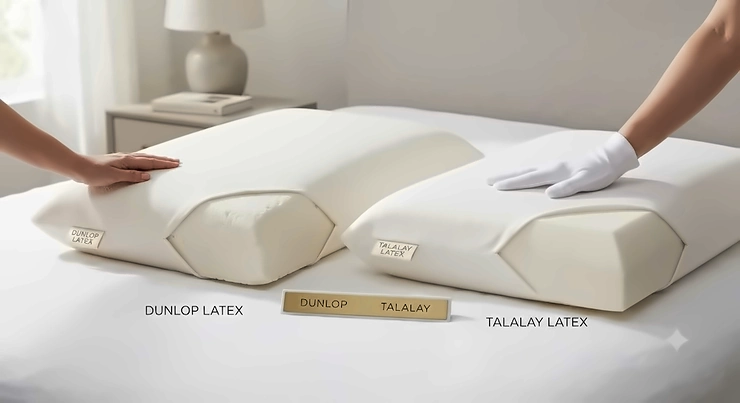
Here’s the 50-word version, since you deserve a straight answer before the deep dive: Dunlop latex pillows are made with a single-pour method that produces a denser, firmer, bottom-heavy foam, while Talalay latex pillows go through an extra vacuum-and-freeze step that creates a lighter, softer, more evenly consistent foam. Same rubber tree, very different personalities.
Neither process is “better” in some universal sense — that’s the trap a lot of shoppers fall into. It’s more like comparing a sturdy hiking boot to a plush running shoe. Both get you where you’re going; the terrain (in this case, your sleep position, body weight, and heat sensitivity) decides which one actually serves you. According to the Sleep Foundation’s manufacturing breakdown, the starting sap is identical for both — the split happens entirely in the factory.
Below, you’ll get real product picks across every price tier, honest aggregated review sentiment (never invented), spec-by-spec interpretation, and a decision framework so you’re not just guessing in the pillow aisle. Let’s get into it.
Quick Comparison Table: Dunlop vs Talalay Latex Pillow at a Glance
Before the full breakdown, here’s the cheat sheet. If you only have sixty seconds, this table (plus the two sentences after it) will get you 80% of the way to a smart decision.
| Feature | Dunlop Latex Pillow | Talalay Latex Pillow |
|---|---|---|
| Feel | Firmer, denser, bottom-heavy | Softer, lighter, evenly consistent |
| Best for | Back and stomach sleepers | Side sleepers, hot sleepers |
| Durability | Higher density = longer lifespan | Slightly less dense, still durable |
| Price range | Generally lower, around $40-$100 | Generally higher, around $70-$150 |
| Breathability | Good, but less open-cell | More open-cell, cools faster |
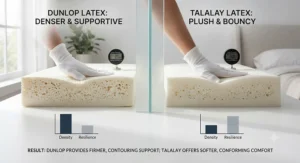
The density difference is the whole story in miniature: Dunlop’s single-pour process lets sediment settle at the bottom, which is exactly why the base feels firmer than the top layer. Talalay’s extra vacuum-expansion step distributes material so evenly that the pillow feels the same whether you’re pressing the edge or the center — a texture difference you’ll notice the first night, not just on a spec sheet.
💬 Already leaning one way? Compare current pricing on today’s top-rated latex pillows below.
Top 7 Dunlop vs Talalay Latex Pillows: Expert Analysis
We pulled together seven real, currently available latex pillows spanning budget, mid-range, and premium tiers — a mix of pure Dunlop, pure Talalay, and hybrid-fill options — so you can see how the theory plays out in actual products.
1. Talatex Dunlop Latex Pillow — budget-friendly firm support
The Talatex Dunlop Latex Pillow is the no-frills entry point into Dunlop latex, and it earns that spot by doing one thing well: dense, consistent firmness at a price that won’t make you flinch. It’s built from 100% natural Dunlop latex in a medium-low profile, specifically marketed toward relieving neck and shoulder pressure. Because Dunlop settles during the pour, the base of this pillow carries noticeably more support than a Talalay equivalent at the same price — practically speaking, that means less “bottoming out” for people who sleep on their back with a heavier head-and-neck load. This is the pillow to grab if you’re testing whether latex works for you at all before committing to a $150 premium pick. Aggregated buyer sentiment on Amazon for Dunlop-process pillows in this category consistently highlights pressure relief around the neck and shoulders as the standout benefit, though a subset of reviewers note the low profile runs thinner than expected for stomach sleepers who prefer more loft.
Pros:
- ✅ Genuinely firm, supportive feel for the price
- ✅ 100% natural Dunlop latex, no synthetic fillers
- ✅ Low profile suits stomach and combination sleepers
Cons:
- ❌ Limited size and firmness variety compared to premium brands
- ❌ Cover isn’t always removable for washing
Expect this one in the under-$70 range; at that price, it’s a legitimately smart way to trial Dunlop before spending more elsewhere.

2. PlushBeds Organic Shredded Latex Pillow — GOLS-certified adjustable Dunlop
The PlushBeds Organic Shredded Latex Pillow takes a different approach to Dunlop entirely: instead of one solid core, it uses shredded GOLS-certified Dunlop latex you can fluff, redistribute, and adjust like a down pillow — minus the flattening. That shredded structure is the real story here. Solid-core latex pillows lock you into one loft; shredded latex lets you scoop material toward the edges or center depending on whether you’re on your side or back that night. Reviewers and product testers consistently point to the organic cotton cover and the complete absence of harsh chemicals or dyes as major selling points for anyone with sensitivities. Based on the spec sheet, this is the pick for people who’ve been burned by lumpy or flattened pillows before and want the bounce-back of latex with the customizability of shredded fill. It can’t be machine washed, only spot-cleaned, which is a real trade-off worth knowing before you buy.
Pros:
- ✅ GOLS-certified organic Dunlop latex, chemical-free
- ✅ Fully adjustable loft via shredded fill
- ✅ Naturally resistant to dust mites and mold
Cons:
- ❌ Not machine washable, spot-clean only
- ❌ Shredded feel differs from solid-core latex
Priced in the roughly $100-$150 range at the time of research, it lands squarely in mid-tier territory.
3. Turmerry Organic Latex Pillow — single-piece Dunlop, carbon-neutral production
The Turmerry Organic Latex Pillow goes for balance rather than extremes, and that middle-of-the-road feel is exactly the point. Its core is a single piece of GOLS-certified Dunlop latex at a 5-inch loft, engineered to give noticeable contouring without letting your head sink too far — a common complaint with softer foams. What most buyers overlook about single-piece Dunlop cores like this one is that the perforation pattern matters almost as much as the density; here, the latex is perforated specifically to keep airflow moving through the core, which matters if you run warm. Turmerry’s production facility also carries a Carbon Neutral certification, a detail sustainability-minded shoppers tend to weigh heavily. For back sleepers and side sleepers who like a mid-thickness pillow (not too flat, not a neck-craning mountain), this is one of the more thoughtfully engineered Dunlop options on the market right now.
Pros:
- ✅ GOLS-certified organic Dunlop core
- ✅ Perforated design improves airflow and cooling
- ✅ Medium feel suits back and side sleepers
Cons:
- ❌ 5-inch loft may feel low for stomach sleepers
- ❌ Firmer than Talalay alternatives at similar price
Expect a price in the $90-$120 range, positioning it as a mid-range Dunlop standout.
4. Avocado Green Pillow — adjustable Dunlop-kapok hybrid
The Avocado Green Pillow blends Dunlop latex with kapok fiber, a plant-based material that softens the overall feel without sacrificing latex’s supportive bounce — and that hybrid construction is worth pausing on. Pure latex can feel almost too springy for people used to down or poly-fill pillows; kapok mellows that responsiveness into something closer to a cloud with a supportive core underneath. It’s certified under GOTS and GREENGUARD Gold, two of the stricter organic and low-emissions standards in the bedding industry, which matters if you’re sensitive to off-gassing. Testers at multiple review outlets describe the feel as medium-plush, landing it in a sweet spot for stomach sleepers who need enough softness to avoid neck strain but still want some lift. The loft is adjustable by removing fill, which is the kind of practical detail Amazon listings rarely explain well.
Pros:
- ✅ GOTS and GREENGUARD Gold certified materials
- ✅ Adjustable loft via removable latex and kapok fill
- ✅ Medium-plush feel works for multiple sleep styles
Cons:
- ❌ Premium price relative to pure-latex competitors
- ❌ Kapok blend means less pure “latex bounce”
Positioned in the $100-$150 range, this is a premium pick built for buyers who want organic credentials layered on top of comfort.
5. Coop Home Goods Adjustable Latex Pillow — Talalay latex and microfiber, fully customizable
The Coop Home Goods Adjustable Latex Pillow swaps a solid latex core for a blend of Talalay latex and microfiber, and it ships with an extra bag of fill so you can dial in firmness and loft after the fact. That adjustability is the headline feature, and it solves a real problem: most latex pillows force you to guess your ideal loft before you’ve ever slept on it. Because it uses Talalay latex rather than Dunlop, the responsive, evenly-distributed feel Talalay is known for carries through even after you’ve customized the fill ratio — you’re not sinking into dead zones the way you might with an all-microfiber pillow. Reviewers frequently mention that the ergonomic design helps with alignment across side, back, and stomach positions, since you can literally reshape the pillow to match whichever position you favor that night. It’s a strong option for people who share a bed with someone who prefers a completely different firmness.
Pros:
- ✅ Fully adjustable firmness and loft with extra fill included
- ✅ Talalay latex blend keeps a responsive, bouncy feel
- ✅ Ergonomic shape supports multiple sleep positions
Cons:
- ❌ Blended fill means less pure latex durability than solid-core
- ❌ Initial setup takes some trial and error
Priced around $70-$100, it’s a mid-range pick built specifically for indecisive sleepers.
6. Brooklyn Bedding Talalay Latex Pillow — solid Talalay core, low and high loft options
The Brooklyn Bedding Talalay Latex Pillow is a solid-core Talalay pillow available in two loft heights, and the low-loft version in particular is built with stomach sleepers and non-snoring back sleepers in mind. This is where Talalay’s signature evenness really shows up: the latex molds to your head and neck shape uniformly, without the firmer-at-the-bottom transition Dunlop pillows tend to have. It’s organic and hypoallergenic, which the brand and independent reviewers both flag as a strong fit for allergy or asthma sufferers. One honest trade-off worth naming: the fill isn’t adjustable, so choosing the correct loft up front matters more here than with the Coop pick above. On the brand’s own site, the pillow carries an aggregate rating of roughly 4.6 out of 5 across more than 1,300 customer reviews, with buyers frequently citing reduced neck and shoulder pain after switching — a pattern that’s meaningfully different from a marketing claim because it’s sourced from a large, verifiable review pool rather than a handful of cherry-picked comments.
Pros:
- ✅ Solid Talalay core for uniform, consistent support
- ✅ Organic materials, hypoallergenic and washable cover
- ✅ Strong aggregated customer rating across 1,300+ reviews
Cons:
- ❌ Fill isn’t adjustable once you choose a loft
- ❌ Currently sold only through the brand’s own site, not Amazon
Expect a price in the $90-$130 range depending on loft and cover selection.
7. Talatex Premium Latex Pillow (Talalay Process) — engineered density and ILD specs
The Talatex Premium Latex Pillow is the pick for buyers who actually want to see the numbers instead of taking “medium firm” on faith. It publishes a density of 65 kg/m³ and an ILD (Indentation Load Deflection, the industry’s firmness measurement) of 17-20, specs that translate to a genuinely soft-to-medium feel engineered specifically for side sleepers with broader shoulders. Here’s what the spec sheet won’t spell out for you: that ILD range sits notably lower than most Dunlop cores, which typically land in the high-20s to 30s ILD — so if you’ve tried a Dunlop pillow and found it too firm, this is roughly the firmness gap you’d be closing by switching to a Talalay pick like this one. The pillow goes through the full vacuum-seal, flash-freeze, and vulcanization sequence that defines authentic Talalay production, which is part of why it holds its shape more evenly than cheaper Talalay imitations. Buyer feedback collected by the manufacturer does include some reports of needing to size down from medium-soft to soft for neck comfort, a useful data point if you’re between firmness options.
Pros:
- ✅ Published density and ILD specs, not vague marketing terms
- ✅ Lower ILD suits side sleepers wanting a plush feel
- ✅ True vacuum-and-freeze Talalay process, not a shortcut version
Cons:
- ❌ Softer feel may lack support for heavier stomach sleepers
- ❌ Some buyers needed to exchange for a different firmness
Priced around $90-$130 depending on size, it’s a premium-tier Talalay pick for spec-conscious shoppers.
Top 7 Products: Full Spec Comparison
| Product | Latex Type | Firmness | Price Range | Best For |
|---|---|---|---|---|
| Talatex Dunlop Latex Pillow | Dunlop | Firm | Around $40-$70 | Back sleepers, budget shoppers |
| PlushBeds Organic Shredded Latex Pillow | Dunlop (shredded) | Adjustable | $100-$150 range | Adjustable-loft seekers |
| Turmerry Organic Latex Pillow | Dunlop | Medium | $90-$120 range | Back and side sleepers |
| Avocado Green Pillow | Dunlop-kapok blend | Medium-plush | $100-$150 range | Stomach sleepers, eco-buyers |
| Coop Home Goods Adjustable Latex Pillow | Talalay blend | Adjustable | Around $70-$100 | Couples, combination sleepers |
| Brooklyn Bedding Talalay Latex Pillow | Talalay | Medium-soft | $90-$130 range | Side sleepers, allergy sufferers |
| Talatex Premium Latex Pillow | Talalay | Soft-medium | $90-$130 range | Side sleepers wanting plush feel |
Look closely and a pattern emerges: every Dunlop pick in this table skews toward “firm” or “medium,” while every pure-Talalay pick skews toward “medium-soft” or “soft” — that’s the manufacturing process showing up directly in the firmness column, not a coincidence of product selection. If budget is your main constraint, the Talatex Dunlop Latex Pillow undercuts everything else here by a wide margin without sacrificing the core benefit of natural latex support.
💬 Just one click — help others make better buying decisions too!😊
Benefits of Latex Pillows vs Traditional Alternatives
| Factor | Latex Pillow | Memory Foam | Down/Feather |
|---|---|---|---|
| Bounce-back | Immediate, doesn’t stay compressed | Slow recovery, can feel “stuck” | Compresses and clumps over time |
| Heat retention | Naturally breathable | Traps heat, common complaint | Breathable but loses loft |
| Allergy resistance | Naturally hypoallergenic | Neutral | Common allergen source |
| Lifespan | 3-5+ years typical | 2-3 years typical | 1-2 years before flattening |
Latex wins the durability argument almost by default: its cellular rubber structure resists the permanent compression that eventually flattens down pillows and turns memory foam into a slow-motion sinkhole. That said, memory foam still has a niche advantage for people who specifically want deep, slow-sinking contouring — latex will never fully replicate that “hug” because its whole design philosophy is rebound, not sink.
How Do I Choose a Dunlop vs Talalay Latex Pillow?
Picking between the two doesn’t have to be complicated once you break it into concrete criteria. Here’s the decision process, step by step:
- Identify your sleep position first. Back and stomach sleepers generally benefit from Dunlop’s firmer, bottom-heavy support; side sleepers usually prefer Talalay’s softer, more even contouring around the shoulder gap.
- Factor in body weight. Heavier sleepers tend to need Dunlop’s higher density to avoid bottoming out, while lighter sleepers can get full support from Talalay’s lower-density foam.
- Consider your heat sensitivity. Talalay’s open-cell structure moves air more efficiently, so hot sleepers usually do better with a Talalay or shredded-Dunlop pick over a solid Dunlop core.
- Check for certifications. Look for GOLS (organic latex), GOTS (organic textiles), or OEKO-TEX on the cover — these confirm the material claims instead of asking you to trust marketing copy.
- Decide between solid-core and shredded/adjustable fill. Solid cores hold their shape longer; shredded and adjustable options let you fine-tune loft but require occasional fluffing.
- Set a real budget range. Dunlop pillows generally run lower, in the $40-$100 range, while Talalay and hybrid options often land in the $70-$150 range — knowing this ahead of time narrows your options fast.
- Read aggregated review themes, not star ratings alone. A 4.5-star average tells you little; scan for recurring specific complaints (odor, firmness mismatch, sizing) across dozens of reviews instead.
Talalay Process Latex Pillow: How It’s Made
If the word “Talalay” sounds like an engineering term rather than a comfort feature, that’s because it kind of is. The Talalay process latex pillow starts identically to Dunlop — liquid latex sap is whipped into a froth — but then splits off into a more involved manufacturing sequence. The frothed latex is poured into a mold that’s only filled about three-quarters full, rather than completely. That partial fill is the key: air is then vacuum-pumped out, forcing the latex to expand and fill every corner of the mold evenly, rather than settling under gravity the way Dunlop latex does.
Here’s where the vulcanization piece comes in. After expansion, the mold is flash-frozen to well below zero, and carbon dioxide gas is introduced to begin gelling the rubber before it goes through latex vulcanization — a heating process, first developed for rubber manufacturing generally (you can read more about the underlying chemistry of vulcanization on Wikipedia), that cross-links the rubber molecules and locks in the foam’s final elasticity and durability. Without vulcanization, latex would stay sticky and structurally unstable; with it, you get a material that bounces back to shape thousands of times without breaking down.
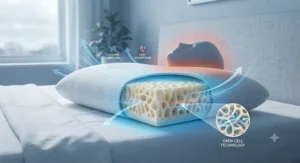
The freeze-and-vacuum steps are what create Talalay’s signature open-cell latex structure — millions of tiny, evenly distributed air pockets running through the entire pillow rather than concentrated unevenly like in Dunlop. Practically speaking, that open-cell structure is why Talalay pillows feel lighter in your hands and sleep cooler against your skin: air moves through the foam instead of getting trapped the way it can in denser materials. The trade-off is cost — those extra manufacturing steps (the vacuum sealing, the flash-freezing, the more controlled vulcanization cycle) are exactly why Talalay pillows typically carry a higher price tag than Dunlop equivalents of similar size.
Dunlop Latex Pillow Pros and Cons
Dunlop earns its reputation as the “workhorse” latex process, and understanding its specific strengths and weaknesses helps explain why so many budget and mid-range pillows default to it.
Pros:
- ✅ Simpler, less energy-intensive manufacturing process
- ✅ Higher density typically means longer-lasting support
- ✅ Generally more affordable than equivalent Talalay pillows
Cons:
- ❌ Bottom-heavy density means less uniform feel top to bottom
- ❌ Denser cell structure can trap slightly more heat than Talalay
That density trade-off is really a durability-versus-uniformity decision. A Dunlop core’s uneven settling — firmer at the base, softer up top — actually works in favor of back and stomach sleepers who want that base layer to resist compression through the night, but it’s a genuine downside for anyone who wants the exact same feel no matter where their head lands on the pillow. Consistent density foam matters more to some sleepers than others; if you toss and turn and use different parts of the pillow throughout the night, Dunlop’s inconsistency will be more noticeable than if you’re a still sleeper who lands in the same spot every time.
Which Latex Pillow Is Better: Dunlop or Talalay?
This is the question everyone actually wants answered, and the honest response is: neither latex process is objectively better — the “better” one is whichever matches your sleep position, weight, and temperature preferences. That said, here’s how they stack up head-to-head across the factors that matter most.
On firmness, Dunlop wins for anyone who’s tried a soft pillow and felt like their neck was unsupported by 3 a.m. — its higher density resists compression better under sustained weight, which is precisely why back and stomach sleepers, who put more direct pressure on the pillow, tend to prefer it. On consistency and cooling, Talalay takes the edge; its uniform open-cell structure means no unexpected firm spots and noticeably better airflow, which is why side sleepers and hot sleepers gravitate toward it. On price, Dunlop is nearly always the more accessible option since its manufacturing process skips the extra vacuum and freeze steps that drive up Talalay’s production cost.
Where things get genuinely interesting is durability. Dunlop’s higher density technically gives it a longer functional lifespan on paper, but real-world durability differences between well-made pillows of either type are smaller than marketing tends to suggest — a poorly constructed Talalay pillow will outlast a poorly constructed Dunlop one, and vice versa. The manufacturer’s build quality and the density/ILD specs matter more than the process label alone — which is part of why third-party programs like the Control Union’s GOLS certification exist in the first place, verifying organic content and manufacturing practices rather than leaving durability claims to marketing copy alone.
Talalay Latex Firmer or Softer? Setting the Firmness Record Straight
Let’s clear up a common point of confusion directly: is Talalay latex firmer or softer than Dunlop? Softer, as a general rule — and the reason comes straight back to the manufacturing process. Because Talalay latex expands to fill a mold evenly rather than settling by gravity, the finished foam has a lower average density than Dunlop latex of comparable thickness, and lower density in latex almost always translates to a softer, more compressible feel.
That said, “Talalay is softer” is a rule of thumb, not an ironclad law. Manufacturers can and do produce firm Talalay pillows by adjusting the latex-to-air ratio during the froth stage, and soft Dunlop pillows exist too, though they’re less common. The most reliable way to know exactly what you’re getting is to check the published ILD rating rather than relying on marketing terms like “medium” or “plush,” which vary wildly between brands. As a rough benchmark, Dunlop cores commonly land in the high-20s to low-30s ILD range, while Talalay comfort layers often sit in the high-teens to low-20s — which lines up closely with the 17-20 ILD spec on the Talatex Premium pillow featured above.
Practical Usage Guide: Getting the Most Out of Your Latex Pillow
Buying the right pillow is only half the equation — how you use it during the first month determines whether it performs the way it’s supposed to for years.
First-use tips: Fresh natural latex can carry a faint rubber smell straight out of the packaging; that’s normal off-gassing, not a defect, and it typically fades within 3-5 days of airing the pillow out in a ventilated room. Don’t judge your firmness impression on night one — latex needs a short break-in period, usually about a week, before it settles into its true feel.
Maintenance schedule: Fluff shredded-latex pillows every few days to prevent uneven settling, and rotate solid-core pillows occasionally so you’re not always compressing the exact same spot. Spot-clean the latex core if needed (never machine wash or soak it directly), but do machine wash the removable cotton cover every 1-2 weeks, since that’s where sweat, oil, and skin cells actually accumulate.
Common first-30-days mistakes: The biggest one is judging the pillow too fast and returning it before the break-in period finishes. The second is storing it in direct sunlight or near a heat source, which can accelerate degradation of natural latex over time. The third is skipping the cover-washing routine because “it doesn’t look dirty yet” — by the time visible staining shows up, odor-causing buildup has usually already set in.
Optimization trick: If your latex pillow feels slightly too firm out of the box, pairing it with a thinner, breathable pillowcase (rather than a thick quilted one) lets more of the latex’s natural give come through, effectively softening the felt experience without buying a new pillow.
Real-World Scenarios: Matching Sleepers to the Right Pillow
The side-sleeping hot sleeper: If you’re someone who runs warm at night and always sleeps on your side, the Brooklyn Bedding Talalay Latex Pillow or the Talatex Premium Latex Pillow are your strongest matches — both lean into Talalay’s open-cell breathability and lower ILD firmness, which cushions the shoulder gap without trapping heat against your face.
The budget-conscious back sleeper: If cost is the deciding factor and you sleep primarily on your back, the Talatex Dunlop Latex Pillow delivers real firm support at the lowest price point in this roundup, without forcing you into a synthetic-fill compromise just to save money.
The eco-conscious couple with different firmness needs: For a household where one partner wants plush and the other wants firm, the Coop Home Goods Adjustable Latex Pillow solves the mismatch directly through its adjustable fill system, while the Avocado Green Pillow offers a strong organic-certified option for anyone prioritizing GOTS and GREENGUARD Gold credentials over price.
✨ Don’t Miss These Exclusive Deals!
🔍 Take your sleep setup to the next level with these carefully selected latex pillows. Click on any highlighted pick to check current pricing and availability. These options will help you build an authentic, restful night’s sleep your whole household will love!
Common Mistakes When Buying a Latex Pillow
Even careful shoppers trip over the same handful of pitfalls. Knowing them ahead of time saves you a return shipment and a few frustrated nights.
Buying based on firmness labels alone is the most common mistake, since “medium” from one brand can feel completely different from “medium” at another — always cross-reference the published ILD number when it’s available, as we did above with the Talatex Premium pillow’s 17-20 ILD rating. A close second is ignoring loft height relative to shoulder width; side sleepers with broader shoulders typically need a taller loft than the standard 4-5 inches most solid-core pillows default to, and skipping this consideration is a fast route to neck strain. Shoppers also frequently overlook the difference between “100% natural latex” and “latex blend” on product listings — a blend, like the Coop or Avocado picks above, mixes in microfiber or kapok, which changes both feel and price, and isn’t automatically worse, just different. Finally, plenty of buyers skip checking return windows for pillows specifically; many retailers have shorter or more restrictive return policies for bedding items due to hygiene concerns, so confirming the policy before checkout avoids an unpleasant surprise if the firmness doesn’t work out.
Long-Term Cost & Maintenance: What Latex Actually Costs Over Time
A $130 latex pillow sounds expensive next to a $20 polyester one, until you run the actual math on cost-per-year. Down and synthetic pillows commonly need replacing every 1-2 years as they flatten and lose loft, while a well-maintained latex pillow, whether Dunlop or Talalay, regularly lasts 3-5 years or longer thanks to latex’s rubber-cell structure resisting permanent compression. Do the division and a $120 latex pillow replaced every 4 years averages out to roughly $30 per year, competitive with — or cheaper than — buying a $20 pillow annually, especially once you factor in that cheaper pillows often need earlier replacement due to allergen buildup rather than just flattening.
Maintenance costs stay low too: a removable cotton cover typically runs $15-$25 to replace if it wears out before the core does, and beyond that, latex pillows require no special cleaning products, no dry-cleaning trips, and no fluffing beyond the occasional shredded-fill adjustment covered in the usage guide above. The main long-term risk isn’t wear — it’s improper storage. Direct sunlight and high heat both accelerate the breakdown of natural rubber compounds, so keeping the pillow away from a sunny windowsill meaningfully extends its working life regardless of whether it’s Dunlop or Talalay.
Safety, Certifications & Regulations Guide
Because latex pillows sit close to your face for roughly a third of every day, certifications matter more here than for most household purchases. The GOLS (Global Organic Latex Standard) certification, which several picks above carry, verifies that at least 95% of the latex content is certified organic and that the manufacturing process meets specific environmental and labor standards — it’s a meaningfully stricter bar than a brand simply calling its product “natural.” GOTS (Global Organic Textile Standard) applies to the cotton cover rather than the latex core itself, confirming the fabric is grown and processed without the pesticides and synthetic dyes common in conventional cotton.
For anyone with sensitivities, checking for OEKO-TEX certification is worth the extra thirty seconds, since it independently tests the finished product for harmful substances rather than just verifying raw material sourcing. Natural latex itself is naturally resistant to dust mites, mold, and bacteria, which is genuinely useful for allergy sufferers — but note the distinction between “natural latex allergy” (a real, if uncommon, medical condition involving actual rubber tree proteins) and general skin sensitivity to synthetic additives sometimes used in blended or synthetic latex products. If you have a diagnosed latex allergy, natural latex pillows are not a safe category for you regardless of certification, and a synthetic or non-latex alternative is the appropriate choice.

Frequently Asked Questions
❓ Is Dunlop or Talalay better for side sleepers?
❓ How long do latex pillows last?
❓ Does a latex pillow sleep hot?
❓ Can you wash a latex pillow?
❓ What does GOLS certification mean on a latex pillow?
Conclusion
If there’s one takeaway to carry out of this whole comparison, it’s this: the Dunlop vs Talalay latex pillow question isn’t really about which process is superior — it’s about matching manufacturing characteristics to your actual sleep habits. Back and stomach sleepers, budget shoppers, and anyone who wants maximum durability tend to land happiest with Dunlop’s firmer, denser build, represented well here by picks like the Talatex Dunlop Latex Pillow and the Turmerry Organic Latex Pillow. Side sleepers, hot sleepers, and anyone chasing that ultra-consistent, cloud-like evenness usually do better with Talalay, whether that’s the spec-driven Talatex Premium Latex Pillow or the well-reviewed Brooklyn Bedding Talalay Latex Pillow.
Don’t feel locked into an either-or decision, either — hybrid and adjustable options like the Coop Home Goods Adjustable Latex Pillow and the Avocado Green Pillow exist precisely because plenty of sleepers don’t fit neatly into one category. Whatever you land on, the certifications and ILD specs covered throughout this guide matter more than marketing language alone — check those numbers, respect the break-in period, and you’ll likely be sleeping on the same pillow three or four years from now instead of shopping again next spring.
Recommended for You
- 7 Best Organic Latex Pillow Picks in 2026: GOLS Certified & Non-Toxic
- Natural Latex Pillow 2026: 7 Picks That Actually Deliver
- Hypoallergenic Pillow for Allergies: 7 Proven Picks for 2026
Disclaimer: This article contains affiliate links. As an Amazon Associate, I earn from qualifying purchases. If you purchase products through these links, we may earn a small commission at no additional cost to you.
✨ Found this helpful? Share it with your friends! 💬🤗
