
In This Article
If you’ve ever woken up with a dead arm, a crick in your neck, or a pillow mysteriously wedged under your ribs, you already know the stakes here. The debate over a contour pillow vs regular pillow for side sleepers isn’t just marketing noise — it comes down to basic geometry. Your shoulder is wide, your head has to stay level with your spine, and a flat, squishy pillow simply wasn’t built to bridge that gap night after night
 \
\
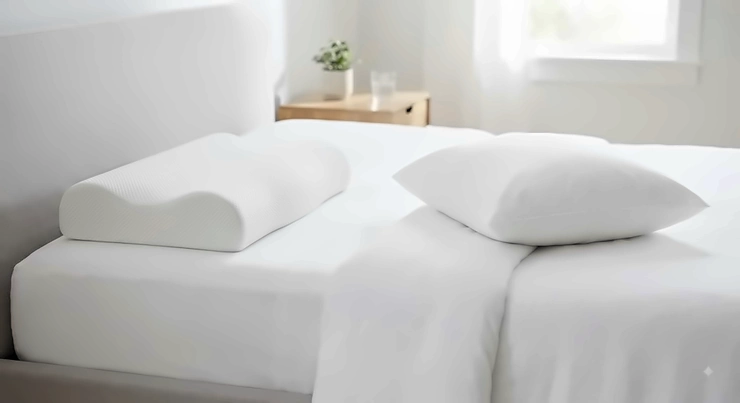
So what’s the actual difference? A contour pillow uses a molded or curved shape — usually a raised ridge and a dipped center — to cradle the neck and hold the head at a consistent height, while a regular pillow is a uniform, flat rectangle that relies entirely on loose fill (down, fiber, or shredded foam) to create support, which means it compresses unevenly and needs constant fluffing to hold its shape.
That distinction matters more for side sleepers than for any other position, because roughly 70% of adults favor sleeping on their side, and the gap between the ear and the mattress is the single biggest factor in whether you wake up refreshed or reaching for the heating pad. A randomized clinical trial comparing pillow shapes in side-lying sleepers found that pillow type genuinely does change how the neck and upper spine sit through the night — which is exactly why we’re not treating this as a coin flip.
We also dug into two specific angles that general “best pillow” roundups tend to skip: what actually works if you’re a petite side sleeper swimming in a pillow built for a linebacker, and how memory foam density quietly determines whether that contour pillow will still hold its shape in two years or turn into a pancake by month six. Below, you’ll get real product picks across every budget, a side-by-side comparison, and the honest reasoning behind each recommendation.
Quick Comparison: Contour Pillow vs Regular Pillow for Side Sleepers
Before we get into individual products, here’s the general shape of the contour pillow vs regular pillow for side sleepers debate, attribute by attribute.
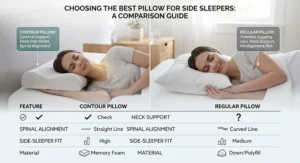
| Attribute | Contour Pillow | Regular Pillow | Best For |
|---|---|---|---|
| Neck support consistency | High — molded curve holds shape all night | Variable — depends on fill and how it’s fluffed | Side sleepers with neck pain → Contour |
| Shoulder pressure | Often built with a cutout or dip | None — flat surface only | Broad shoulders → Contour |
| Adjustability | Moderate (some have removable inserts) | High if shredded fill, low if solid fill | Petite frames → Adjustable regular or contour |
| Break-in period | 1–2 weeks for solid foam | Minimal, usually immediate | Impatient sleepers → Regular |
| Airflow / cooling | Can trap heat unless ventilated or gel-infused | Generally breathes better (down, down alternative) | Hot sleepers → Regular or cooling contour |
| Typical price range | $25–$130 | $15–$100 | Budget shoppers → Regular |
| Longevity | 2–3 years with high-density foam | 1–2 years before fill flattens | Long-term investment → Contour |
Reading across that table, the honest takeaway is that neither shape wins outright — a molded contour pillow generally wins on consistent support and durability, while a well-made regular pillow wins on breathability and immediate comfort with zero adjustment period. Where you land depends heavily on your body size and whether neck pain is already part of the equation; a 200-pound side sleeper with broad shoulders needs different loft math than someone under 5’4″ and 115 pounds. We’ll unpack that petite-specific math in detail further down.
💬 Already leaning toward one type? Scroll down to the product picks below and compare real specs side by side.
Top 7 Pillows for Side Sleepers: Expert Analysis
We researched real, currently available products across budget, mid-range, and premium tiers — mixing contour and regular designs so you can compare both approaches directly, plus a couple of specialty picks that solve the petite-frame problem specifically.
1. Coop Home Goods The Original Adjustable Pillow — most adjustable loft for any body type
The headline feature here is the zippered opening that lets you physically remove or add fill, which sidesteps the biggest complaint about both contour and regular pillows: you’re locked into one loft. Inside is a blend of shredded, gel-infused CertiPUR-US certified memory foam and microfiber, so it behaves like a regular pillow (soft, breathable, no break-in) while letting you dial in contour-like support by scooping foam out until the loft matches your shoulder width. Because you’re setting the height yourself, this is one of the rare picks that genuinely works for both a broad-shouldered stomach-turned-side sleeper and someone considerably smaller — you just remove more fill.
Based on the spec comparison against fixed-shape contour pillows, the tradeoff is that you lose the built-in ridge-and-dip geometry, so it won’t cradle the neck curve as precisely as a molded foam contour pillow will. Reviewers consistently report that the adjustability solves overheating complaints common to solid memory foam, and that the fill settles within the first week without a rigid break-in period. It’s a strong pick for anyone who’s tried both a flat regular pillow and a rigid contour pillow and disliked both extremes.
Pros:
- ✅ Fully adjustable loft fits almost any body size
- ✅ Shredded foam sleeps cooler than solid memory foam
- ✅ CertiPUR-US certified, machine-washable cover
Cons:
- ❌ Less precise neck cradling than a molded contour shape
- ❌ Removing fill can feel fussy for first-time buyers
Expect to pay in the $60–$75 range depending on size, which puts it firmly in the mid-tier — a fair value verdict given that you’re essentially buying two pillows’ worth of adjustability in one.

2. EPABO Contour Memory Foam Pillow — budget-friendly butterfly contour
This is the pillow most people picture when they hear “contour pillow”: a butterfly-shaped block of solid memory foam with a dipped center and two raised wings, plus a lower and higher lobe so you can flip it depending on preferred loft. The bamboo-polyester cover adds a bit of stretch and breathability that older-generation contour foam pillows lacked. What most buyers overlook about this shape is that the removable foam inserts inside let you shave down the loft slightly, which partially answers the “too tall” complaint that plagues cheaper solid-foam contour pillows.
For side sleepers specifically, the higher lobe fills the ear-to-shoulder gap reasonably well for average and larger frames, while the lower lobe suits back sleepers or petite side sleepers who don’t need much lift. Reviewers consistently note a noticeable “new foam” smell for the first few days that fades with airing out, and a firmer, less plush feel than shredded-fill alternatives — which some side sleepers with sensitive shoulders find too rigid initially.
Pros:
- ✅ Genuinely low price for a true contour shape
- ✅ Dual-height design offers some flexibility
- ✅ Bamboo cover is machine washable and breathable
Cons:
- ❌ Solid foam needs a multi-night break-in period
- ❌ Firmer feel may be too rigid for petite frames
Priced typically under $35, this is the easiest entry point if you want to try a contour shape without committing to a premium price tag — the value verdict is straightforward: hard to beat for a first contour pillow experiment.
3. Beckham Hotel Collection Gel Pillow (2-Pack, Queen) — best classic regular pillow, hotel-soft
On the “regular pillow” side of this comparison, this is the closest thing to a category benchmark — a plush, down-alternative gel-fiber fill wrapped in a soft cotton-blend shell, sold in pairs so you can stack two for extra loft. There’s no molded shape here at all; the appeal is the hotel-mattress-adjacent softness that a lot of side sleepers actually prefer over rigid foam, especially if they also switch to their back or stomach during the night, since a flat pillow doesn’t fight you when you roll over.
Here’s what the spec sheet won’t tell you, but reviewers note repeatedly: stacking two of these is a popular workaround for the “ear to shoulder gap” problem that regular pillows usually struggle with, and it works reasonably well for medium to larger frames, though it sacrifices the single, consistent loft that a contour pillow delivers automatically. Aggregated review sentiment describes the fill as soft without going flat immediately, though like most down-alternative pillows, some loft loss over months of nightly compression is normal and expected.
Pros:
- ✅ Extremely soft, no break-in period needed
- ✅ Machine washable and dryer safe
- ✅ Two-pack lets you customize loft by stacking
Cons:
- ❌ No built-in neck support — relies on fill volume
- ❌ Down-alternative fill flattens faster than foam over time
At roughly $30–$40 for the pair, this is the most affordable way to test whether the regular-pillow approach actually suits your sleep style before investing in a pricier contour design.
4. UTTU Ergonomic Cervical Contour Pillow — coolest sleep for hot sleepers
This is a hollow-center contour design — picture a concave dip in the middle surrounded by two raised, curved lobes — paired with an Arc-Chill cooling cover that’s noticeably cooler to the touch than a standard foam cover. The hollow core reduces the amount of foam pressing directly against the back of the head, which is a clever workaround for the “memory foam runs hot” complaint that dogs a lot of solid-block contour pillows.
Based on the spec comparison with denser, fully solid contour models, this pillow trades a bit of firmness for that airflow advantage — the cervical curve still supports the neck, but the center dip means less direct head-in-foam contact than the EPABO-style butterfly shape. What most buyers overlook is that the two lobes differ slightly in height, so — similar to the EPABO — you can flip it for a lower or higher loft depending on shoulder width, which helps it stretch across more body types than a single-height contour pillow would.
Pros:
- ✅ Noticeably cooler than solid-foam contour pillows
- ✅ Two loft heights built into one pillow
- ✅ Firm enough to hold cervical curve all night
Cons:
- ❌ Hollow-core shape feels unfamiliar at first
- ❌ Firmness may feel too structured for plush-pillow fans
Sitting in the $35–$45 range, it’s a smart mid-tier pick specifically for side sleepers who run hot — a common enough problem that it’s worth paying a small premium over the EPABO to solve it.
5. Eli & Elm Cotton Side-Sleeper Pillow — built-in shoulder cutout for true side sleepers
Unlike the butterfly or hollow-core contour shapes above, this pillow uses a distinct U-shaped cutout at the bottom edge specifically so your shoulder has somewhere to go, rather than pushing against the pillow’s edge. The fill is a proprietary blend of crosscut memory foam and down-alternative clusters inside an organic cotton cover, and — like the Coop pick — it’s fully adjustable, so you add or remove fill through a zippered opening to fine-tune both firmness and loft.
Here’s the honest analytical read: this is arguably the most purpose-built option on this list for the exact keyword we’re answering — it’s not a generic contour shape adapted for side sleeping, it’s engineered around the specific mechanics of lying on your shoulder. Reviewers consistently mention that dialing in the right fill volume takes a few nights of trial and error, which is the tradeoff for that level of customization. It’s also one of the few picks equally well-suited to petite side sleepers (remove fill) and larger frames (leave it fully stuffed).
Pros:
- ✅ Shoulder cutout genuinely reduces pressure points
- ✅ Fully adjustable for petite to large frames
- ✅ Organic cotton cover, machine washable
Cons:
- ❌ Fine-tuning fill volume takes several nights
- ❌ Pricier than basic contour options
Expect to pay in the $70–$90 range, and given how directly it targets the side-sleeping mechanics this whole article is about, the value verdict leans strongly positive for anyone who’s ruled out generic shapes already.

6. Royal Therapy Memory Foam Contour Pillow — plushest cradle for sensitive necks
Where the EPABO and UTTU lean firm and structured, this pillow takes the opposite approach: ventilated CertiPUR-US certified foam that’s noticeably softer and more forgiving, wrapped in a bamboo-derived cover that regulates temperature reasonably well for a solid-foam design. It includes a removable inner layer, so — like most pillows on this list — you get some loft adjustment, though less range than the fully shreddable options.
What the spec sheet won’t tell you, but user reports suggest, is that this softness is a double-edged sword: side sleepers who found rigid contour pillows created new pressure points along the jaw or cheekbone tend to prefer this gentler cradle, but side sleepers who need firm, unwavering support to keep the head from sinking may find it lacks the lift a firmer contour design provides. It’s a genuinely different feel from the other contour picks here, not just a repackaged version of them.
Pros:
- ✅ Softer, more forgiving contour than rigid foam blocks
- ✅ Ventilated design sleeps cooler than dense foam
- ✅ Removable layer allows modest height adjustment
Cons:
- ❌ Less firm support than structured contour designs
- ❌ Priced above comparable budget contour pillows
Typically priced in the $40–$55 range, it sits in the middle of the pack — worth the upcharge over the EPABO specifically if plush comfort matters more to you than rigid structure.
7. Saatva Latex Pillow — premium latex durability that won’t go flat
The premium pick on this list swaps memory foam entirely for shredded Talalay latex blended with down alternative, inside an adjustable shell. Latex behaves differently than foam — it’s more responsive (it springs back faster instead of slowly reshaping), stays naturally cooler, and historically holds its shape for years longer than standard memory foam, which matters if you’re tired of replacing a flattened pillow every twelve months.
Based on the spec comparison against foam-based contour pillows, this is closer to a “smart regular pillow” than a true contour shape — it doesn’t have a molded ridge-and-dip geometry, but the adjustable shredded fill lets you build your own contour-like support by shaping the latex around your neck. Reviewers consistently describe a medium-soft feel with strong shoulder and neck support, and one recurring caution: the latex interior should never be machine washed or left damp, since moisture degrades natural latex over time.
Pros:
- ✅ Latex resists flattening far longer than foam
- ✅ Naturally cooler and more responsive feel
- ✅ Adjustable fill mimics a custom contour
Cons:
- ❌ Highest price point on this list
- ❌ Latex core can’t be laundered like foam or fiber
Pricing lands in the $100–$130 range, which is a real investment, but the value verdict holds up if you calculate cost-per-year rather than upfront cost — latex’s longevity often closes the price gap with cheaper pillows you’d replace twice as often.
Top 7 Products: Side-by-Side Comparison
| Product | Type | Price Range | Best For |
|---|---|---|---|
| Coop Home Goods The Original Adjustable Pillow | Adjustable / hybrid | $60–$75 | Any body type wanting full control |
| EPABO Contour Memory Foam Pillow | Contour (solid foam) | Under $35 | First-time contour buyers on a budget |
| Beckham Hotel Collection Gel Pillow | Regular | $30–$40 (2-pack) | Fans of soft, flat, familiar pillows |
| UTTU Ergonomic Cervical Contour Pillow | Contour (hollow-core) | $35–$45 | Hot sleepers who need cooling |
| Eli & Elm Cotton Side-Sleeper Pillow | Contour (cutout, adjustable) | $70–$90 | Purpose-built side-sleeper support |
| Royal Therapy Memory Foam Contour Pillow | Contour (plush foam) | $40–$55 | Sensitive necks needing a gentler cradle |
| Saatva Latex Pillow | Adjustable / latex | $100–$130 | Long-term durability, premium buyers |
Scanning this table, the pattern is clear: the more adjustable a pillow is — Coop Home Goods, Eli & Elm, and Saatva — the more it can flex between petite and larger frames, while the fixed-shape contour pillows like EPABO and UTTU are better suited to a specific loft preference you already know you like. If you’re still uncertain which category fits your body, the Coop Home Goods The Original Adjustable Pillow is the safest starting point precisely because you can’t get the loft “wrong.”
✨ Don’t Miss These Exclusive Deals!
🔍 Take your side-sleeping comfort to the next level with these carefully selected picks above. Click on any highlighted product to check current pricing and availability before you buy. The right pillow tonight means a pain-free morning tomorrow!
Your First 30 Nights With a New Side-Sleeper Pillow: Practical Usage Guide
New pillow, new problems — at least for the first week or two. Solid memory foam pillows like the EPABO Contour Memory Foam Pillow and UTTU Ergonomic Cervical Contour Pillow ship compressed in plastic, and they need 24–48 hours out of the packaging to fully expand before you judge the loft. Air them out in a ventilated room during that window; the “new foam” smell some reviewers mention fades faster with airflow than by ignoring it under a pillowcase.
For adjustable models like the Coop Home Goods The Original Adjustable Pillow or Eli & Elm Cotton Side-Sleeper Pillow, resist the urge to remove fill on night one. Sleep on it as-shipped for three to four nights first, since fill often settles and compresses slightly with regular use — pulling foam out too early can leave you under-filled once it settles further. If your neck still feels tilted upward after that adjustment window, remove fill in small handfuls rather than large scoops.
Maintenance-wise, most memory foam and latex cores can’t go in the washer — only the removable cover can. Wash covers every one to two weeks, and spot-clean the foam core with a light detergent solution if needed, letting it air-dry completely before reassembling. For fiber-fill regular pillows like the Beckham Hotel Collection Gel Pillow, a full pillow (not just the cover) is typically machine washable — check the care tag, but plan on drying with a couple of tennis balls or dryer balls to redistribute clumped fill. The single most common first-30-days mistake is judging a contour pillow’s support after one night; give any new pillow at least a week before deciding it’s wrong for you.
Common Side-Sleeping Pain Points, Solved
Problem: waking up with a numb or tingling arm. This usually means the pillow isn’t tall enough to keep your top shoulder from rolling forward and compressing the arm underneath. A shoulder-cutout design like the Eli & Elm Cotton Side-Sleeper Pillow directly addresses this by giving the shoulder somewhere to sit instead of pushing against it.
Problem: neck pain that’s worse in the morning than before bed. This is a loft mismatch — the pillow is either too high (tilting the head upward) or too low (letting it drop toward the mattress). An adjustable option like the Coop Home Goods The Original Adjustable Pillow or Saatva Latex Pillow lets you correct this without buying an entirely new pillow.
Problem: overheating and waking up to flip the pillow. Solid memory foam traps body heat more than ventilated or hollow designs. Swapping to the UTTU Ergonomic Cervical Contour Pillow‘s hollow-core cooling design, or a naturally breathable option like the Saatva Latex Pillow, tends to resolve this without sacrificing support.
Problem: the pillow feels great at first, then goes flat within months. Cheap, low-density fiber fill compresses permanently faster than higher-density foam or latex. This is where the Beckham Hotel Collection Gel Pillow trades some longevity for comfort — fine if you don’t mind replacing pillows more often, but the Saatva Latex Pillow solves this specifically through material choice.
Problem: the pillow is comfortable but too large for a smaller frame. Standard contour pillows are often designed around average-to-larger shoulder widths. This is exactly the scenario the petite-sleeper section below addresses in more depth.
Contour Pillow vs Regular Pillow: The Real Difference
Beyond the surface-level “one has a shape, one doesn’t,” the functional difference comes down to how each design handles the gap between your ear and your mattress. A contour pillow is engineered with a fixed ridge height, so the support doesn’t shift as you move through the night — it’s the same loft at 11 p.m. as it is at 4 a.m. A regular pillow’s support depends entirely on how the loose fill happens to be distributed at any given moment, which is why you might wake up mid-night to re-fluff it.
That consistency is exactly why a randomized trial found measurable differences in how the cervico-thoracic spine settled depending on pillow shape and content — the geometry genuinely changes what your neck does while you sleep, it’s not purely subjective comfort. That said, it’s worth being honest that the broader research picture is mixed: a separate meta-analysis found pillow design alone didn’t reliably improve overall sleep quality or spinal alignment scores across all neck-pain patients, even though certain pillow types measurably reduced pain and disability. Foam quality plays into this too — look for pillows carrying CertiPUR-US certification as a baseline signal of foam content and durability standards.
| Factor | Contour Pillow | Regular Pillow |
|---|---|---|
| Consistency through the night | High (fixed shape) | Lower (fill shifts) |
| Best for existing neck pain | Often yes | Sometimes, if adjustable |
| Learning curve | 1–2 weeks | Minimal |
| Versatility across sleep positions | Lower — built for one position | Higher — works for back/stomach too |
The analysis here suggests a simple rule of thumb: if you switch positions frequently through the night, a regular or adjustable pillow like the Beckham Hotel Collection Gel Pillow or Coop Home Goods The Original Adjustable Pillow flexes with you, while committed side sleepers dealing with recurring neck stiffness are usually better served by a true contour shape like the Eli & Elm Cotton Side-Sleeper Pillow.
How to Choose a Pillow for Side Sleeping
Here’s a practical, numbered framework for narrowing the field, whether you’re leaning contour or regular.
- Measure your shoulder-to-neck distance roughly. Broader shoulders generally need a higher loft (5–7 inches); narrower frames need less — this single measurement eliminates more bad options than any spec sheet will.
- Decide firm vs plush based on existing pain. If you already deal with neck stiffness, medium-firm support (like the UTTU Ergonomic Cervical Contour Pillow) tends to outperform ultra-soft fill.
- Prioritize adjustability if you’re unsure. An adjustable pillow like the Coop Home Goods The Original Adjustable Pillow removes the guesswork of buying blind.
- Factor in temperature sensitivity. Hot sleepers should lean toward ventilated foam, hollow-core designs, or latex over dense solid foam.
- Set a realistic budget band. Under $40 gets you a solid entry-level contour or regular pillow; $70+ buys purpose-built or premium materials with better longevity.
- Check the care instructions before buying. If easy washing matters to you, a fiber-fill regular pillow beats a latex or solid-foam core.
- Give any new pillow a two-week trial before judging it. Break-in periods are real, and snap judgments on night one are the most common reason people return a genuinely good pillow.
Common Mistakes When Buying a Contour Pillow
The most frequent mistake is buying based on a photo instead of a loft measurement — a butterfly-shaped contour pillow that looks similar to another can differ by an inch or more in actual height, which is the difference between neutral spine alignment and a tilted neck. A close second is ignoring firmness ratings entirely; buyers often assume “memory foam” means one universal feel, when in reality density and firmness vary enormously between models, which is exactly why the density section below matters.
Another common misstep is expecting a contour pillow to feel perfect on night one. Solid foam needs time to soften and for your body to adjust to the more structured support, and a lot of returns happen in that first uncomfortable week that would have resolved with patience. Finally, buyers frequently skip checking whether inserts or fill are removable — a pillow that seems too tall out of the box is often adjustable, but only if you read the product details closely enough to notice.
What to Expect: Real-World Performance for Side Sleepers
On paper, loft numbers and firmness ratings are useful, but they don’t tell you what the first week actually feels like. Expect the first few nights on any new contour pillow to feel noticeably more structured than whatever flat pillow you’re replacing — that’s not a defect, it’s the support doing its job. By night five to seven, most sleepers stop consciously noticing the shape and simply notice they’re waking up without the usual shoulder ache.
Regular pillows perform differently: comfort is immediate, but you’ll likely find yourself re-positioning or re-fluffing more often through the night, especially with lower-density fiber fill like a basic version of the Beckham Hotel Collection Gel Pillow. Adjustable hybrids such as the Eli & Elm Cotton Side-Sleeper Pillow sit in between — expect a short tuning period where you’re removing or repositioning fill, followed by a more stable, personalized feel than either fixed option once dialed in.
Pillow for Petite Side Sleepers: What Actually Works
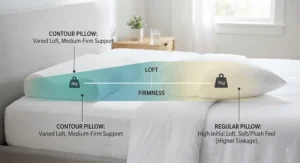
This is the secondary keyword most generic pillow guides skip entirely, and it deserves real attention. Standard contour and even standard “medium loft” regular pillows are frequently designed around average-to-larger shoulder widths, which means a smaller-framed side sleeper ends up with their head tilted upward all night — the exact opposite of the spinal alignment a pillow is supposed to provide. The practical fix isn’t necessarily a “smaller” pillow so much as a lower-loft or adjustable one that won’t overshoot a narrower shoulder gap.
Among the picks above, three stand out specifically for petite frames. The EPABO Contour Memory Foam Pillow‘s lower lobe offers a genuinely reduced loft option without buying a separate product. The Coop Home Goods The Original Adjustable Pillow and Eli & Elm Cotton Side-Sleeper Pillow both solve the problem more directly — since you’re physically removing fill, you can dial the loft down until it matches a smaller shoulder-to-neck gap precisely, rather than hoping a fixed shape happens to fit. Reviewers with smaller frames consistently report that fixed-height contour pillows without any adjustability are the single most common return reason, which reinforces why adjustability, not just size, is the real solution here.
A quick gut-check: if you’re under roughly 5’4″ or have narrower shoulders, start with fill removed rather than added, and only add it back if you notice your head dropping below spine level. That’s a cheaper, faster fix than cycling through multiple fixed-shape pillows hoping one happens to match your frame.
Memory Foam Density Explained
Density and firmness get confused constantly, and it’s worth untangling because it directly affects which contour pillow will actually last. Density, measured in pounds per cubic foot (PCF), describes how much material is packed into the foam — foam density and firmness are technically independent measurements, meaning a high-density foam isn’t automatically firm, and a low-density foam isn’t automatically soft. Firmness is a separate spec, called Indentation Load Deflection (ILD), which measures how much force it takes to compress the foam by 25% of its thickness.
For pillows specifically, higher-density foam (generally above 4 PCF) tends to hold its shape longer and resist permanent compression, which is why premium contour pillows and the shredded latex in the Saatva Latex Pillow cost more but sag less over time. Lower-density foam, common in budget contour pillows, is more prone to flattening within a year or two of nightly use, even if it feels perfectly firm the day you buy it. When shopping, look specifically for CertiPUR-US certification — it doesn’t guarantee a specific density number, but it does confirm the foam meets baseline standards for content, emissions, and durability testing, which at minimum rules out the lowest-quality foam on the market.
Practically speaking, this is why the Royal Therapy Memory Foam Contour Pillow‘s ventilated, certified foam and the Saatva Latex Pillow‘s latex core both outperform ultra-cheap uncertified contour pillows on longevity, even at similar firmness levels — the material quality behind the number matters as much as the number itself.
Long-Term Cost & Maintenance
It’s tempting to compare pillows purely on sticker price, but total cost of ownership tells a more useful story. A $30 Beckham Hotel Collection Gel Pillow that needs replacing every 12–18 months as the fiber fill compresses works out to roughly $20–$30 per year of use. A $110 Saatva Latex Pillow that holds its shape for four-plus years due to latex’s natural resilience works out closer to $25–$30 per year too — meaning the “expensive” option isn’t actually more costly once you account for replacement frequency, it’s simply a bigger upfront payment for the same annual cost.
Mid-range contour pillows like the UTTU Ergonomic Cervical Contour Pillow or Royal Therapy Memory Foam Contour Pillow, priced around $35–$55 with an expected two-to-three-year lifespan under normal use, land in a similar per-year range. The maintenance side matters too: covers should be washed every one to two weeks regardless of pillow type, and any pillow — foam, latex, or fiber — should be replaced once it no longer springs back to roughly its original shape within a few seconds of removing pressure, since that loss of “memory” is a reliable signal that support has degraded below a level that still helps your spine.

Frequently Asked Questions
❓ Is a contour pillow or a regular pillow better for side sleepers?
❓ How long does it take to get used to a contour pillow?
❓ What loft height is best for a petite side sleeper?
❓ Does memory foam density affect how long a pillow lasts?
❓ Can a regular pillow cause neck pain for side sleepers?
Conclusion
There’s no single universal winner in the contour pillow vs regular pillow for side sleepers debate — the honest answer depends on your shoulder width, whether you already deal with neck pain, and how much you value consistency over immediate softness. If you want the shape doing the support work for you, the Eli & Elm Cotton Side-Sleeper Pillow and UTTU Ergonomic Cervical Contour Pillow are purpose-built for exactly that. If you’d rather ease in gently or split the difference, the Coop Home Goods The Original Adjustable Pillow and Saatva Latex Pillow let you shape your own support without committing to a rigid mold, and remain some of the smartest picks for petite frames specifically because they adjust to you instead of the other way around.
Budget shouldn’t be the deciding factor either — the EPABO Contour Memory Foam Pillow and Beckham Hotel Collection Gel Pillow both prove you don’t need to spend $100+ to test whether contour or regular support suits your body better. Whichever direction you lean, give it the full two-week adjustment window before judging it, check that the density and firmness actually match your frame, and remember that the “best” pillow is the one your specific neck stops complaining about — not the one with the most five-star reviews from people built differently than you.
✨ Ready to Fix Your Mornings?
🔍 Your neck has put up with enough. Pick the pillow above that matches your frame and sleep style, check current pricing, and give it the two-week trial it deserves — future-you will thank you at 6 a.m.
Recommended for You
- 7 Best Pillows for Side Sleepers With Shoulder Pain (2026)
- 7 Best Cooling Pillow Picks for Hot Sleepers in 2026
- Gel Memory Foam Pillow: 7 Best Picks That Really Cool You (2026)
Disclaimer: This article contains affiliate links. As an Amazon Associate, I earn from qualifying purchases. If you purchase products through these links, we may earn a small commission at no additional cost to you.
✨ Found this helpful? Share it with your friends! 💬🤗
