
In This Article
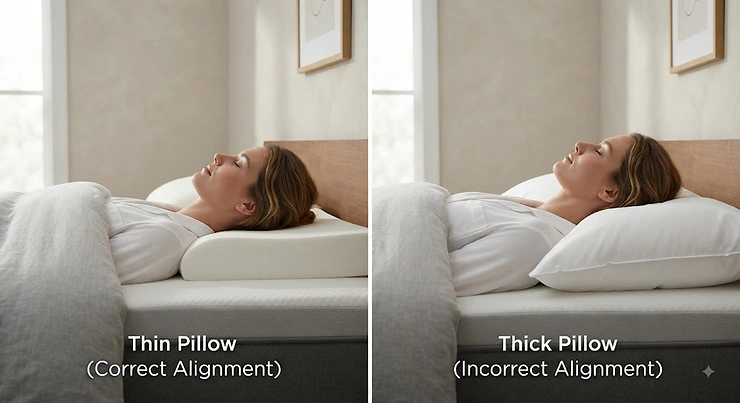
Somewhere around 2 a.m., a lot of back sleepers wake up, punch their pillow into a new shape, flip it over to the “cool side,” and drift back off — only to repeat the whole ritual an hour later. If that’s you, the problem probably isn’t your mattress. It’s the thin pillow vs thick pillow for back sleepers debate playing out under your head every single night, and most people have never actually resolved it. A pillow that’s too thick tips your chin toward your chest. One that’s too thin lets your head tip backward. Either way, your neck spends eight hours in a position it was never built to hold.

Here’s the short version: thickness, or what the bedding industry calls pillow loft, determines whether your cervical spine stays level with your mattress or gets pulled out of its natural curve. Get it right, and you stop waking up with that dull ache between your shoulder blades. Get it wrong, and no amount of fancy fabric or “cooling gel” marketing is going to fix it.
This guide breaks down exactly how thin and thick pillows behave differently for back sleepers, walks through seven real, currently available options across every price tier, and gives you a framework for choosing based on your body, not a stranger’s five-star review.
Quick Comparison Table
| Pillow Type | Typical Loft | Best For | Watch Out For |
|---|---|---|---|
| Thin/Low-Loft Foam | 3-4 inches | Petite frames, flat sleepers, neck pain | Can feel unsupportive to broader shoulders |
| Medium/Adjustable | 4-6 inches (customizable) | Most back sleepers, combo sleepers | Requires initial trial-and-error fluffing |
| Thick/High-Loft | 6-8+ inches | Broad-shouldered or larger-framed sleepers | Can push chin down, straining the neck |
A quick glance at that table tells you most of what marketing copy tries to obscure: there is no universally “best” loft, only a loft that matches your frame and mattress firmness. Someone with narrow shoulders sleeping on a plush mattress needs far less pillow than someone with broad shoulders on a firm one, because the mattress itself is already doing some of the cushioning work. Loft also isn’t fixed — several of the picks below let you add or remove fill so the same pillow can serve a 5’2″ side-sleeping partner and a 6’2″ back sleeper in the same bed.
💬 Found a match already? Skip ahead and see the full breakdown below!
Top 7 Pillows for Back Sleepers: Expert Analysis
1. Beckham Hotel Collection Original Down Alternative Pillow (2-Pack) — thickest budget pick for back-and-side combo sleepers
The Beckham Hotel Collection pillow built its reputation on hotel-style plushness at a price that makes replacing pillows every couple of years painless. Each pillow packs roughly 1,050 grams of hollow-fiber down alternative into a 250-thread-count cotton shell, producing a loft that lands close to 8 inches uncompressed — solidly in “thick pillow” territory. That much fill means back sleepers with broader shoulders or a firmer mattress get real lift under the neck rather than sinking flat. Reviewers consistently note that the plushness is immediately noticeable out of the bag, with the OEKO-TEX-certified cotton cover feeling closer to a boutique hotel pillow than a typical big-box option. What the spec sheet won’t tell you, but aggregated reviews do, is that this generous loft comes at a durability cost: independent testers found the polyester fill compresses noticeably within four to six months of nightly use, especially for sleepers over roughly 200 pounds, which gradually erodes the neck support that made it appealing in the first place. For anyone using it as a guest-room pillow or a budget refresh rather than a decade-long investment, that trade-off is easy to accept.
Pros:
- ✅ Generous 8-inch loft suits broader-shouldered back sleepers
- ✅ OEKO-TEX certified, hypoallergenic, fully machine washable
- ✅ Sold as a 2-pack, so cost per pillow stays low
Cons:
- ❌ Fill compresses noticeably within 4-6 months of regular use
- ❌ No adjustability if the stock loft doesn’t fit your frame
At around $55-$65 for the queen 2-pack, the Beckham Hotel Collection pillow delivers strong short-term value for anyone testing whether a thicker profile helps their back-sleeping alignment before committing to a pricier, longer-lasting pick.

2. Utopia Bedding Cooling Adjustable Shredded Memory Foam Pillow — adjustable cooling loft under $40
If the idea of a fixed loft makes you nervous, the Utopia Bedding cooling pillow solves that with a zippered access panel and an extra half-pound bag of shredded memory foam included in the box. That single feature means this pillow can function as a thin pillow or a thick pillow depending on how much fill you leave inside, which is unusually flexible for something priced well under $40. The shredded (rather than solid) foam structure lets air move between the individual foam pieces, which is genuinely different from a slab of dense memory foam and does measurably improve breathability, even if “cooling” claims on inexpensive pillows are often overstated. Consumer Reports’ lab testing of Utopia’s pillow lineup has scored similar models reasonably well on back-support and resilience metrics relative to their price point, which is a meaningful data point in a category flooded with unverifiable marketing claims. Reviewers commonly describe the initial feel as springy rather than plush, and note that the shredded fill needs occasional redistribution to avoid lumping in the corners — a minor chore compared to the flattening problem cheaper solid-fill pillows face.
Pros:
- ✅ Fully adjustable loft via zippered fill access
- ✅ Shredded structure genuinely improves airflow vs. solid foam
- ✅ Machine-washable cover at a genuinely low price point
Cons:
- ❌ Shredded fill needs occasional fluffing to avoid clumping
- ❌ Cover materials feel noticeably less premium than pricier picks
Priced in the $25-$40 range, the Utopia Bedding pillow is the easiest low-risk way to experiment with loft adjustment before spending real money on a premium adjustable pillow.
3. Coop Home Goods Original Adjustable Pillow — best adjustable loft for dialing in exact thinness
The Coop Home Goods Original has built a loyal following largely because it treats “loft” as a spectrum rather than a fixed spec. Cross-cut memory foam blended with microfiber fills a zippered shell, and every pillow ships with an extra half-pound bag of fill so you can go thicker if needed or pull fill out to flatten it for a genuinely thin back-sleeping profile. That range matters enormously for the thin pillow vs thick pillow question, because it means one pillow can be re-tuned as your mattress ages, your weight changes, or you simply get it wrong the first time. Both CertiPUR-US and GREENGUARD Gold certifications back up the material safety claims, which carries real weight for sleepers concerned about off-gassing in memory foam products. Aggregated review sentiment across major mattress-review outlets consistently ranks the Original among the top-scoring adjustable pillows for back support and resilience, and it has reportedly performed well in independent lab-style testing focused specifically on those two categories. The trade-off with any shredded-fill pillow applies here too: expect to refluff every few days to keep the loft even across the surface.
Pros:
- ✅ Genuinely adjustable loft — add or remove fill anytime
- ✅ CertiPUR-US and GREENGUARD Gold certified materials
- ✅ Strong aggregated review scores for back-sleeper support
Cons:
- ❌ Requires periodic refluffing to prevent uneven lumps
- ❌ Some buyers report a mild off-gassing smell at first unboxing
At around $70-$90 for a queen, the Coop Home Goods Original earns its reputation as the safest “can’t go too far wrong” middle-ground pick for back sleepers still dialing in their ideal thickness.
4. TEMPUR-Cloud Pillow by Tempur-Pedic — thinnest solid-foam profile for true back sleepers
Where most pillows on this list lean thick or adjustable, the TEMPUR-Cloud goes the opposite direction on purpose. It’s a solid block of Tempur-Pedic’s proprietary pressure-relieving foam with a fixed, low loft — roughly in the 3-to-4-inch range — specifically engineered around back and stomach sleepers who need their head to sit close to mattress level rather than propped up. Reviewers across multiple outlets are remarkably consistent on this point: the low profile keeps the cervical spine level for back sleeping, but the same trait makes it a poor fit for side sleepers, who need far more loft to fill the gap between ear and shoulder. What most buyers overlook is that “solid foam” also means “not adjustable” — unlike the Coop or Utopia picks, you cannot add or remove material if the stock loft feels slightly off for your frame, so trying before buying (or checking a generous return window) matters more here than with adjustable alternatives. Aggregated reviews are similarly consistent on heat: the dense memory foam construction retains warmth, and Tempur-Pedic sells a separate cooling-cover upgrade specifically because so many owners flagged that as their main complaint.
Pros:
- ✅ Low, fixed loft is purpose-built for back-sleeper spinal alignment
- ✅ Premium contouring foam with genuine pressure relief
- ✅ Backed by a 5-year manufacturer warranty
Cons:
- ❌ Fixed loft — no way to adjust thickness after purchase
- ❌ Retains heat unless you add the paid cooling-cover upgrade
Priced around $89 for a queen (roughly $109 for king, plus a $20 cooling add-on), the TEMPUR-Cloud is the clearest example on this list of a genuinely thin pillow engineered specifically for back sleepers rather than repurposed from a side-sleeper design.
5. Purple Harmony Pillow — best cooling grid with three loft heights
The Purple Harmony takes a different engineering approach entirely: instead of foam or down, it pairs a Talalay latex core with Purple’s GelFlex hex-grid layer, the same material used in the brand’s mattresses. It ships in three distinct loft heights — Low (5.5″), Medium (6.5″), and Tall (7.5″) — which lets back sleepers select their thickness at checkout rather than fighting with fill afterward; reviewers are explicit that back sleepers should choose the Low loft specifically, since the Medium and Tall versions run tall enough to crank the chin toward the chest. The open-grid structure is the standout feature here: because air moves freely through the hundreds of individual columns rather than getting trapped in solid foam, aggregated testing consistently reports minimal heat buildup even after a full night’s sleep, addressing the single biggest complaint about foam-based cooling pillow for back sleepers alternatives. The latex core also holds its shape for three to five years without the flattening that plagues cheaper down-alternative and polyester-fill pillows. The trade-offs are cost and weight — this is a genuinely heavy pillow, and at nearly triple the price of the Coop or Utopia picks, it’s an investment rather than an impulse buy.
Pros:
- ✅ Three loft heights let back sleepers select exact thickness
- ✅ GelFlex grid delivers genuinely minimal heat retention
- ✅ Latex core resists flattening for 3-5+ years of nightly use
Cons:
- ❌ Noticeably heavier than foam or down-alternative pillows
- ❌ Premium pricing puts it out of reach for budget shoppers
Running $179-$250 depending on size and loft, the Purple Harmony is the strongest pick here specifically for back sleepers who run hot and want precise control over thickness without sacrificing durability.
6. Saatva Latex Pillow — most durable adjustable latex pick
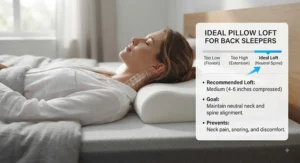
The Saatva Latex pillow uses a shredded Talalay latex core wrapped in a plush down-alternative microdenier layer, all inside an organic cotton cover — and critically, that latex core is removable, so back sleepers can pull it for a lower, softer profile or leave it in for the brand’s “Standard Loft” of roughly 4-5 inches. That standard loft height happens to sit in the sweet spot testers repeatedly flag as ideal for average-weight back sleepers, striking a “C-curve” that supports the neck without pushing the head too far forward. Latex is also naturally more breathable than memory foam, and Saatva shreds the core specifically to promote additional airflow, which aggregated reviewer sentiment credits for a consistently cool sleeping surface. One nuance worth knowing: brand-new latex has a faint rubber smell for the first several days that fades with airing out — reviewers note it clearly but don’t consider it a lasting issue. Compared to the Purple Harmony’s fixed-grid approach, the Saatva’s adjustability via the removable core gives back sleepers more room to fine-tune thickness after the fact, at a slightly lower starting price.
Pros:
- ✅ Removable latex core lets you adjust loft after purchase
- ✅ Naturally cooling, breathable latex construction
- ✅ Reported 3-5+ year lifespan without significant compression
Cons:
- ❌ Faint latex odor for the first several days out of the box
- ❌ Priced well above big-box down-alternative alternatives
At roughly $165 for a queen and $185 for a king, the Saatva Latex pillow is the pick for back sleepers who want the durability of latex with more built-in flexibility to adjust thickness than a fixed-loft model allows.
7. Brooklinen Down Pillow — plushest natural-down luxury option
Unlike the down alternative pillow for back sleepers options earlier in this list, the Brooklinen Down pillow uses actual down fill rather than polyester fiber, and it’s sold across three separate firmness levels so shoppers can match loft to their frame directly at purchase. The plush option in particular caters to back sleepers who want their head and neck to genuinely sink into the material rather than rest on top of it, while the firmer options provide more lift for broader-shouldered sleepers. A smooth cotton sateen shell with double-stitched, reinforced edges keeps the down from working its way out over time, and every pillow gets an antimicrobial treatment as a hedge against allergens and bacteria buildup. Because real down compresses and lofts differently than synthetic fiber or foam, it behaves less predictably under sustained pressure — reviewers note it needs more frequent fluffing than latex or memory foam to maintain even loft across a full night, though the trade-off is a softness that’s difficult to replicate with synthetic fill. One practical downside: Brooklinen specifically discourages machine washing since it can damage the down clusters, so care requires spot cleaning or occasional professional dry cleaning rather than a quick toss in the laundry.
Pros:
- ✅ Three firmness options let you match loft precisely to your frame
- ✅ Genuine down fill offers a softness synthetic fibers can’t fully match
- ✅ Reinforced double-stitched edges and antimicrobial treatment
Cons:
- ❌ Not machine washable — spot clean or dry clean only
- ❌ Needs more frequent fluffing than latex or foam alternatives
Pricing generally runs $95-$165 depending on firmness and size, positioning the Brooklinen Down pillow as the go-to for back sleepers who specifically want a natural-fill, sink-in feel rather than a foam or latex structure.
Top 7 Products: Full Comparison
| Product | Fill Type | Loft Style | Price Range | Best For |
|---|---|---|---|---|
| Beckham Hotel Collection | Down alternative | Fixed, thick (~8″) | $55-$65 (2-pack) | Broad-shouldered budget shoppers |
| Utopia Bedding | Shredded memory foam | Fully adjustable | $25-$40 | Budget-conscious experimenters |
| Coop Home Goods | Foam + microfiber blend | Fully adjustable | $70-$90 | Most back sleepers, undecided on loft |
| TEMPUR-Cloud | Solid memory foam | Fixed, thin (~3-4″) | $89-$109 | True low-loft back/stomach sleepers |
| Purple Harmony | Latex + GelFlex grid | 3 fixed heights | $179-$250 | Hot sleepers wanting precise loft |
| Saatva Latex | Shredded latex | Adjustable core | $165-$185 | Durability-focused, average-weight frames |
| Brooklinen Down | Natural down | 3 firmness options | $95-$165 | Sink-in softness, natural-fill preference |
Looking at the comparison above, the Utopia Bedding and Coop Home Goods pillows offer the most practical entry points for anyone still uncertain whether they need a thin or thick loft, since both let you physically test the difference on the same pillow. Sleepers who already know they need a fixed low profile can skip straight to the TEMPUR-Cloud, while those chasing both thickness control and cooling performance will get more mileage out of the Purple Harmony despite its higher price tag.
✨ Ready to try one? Check current pricing before stock or promotions shift.
Benefits vs. Traditional Flat Pillows
| Factor | Traditional Flat Pillow | Adjustable/Engineered Pillow |
|---|---|---|
| Loft Control | None — fixed at purchase | Add/remove fill or select loft height |
| Spinal Alignment | Often inconsistent | Purpose-engineered for back sleeping |
| Lifespan | Typically 1-2 years | Often 3-5+ years before replacement |
| Cooling | Rarely addressed | Shredded/grid designs improve airflow |
The gap here isn’t subtle: a traditional flat pillow off a big-box shelf was likely never engineered around any specific sleep position, which is exactly why so many back sleepers cycle through cheap pillows every year without solving their neck pain. Products like the Coop Home Goods or Purple Harmony picks exist specifically to close that gap by treating loft as an adjustable, position-specific variable rather than a one-size-fits-all guess. That said, traditional pillows still have a place — they’re cheap enough to replace often and work fine for occasional guest use where long-term spinal support isn’t the priority.
How to Test and Adjust Your Pillow Loft in the First 30 Nights
Buying the right pillow is only half the job — the first month determines whether it actually works for you. On night one, lie flat on your back in your normal position and have a partner (or your phone’s front camera on a tripod) check whether your chin points straight up or tilts toward your chest; either extreme signals the loft is wrong. For adjustable pillows like the Coop Home Goods or Utopia Bedding picks, remove roughly a handful of fill at a time rather than emptying half the bag — small adjustments are easier to walk back if you overcorrect. Expect a genuine settling-in period of five to seven nights before judging any new pillow fairly, since your neck muscles need time to release tension built up from your old setup. A common mistake in the first 30 days is switching pillows too quickly after one uncomfortable night; give the adjustment period a real chance before concluding the loft is wrong. Finally, refluff shredded-fill and down pillows every two to three days during this window, since fill naturally migrates toward the edges under nightly pressure and uneven distribution can mimic the symptoms of a poorly-fitted loft.
Which Back Sleeper Are You? Three Real-World Scenarios
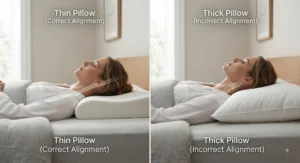
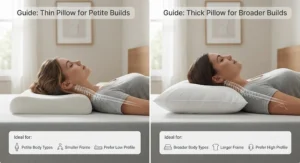
Not every back sleeper has the same body, mattress, or budget, so matching yourself to a scenario below is often faster than trial-and-error. A petite back sleeper on a plush memory-foam mattress — think five-foot-four, sinking noticeably into a soft surface — typically needs a genuinely thin pillow like the TEMPUR-Cloud, since a thick mattress already fills much of the gap between shoulders and head. A broader-shouldered sleeper on a firmer innerspring or hybrid mattress needs the opposite: more loft to fill the larger gap, making the thicker Beckham Hotel Collection or a Tall-loft Purple Harmony the more sensible starting point. Combination sleepers who shift between back and side through the night are the trickiest case, and they’re generally best served by an adjustable pick like Coop Home Goods or the Saatva Latex pillow, since neither position gets shortchanged when you can add or remove fill depending on how you actually settled that night. In all three cases, budget matters less than matching mattress firmness and body frame to loft — a $200 pillow with the wrong thickness still leaves you misaligned.
Buyer’s Decision Framework
If you’re still unsure which direction to go, a simple priority checklist beats guesswork:
- If you sleep on a soft or plush mattress, choose a thinner pillow (3-5″), because your body is already sinking closer to a neutral spinal alignment before the pillow is added.
- If you sleep on a firm mattress, choose a thicker pillow (6-8″), because a firm surface offers little give and your head needs more lift to stay level.
- If you’re unsure which category you fall into, choose an adjustable pillow like the Coop Home Goods or Saatva Latex picks, since you can dial in the exact loft over your first few weeks.
- If you wake up hot regardless of loft, prioritize a cooling-focused design like the Purple Harmony or Utopia Bedding, since fill material affects comfort as much as thickness does.
- If you’re shopping on a strict budget, start with the Beckham Hotel Collection or Utopia Bedding pick before investing in a premium option, so you can confirm your loft preference before spending more.
Thin Pillow vs Thick Pillow for Back Sleepers: The Core Trade-Off
At its core, the thin pillow vs thick pillow for back sleepers question comes down to one measurement: the distance between your mattress surface and the natural resting point of your head. A thin pillow, roughly 3 to 5 inches, keeps that gap small and works well when your mattress is already soft enough to cradle your shoulders, or when your frame is narrower and doesn’t need much lift. A thick pillow, generally 6 inches or more, fills a larger gap — appropriate for firmer mattresses or broader-shouldered sleepers whose shoulders sit higher relative to their head. Choosing wrong in either direction produces the same underlying problem: your cervical spine gets pulled out of its natural curve, and the muscles supporting it stay mildly contracted all night to compensate. According to Sleep Foundation’s guidance on sleep position and neck pain, maintaining proper head and neck alignment while lying on your back can help ease neck discomfort, and choosing a pillow that keeps the neck in line with the spine is central to making that happen. The honest answer, then, isn’t “thin is better” or “thick is better” — it’s that the correct loft is entirely relative to your mattress firmness and body frame, which is exactly why adjustable pillows solve more problems than fixed-loft ones for uncertain buyers.
How to Choose a Pillow Loft for Back Sleeping
Pillow loft — the height a pillow holds when uncompressed — is the single biggest factor in whether a pillow works for back sleeping, and choosing it methodically beats guessing from a product photo. Follow these steps:
- Measure your mattress firmness first. Soft and medium-soft mattresses need less pillow loft; firm and hybrid mattresses need more, since they offer less give under your shoulders.
- Note your frame size. Broader shoulders and a fuller build generally need more loft to keep the head level; narrower frames need less.
- Start adjustable if you’re unsure. An adjustable pillow removes the guesswork of committing to a fixed loft before you’ve tested it overnight.
- Check alignment with the mirror test. Lie flat on your back and confirm your chin isn’t tucked down or tilted up relative to your ceiling.
- Give it a full week before judging. Muscles need time to release old tension patterns, so a single uncomfortable night doesn’t necessarily mean the loft is wrong.
- Reassess after mattress changes. A new mattress changes how much you sink in, which can instantly make your old pillow’s loft wrong.
- Factor in fill type, not just height. Latex and solid foam hold their loft consistently; down and shredded fill compress and need periodic refluffing to maintain the same measured height.
Foam vs Down Fill: Which Material Actually Suits Back Sleepers
The foam vs down fill decision matters nearly as much as loft itself, because the two materials behave completely differently under nightly pressure. Foam — whether solid, like the TEMPUR-Cloud, or shredded, like the Coop Home Goods pick — holds a consistent shape and pushes back against the head with steady, predictable support, which tends to favor back sleepers who want their neck held in one stable position all night. Down, as in the Brooklinen Down pillow, compresses more readily and lets the head sink in gradually, producing a softer feel that some back sleepers prefer but that requires more frequent fluffing to avoid an uneven, lopsided loft by morning. Latex, used in the Saatva Latex and Purple Harmony picks, splits the difference — it offers foam-like consistency with more natural breathability than dense memory foam. Reviewers consistently note that hot sleepers gravitate toward latex or shredded foam over solid memory foam or dense down, simply because trapped heat is the most common complaint across all foam-based pillows. There’s no universally “correct” material here — the choice depends on whether you prioritize consistent structural support (foam, latex) or a softer, more give-heavy feel (down).
Cooling Pillow for Back Sleepers: Who Actually Needs One
Not every back sleeper needs a dedicated cooling pillow for back sleepers, but certain conditions make it worth the extra spend. If you already run warm during the day, sleep in a bedroom without strong climate control, or have noticed your current pillow feels noticeably warm by morning, a cooling-focused design like the Purple Harmony‘s open GelFlex grid or the Utopia Bedding pillow’s shredded, breathable structure addresses a real, measurable issue rather than a marketing buzzword. Reviewers consistently distinguish between passive cooling — materials like latex and shredded foam that simply don’t trap heat as aggressively — and active cooling gel infusions, which tend to offer only a brief, surface-level cooling sensation that fades within the first hour of contact. Back sleepers specifically may notice heat retention more than side sleepers, since more of the head and neck stay in sustained contact with the pillow surface throughout the night rather than shifting positions. If temperature isn’t currently an issue for you, prioritizing loft accuracy over cooling claims will likely do more for your sleep quality than a marginal temperature difference would.

Down Alternative Pillow for Back Sleepers: Allergies, Cost, and Care
A down alternative pillow for back sleepers, like the Beckham Hotel Collection pick, exists specifically to replicate the soft, plush feel of natural down using polyester or microfiber clusters instead — and for a meaningful share of shoppers, that substitution solves real problems rather than just cutting cost. Down alternative fill is hypoallergenic by design, which matters for sleepers with feather or dust allergies who’d otherwise react to natural down fill. It’s also almost always machine washable, unlike genuine down, which typically requires spot cleaning or professional dry cleaning to avoid damaging the delicate clusters. Cost is the other clear advantage: down alternative pillows routinely run 40-60% less than a comparable natural down pillow at similar loft and softness. The trade-off, based on aggregated reviewer feedback across multiple budget down-alternative pillows, is durability — synthetic fiber clusters tend to compress and flatten faster than natural down or latex, typically needing replacement within one to two years of nightly back-sleeping use rather than the three-to-five-year lifespan latex or adjustable foam pillows can offer.
Common Mistakes When Buying a Pillow for Back Sleepers
Even careful shoppers make predictable errors when choosing a pillow for back sleeping, and most trace back to a handful of recurring patterns. The most common mistake is buying based on a side-sleeper’s loft recommendation, since side sleeping requires significantly more height to fill the gap between shoulder and ear — a pillow marketed generically as “supportive” without specifying sleep position often defaults to that taller loft. A second frequent error is ignoring mattress firmness entirely and choosing loft in isolation, when in reality the two variables work together to determine your actual head position. Shoppers also commonly judge a new pillow after a single night, when muscle tension from a prior mismatched pillow can take several nights to fully release. Another overlooked mistake is skipping care instructions — machine-washing a natural down or solid latex pillow, for instance, can permanently damage fill that was never designed for a washing machine. Finally, many buyers default to the cheapest option available without checking aggregated durability feedback, only to find themselves replacing the same $20 pillow every eight months rather than investing once in a longer-lasting adjustable or latex option.
Spinal Neutral Position: What to Expect from Real-World Performance
Getting your spine into a neutral position while sleeping sounds abstract until you actually feel the difference a correctly-lofted pillow makes. In practice, achieving a spinal neutral position as a back sleeper means your ears, shoulders, and hips form a roughly straight line when viewed from the side, with your neck’s natural forward curve gently supported rather than flattened or exaggerated. As Cleveland Clinic explains, keeping your head, shoulders, and hips aligned puts your body into a neutral posture that eases physical stress, with the underlying goal being a position that preserves your back and neck’s natural curves. Real-world reviewers describe hitting this correctly as a subtle, almost anticlimactic feeling rather than a dramatic one — you simply stop noticing your neck at all, which is a meaningfully different experience from the tightness or tingling that comes with a poorly matched loft. Sleepers who’ve recently switched from a mismatched pillow to a properly fitted one often report a genuine reduction in morning stiffness within the first one to two weeks, though this is based on aggregated user reports rather than any single clinical study, and anyone with persistent or worsening neck pain should still consult a medical professional rather than relying on pillow changes alone.
Long-Term Cost and Maintenance for Back-Sleeper Pillows
Sticker price tells an incomplete story once you factor in how often each pillow type actually needs replacing. A $30 down-alternative pillow that flattens within eight to twelve months and gets replaced twice a year works out to roughly $60-$70 annually, while a $175 latex pillow that holds its shape for four to five years averages closer to $35-$45 per year — meaningfully cheaper over time despite the higher upfront cost. Maintenance costs matter too: machine-washable picks like the Coop Home Goods or Utopia Bedding pillows cost nothing beyond detergent and a wash cycle, while dry-clean-only options like the Brooklinen Down pillow add a recurring expense most buyers don’t factor in at checkout. Certification also plays into long-term value — pillows carrying CertiPUR-US or OEKO-TEX certification have been independently verified against a defined list of harmful substances, which the certifying bodies maintain as part of ongoing safety testing rather than a one-time marketing claim, and that verification can matter for sleepers replacing pillows less frequently and wanting assurance the materials remain safe over years of use.
Safety, Materials, and Regulatory Notes
For sleepers concerned about chemical exposure from foam or synthetic fill, third-party certification is the most reliable signal available, since it comes from an independent testing body rather than the manufacturer’s own marketing claims. CertiPUR-US, referenced on several of the products above including the Coop Home Goods pillow, tests foam specifically for substances like heavy metals, formaldehyde, and certain flame retardants — worth verifying directly through the certifying organization at certipur.us if material safety is a deciding factor for you. Cotton and down components are frequently OEKO-TEX certified as well, a separate textile-specific standard covering the fabric shell rather than the fill. None of these certifications guarantee comfort or the right loft for your body, but they do provide a baseline safety assurance that’s worth checking before buying any foam-based pillow, particularly for households with young children, pregnant sleepers, or anyone with chemical sensitivities.
✨ Don’t Miss These Exclusive Deals!
🔍 Take your search for the right loft to the next level with these carefully tested picks. Click on any highlighted pillow above to check current pricing and availability. The right thickness could be the difference between another restless night and finally waking up without that familiar neck ache.
Frequently Asked Questions
❓ Is a thin or thick pillow better for back sleepers?
❓ What pillow loft is best for back sleepers?
❓ Can a pillow that's too thick cause neck pain?
❓ Do back sleepers need a cooling pillow?
❓ How often should back sleepers replace their pillow?
Conclusion
The thin pillow vs thick pillow for back sleepers debate isn’t really about finding the “correct” answer everyone should follow — it’s about matching loft to your specific mattress and frame, then giving your body a genuine adjustment period to confirm it. A petite back sleeper on a plush mattress and a broad-shouldered back sleeper on a firm one need meaningfully different pillows, and no single product on this list is right for both. If you’re still uncertain, an adjustable pick like the Coop Home Goods Original or Saatva Latex pillow removes most of the guesswork, letting you dial in exact thickness over your first few weeks rather than committing blind. Budget shoppers can start with the Beckham Hotel Collection or Utopia Bedding picks to confirm their loft preference cheaply before upgrading, while hot sleepers chasing both precise thickness and genuine cooling performance will likely get the most consistent results from the Purple Harmony. Whichever direction you go, the mirror test and a full week of adjustment matter more than any single spec on a product page — get the loft right, and the rest of your sleep tends to follow.
🌙 Still Deciding?
Compare the seven picks above side by side, check current pricing, and pick the loft that actually matches your mattress and frame tonight.
Recommended for You
- 7 Best Pillow for Back Sleepers With Neck Support Picks (2026)
- 7 Best Pillows for Side Sleepers in 2026 (Firm & Body Picks)
- Contour vs Regular Pillow for Side Sleepers: 7 Top Picks 2026
Disclaimer: This article contains affiliate links. As an Amazon Associate, I earn from qualifying purchases. If you purchase products through these links, we may earn a small commission at no additional cost to you.
✨ Found this helpful? Share it with your friends! 💬🤗
