
In This Article
Three a.m. has a way of turning into a chemistry lesson. You’re lying flat, gravity has clocked out for the night, and stomach acid is doing exactly what stomach acid does when there’s nothing stopping it — creeping north. If that scene sounds familiar, you’ve probably already typed “wedge pillow vs adjustable bed for acid reflux” into a search bar at some undignified hour, phone glowing in the dark, throat burning.

Here’s the short version, since you deserve one before we go deep: a wedge pillow vs adjustable bed for acid reflux comparison comes down to a foam triangle that inclines your upper body versus a motorized bed frame that lifts the whole mattress on command — both aim to keep stomach acid where it belongs, but they get there through very different engineering, price points, and daily hassle levels.
Nighttime reflux isn’t just uncomfortable — it’s a physics problem. When you’re upright, gravity and a properly functioning esophageal valve keep things moving in one direction. Lie flat, and that advantage disappears. The fix, backed by actual research rather than late-night infomercials, is elevation. The question isn’t whether to elevate — it’s how, and that’s where the wedge-versus-adjustable-base debate gets genuinely interesting.
In this guide, we’ll break down seven real, purchasable products spanning both categories — from a $50 foam wedge to a full motorized base — so you can see exactly what incline angle, cooling performance, and side-sleeper comfort actually look like in practice, not in marketing copy.
Quick Comparison Table
| Product | Type | Incline Angle | Price Range | Best For |
|---|---|---|---|---|
| Kölbs Bed Wedge Pillow | Wedge | 7.5″ or 12″ | Under $60 | Budget back sleepers |
| Lucid L150 Adjustable Bed Base | Adjustable base | 0–58° head | $150–$370 | Cheapest motorized entry |
| Brentwood Home Zuma | Wedge | 7″, 10″, or 12″ | $60–$100 | Cooling, hot sleepers |
| MedCline Reflux Relief System | Wedge system | 15–20° torso | $270–$385 | Side sleepers |
| Helix Wedge Pillow | Wedge | 10″ | $80–$120 | Simplicity, easy returns |
| Nectar Premier Adjustable Base | Adjustable base | Multi-zone, presets | $700–$1,000 | Couples, tech features |
| Sven & Son Adjustable Base (Bundle) | Adjustable base | Single-hinge | Around $1,200 | Long-term, full-torso lift |
Look at the spread and a pattern jumps out fast: wedge pillows cluster under $130, while adjustable bases start around $150 and climb past $1,000 once you add mattress bundles and motorized extras. That gap matters less than it looks, though, because a $60 wedge and a $1,000 base are solving the same problem from opposite directions — one is static and portable, the other is precise and permanent. The MedCline Reflux Relief System stands apart from every other wedge here because it’s the only one engineered around a specific sleep position rather than just a height number.
Just one click — help others make better buying decisions too! 💬😊
Top 7 Products for Acid Reflux: Expert Analysis
1. Kölbs Bed Wedge Pillow — widest budget wedge on the market
At 33 inches wide, the Kölbs Bed Wedge Pillow is noticeably roomier than most competitors, which matters more than it sounds like once you’re actually trying to stay centered on an incline all night. It ships in two heights — 7.5 inches and 12 inches — with a removable, machine-washable cover in a neutral jacquard finish.
Based on the spec comparison, the 7.5-inch version is the one most first-time wedge users should start with: it’s enough elevation to reduce nighttime acid exposure without forcing an uncomfortably upright sleeping angle that fights against you all night. Reviewers consistently report that the cover holds up well through repeated washing without pilling or shrinking, and the pillow is one of the more heavily reviewed wedges sold online, with tens of thousands of ratings averaging solidly in the 4-star range.
What most buyers overlook about this model is that its extra width makes it genuinely usable on a full or queen mattress without sliding off-center — a common complaint with narrower 24-inch wedges.
Pros:
- ✅ Widest wedge in this roundup at 33 inches
- ✅ Two height options for different symptom severity
- ✅ Massive review history with strong average rating
Cons:
- ❌ No cooling technology in the base foam
- ❌ Firm surface may not suit plush-preference sleepers
At under $60 for the 7.5-inch version, the Kölbs Bed Wedge Pillow is the easiest entry point into elevation therapy without any real financial risk.

2. Lucid L150 Adjustable Bed Base — most affordable motorized incline
The Lucid L150 Adjustable Bed Base heads up 0 to 58 degrees and the foot section 0 to 40 degrees via a wireless remote, all on an alloy steel frame rated for 600 pounds. Here’s what the spec sheet won’t tell you outright: that head-range ceiling is dramatically higher than you’ll ever actually use for reflux — realistic therapeutic elevation sits closer to 6 to 8 inches of rise, which the L150 hits well before its motor even gets close to maxed out.
Setup takes about five minutes according to the manufacturer, and the zero-clearance design leaves roughly 11 inches of storage space underneath, a detail that matters if your bedroom is already tight on square footage. Based on the spec comparison against pricier bases later in this list, the L150 skips massage, USB ports, and presets entirely — it’s a motor and a remote, full stop.
That’s not a flaw so much as a design choice: it’s the base for someone who wants the elevation benefit without paying for features they’ll never touch.
Pros:
- ✅ Independent head and foot articulation via wireless remote
- ✅ 600-pound weight capacity and 5-year warranty
- ✅ Quick, tool-light assembly in around five minutes
Cons:
- ❌ No memory presets or massage functionality
- ❌ Basic upholstery finish compared to premium bases
Priced anywhere from around $150 on sale to the mid-$300s at full retail, the Lucid L150 Adjustable Bed Base is the rare motorized product that competes on price with premium wedge pillows.
3. Brentwood Home Zuma Foam Wedge Pillow — best cooling wedge pillow for acid reflux
If nighttime reflux and night sweats are a package deal for you, the Brentwood Home Zuma Foam Wedge Pillow was built with that exact combination in mind. Its cover is a 4-way stretch knit made from bamboo-derived rayon, a fabric that pulls heat away from the body rather than trapping it against a warm foam surface — which is precisely what makes this the strongest cooling wedge pillow for acid reflux in this lineup.
The foam core is CertiPUR-US certified, meaning it’s been independently tested for content, emissions, and durability rather than just marketed as “premium.” It comes in 7-, 10-, or 12-inch inclines and measures 24 by 24 inches, with the firmer overall feel making it best suited to back sleepers rather than side sleepers looking for contouring softness.
What most buyers overlook is that the lower 7-inch incline isn’t just for reflux — it doubles as knee and leg elevation for people managing lower back pressure alongside their nighttime heartburn, so one purchase can solve two separate discomforts.
Pros:
- ✅ Bamboo rayon cover actively wicks heat away
- ✅ CertiPUR-US certified foam for verified safety standards
- ✅ Removable, fully washable cover
Cons:
- ❌ Firm feel isn’t ideal for side sleepers
- ❌ 12-inch version can feel steep for reflux beginners
Expect to pay somewhere in the $60 to $100 range depending on the incline height you choose, making the Brentwood Home Zuma Foam Wedge Pillow a strong mid-tier pick when temperature regulation is your priority.
4. MedCline Reflux Relief System — best acid reflux pillow for side sleepers
Most wedge pillows assume you’ll sleep on your back. The MedCline Reflux Relief System assumes you won’t — and that distinction is the whole product. It’s a three-piece setup: a contoured wedge, a full-length therapeutic body pillow, and an insert pillow, engineered together to hold you at a 15- to 20-degree torso incline while sleeping on your left side, the position research consistently associates with reduced nocturnal acid exposure.
The signature feature is a patented arm pocket built into the body pillow, which takes pressure off your downside shoulder — solving the single biggest reason people abandon left-side sleeping after night one, because a numb arm at 2 a.m. is its own kind of misery. This is genuinely an acid reflux pillow for side sleepers rather than a general wedge that happens to work if you sleep sideways.
The manufacturer points to independent clinical trials behind the design, which is unusual for this product category and worth noting even though it doesn’t substitute for a doctor’s evaluation of your specific case. Reviewers consistently mention an adjustment period of two to four weeks before the sleep position starts feeling natural rather than novel.
Pros:
- ✅ Purpose-built arm pocket for real side-sleeping comfort
- ✅ Backed by manufacturer-cited independent clinical research
- ✅ Sized specifically by user height for proper fit
Cons:
- ❌ Premium price relative to standard wedge pillows
- ❌ Multi-piece system takes up more bed real estate
Running from roughly $270 to $385 depending on size and bundle, the MedCline Reflux Relief System is the wedge category’s specialist tool — expensive, but purpose-built in a way nothing else on this list matches.
5. Helix Wedge Pillow — simplest no-frills option with a real trial period
The Helix Wedge Pillow earns its spot here by doing less, on purpose. It’s a straightforward gel-infused memory foam wedge at a 10-inch incline, hypoallergenic according to the brand, with none of the extra pockets, zones, or bundled accessories some competitors pile on. What stands out isn’t the foam itself — plenty of wedges use gel infusion now — it’s the 30-night trial window, during which you can exchange the pillow or get a full refund if the angle or firmness doesn’t agree with you.
Based on the spec comparison, that risk-free window is genuinely rare in this category, where most wedge pillows are final-sale once the packaging comes off. Here’s what the spec sheet won’t tell you: gel-infused foam runs cooler than standard memory foam but not as cool as a bamboo-rayon cover like the Zuma’s, so if you’re choosing between the two purely on temperature, the Zuma edges it out — the Helix wins on return flexibility instead.
Pros:
- ✅ 30-night trial with exchange or refund option
- ✅ Gel-infused foam runs cooler than standard memory foam
- ✅ Minimalist design with no assembly required
Cons:
- ❌ Single incline height, no customization
- ❌ Less name recognition than legacy wedge brands
At around $80 to $120, the Helix Wedge Pillow suits anyone who wants to try elevation therapy without committing to a non-refundable purchase.

6. Nectar Premier Adjustable Base — best feature-rich adjustable base
Step up from the Lucid, and the Nectar Premier Adjustable Base shows you what the extra money actually buys: a massage function, four USB charging ports, five programmable position presets, and — for couples — a split-king configuration that lets each side incline independently. Based on hands-on reviews from sleep-product testers, the motor runs with only a faint whirring sound during adjustment, quiet enough that a partner sleeping beside you likely won’t notice the base moving into your reflux-friendly incline at bedtime.
What most buyers overlook about programmable presets is that they solve a real adherence problem: GERD relief through elevation only works if you actually maintain the angle every single night, and a one-touch preset removes the “I’ll just leave it flat, I’m tired” excuse that derails most manual elevation attempts within a couple of weeks. The undercarriage lighting is a nice-to-have rather than a reflux feature, but it’s genuinely useful for late-night bathroom trips without flipping on a bright overhead light.
Pros:
- ✅ Five memory presets remove nightly guesswork
- ✅ Split-king option for independently adjustable sides
- ✅ Quiet motor operation reported across reviews
Cons:
- ❌ Meaningfully pricier than basic adjustable bases
- ❌ Massage feature adds cost some buyers won’t use
Pricing typically lands in the $700 to $1,000 range depending on size and current promotions, positioning the Nectar Premier Adjustable Base as the mid-to-premium pick for reflux sufferers who also want daily-use comfort features.
7. Sven & Son Adjustable Bed Base (Queen Essential Bundle) — best for consistent full-torso elevation
Closing out the list, the Sven & Son Adjustable Bed Base takes a single-hinge approach to elevation rather than the multi-zone articulation found in pricier tilt-adjustable bases. On paper this means a slightly less granular range of positions than a base with independent lumbar and pillow-tilt zones — but in practice, for the specific job of holding a steady head-and-torso incline through the night, a well-engineered single hinge does the job reliably and without the added mechanical complexity that can mean more parts to eventually fail.
The Queen Essential bundle pairs the base with a mattress at a price that undercuts several competing premium bundles, though the trade-off shows up in the base warranty length compared to some rivals. What most buyers overlook is that this bundle approach — base plus mattress, purchased together — avoids a real compatibility headache: pairing an adjustable base with a mattress that wasn’t designed to flex can lead to premature sagging exactly at the point where you need support most.
Pros:
- ✅ Reliable single-hinge full-torso elevation
- ✅ Competitively priced bundle including mattress
- ✅ Straightforward, low-complexity mechanism
Cons:
- ❌ Shorter base warranty than some premium competitors
- ❌ Fewer smart-preset features than tech-forward bases
Expect to pay around $1,200 for the Queen Essential bundle, making the Sven & Son Adjustable Bed Base a long-term investment pick rather than an impulse buy.
Practical Usage Guide: Getting the Most From Your Elevation Therapy
Buying the right product is half the equation — using it correctly is the other half, and it’s the half most people skip. For wedge pillows, start with the lower incline option if your brand offers one; jumping straight to a 12-inch wedge on night one often backfires because your body slides down the slope by 3 a.m., undoing the elevation entirely. Position the wedge so it supports your waist through your head, not just your neck and shoulders — a common mistake that creates a painful kink instead of a smooth incline. Give yourself a genuine two-week adjustment window before judging whether it’s working; reviewers across nearly every product in this guide mention an initial adaptation period.
For adjustable bases, the setup stakes are higher but so is the payoff. Save your reflux-friendly incline as a preset the first night if your model supports it — this single step is what separates people who stick with elevation therapy for months from people who quietly flatten the bed back out after a week. Check your mattress compatibility before buying a base; a mattress not designed to flex at the hinge point will sag prematurely and undercut your incline over time. Wipe down the frame’s moving joints every few months per the manufacturer’s maintenance schedule, and resist the urge to overload the frame with heavy under-bed storage that can strain the motor.

Real-World Scenarios: Which Option Fits Your Life
The budget-conscious side sleeper: If you’re managing occasional reflux on a tight budget and you sleep on your side most nights, the MedCline Reflux Relief System is a stretch financially, but the Kölbs Bed Wedge Pillow paired with a standard pillow tucked against your back to discourage rolling can approximate the benefit for a fraction of the cost. It won’t match MedCline’s arm-pocket comfort, but it gets the core elevation benefit into play tonight rather than after a bigger purchase decision.
The couple with mismatched needs: If you have reflux and your partner doesn’t, a wedge pillow is the lower-friction choice — it stays on your side of the bed without changing their sleeping surface at all. If you both want independent control, the Nectar Premier Adjustable Base in a split-king configuration solves this cleanly, letting you incline while they sleep flat.
The long-term GERD patient investing in infrastructure: If reflux has been a nightly fixture for years rather than an occasional flare, a wedge pillow is a patch; an adjustable base is closer to a fix. The Sven & Son Adjustable Bed Base or the Nectar Premier Adjustable Base represent a bigger upfront cost that pays off in consistent, hands-free elevation every single night without repositioning a pillow that’s slid off-center by morning.
Problem → Solution: Common Nighttime Reflux Complaints
Problem: I keep sliding off my wedge pillow overnight. Solution: choose a wider wedge like the Kölbs Bed Wedge Pillow, or switch to a system engineered to hold position, like the MedCline Reflux Relief System, which uses its body-pillow design specifically to prevent sliding.
Problem: My wedge pillow sleeps hot. Solution: prioritize a cooling cover material. The Brentwood Home Zuma Foam Wedge Pillow‘s bamboo rayon cover or the Helix Wedge Pillow‘s gel-infused foam both address this directly rather than trapping heat against standard memory foam.
Problem: I forget to maintain my incline and end up sleeping flat again. Solution: this is exactly the adherence gap that adjustable bases with memory presets, like the Nectar Premier Adjustable Base, are designed to close — one button restores your exact reflux-friendly angle every night.
Problem: I sleep on my side and standard wedges don’t support that position. Solution: the MedCline Reflux Relief System‘s arm pocket exists specifically to make left-side sleeping sustainable through a full night.
Problem: I’m not sure elevation is worth the investment before I commit to an adjustable base. Solution: test the concept with a lower-cost wedge like the Lucid L150 Adjustable Bed Base‘s motorized equivalent in wedge form, or the budget Kölbs Bed Wedge Pillow, before upgrading to a premium base.
How to Choose Between a Wedge Pillow and an Adjustable Bed for Acid Reflux
- Assess your budget ceiling first. Wedge pillows generally run $50 to $400, while adjustable bases start around $150 and climb well past $1,000 with mattress bundles.
- Consider your primary sleep position. Back sleepers do well with almost any wedge; side sleepers should strongly weight toward the MedCline Reflux Relief System or a full adjustable base with independent zones.
- Factor in your living situation. Renters or frequent movers benefit from a wedge pillow’s portability; homeowners settling in long-term get more value from a permanent base.
- Check mattress compatibility before buying a base. Not every mattress flexes well at a hinge point — confirm compatibility to avoid premature sagging.
- Weigh consistency versus effort. An adjustable base with presets removes nightly setup; a wedge requires you to reposition it correctly every night, which some people find they simply won’t sustain.
- Think about shared-bed dynamics. Split-king adjustable bases solve mismatched needs between partners in a way a single wedge pillow can’t.
- Decide how severe and how long-term your reflux is. Occasional, mild reflux often responds well to a modest wedge; frequent, chronic nighttime symptoms may justify the adjustable base investment — though either way, persistent symptoms deserve a conversation with a doctor rather than a purely mechanical fix.
Wedge Pillow vs Adjustable Bed for Acid Reflux: The Deeper Comparison
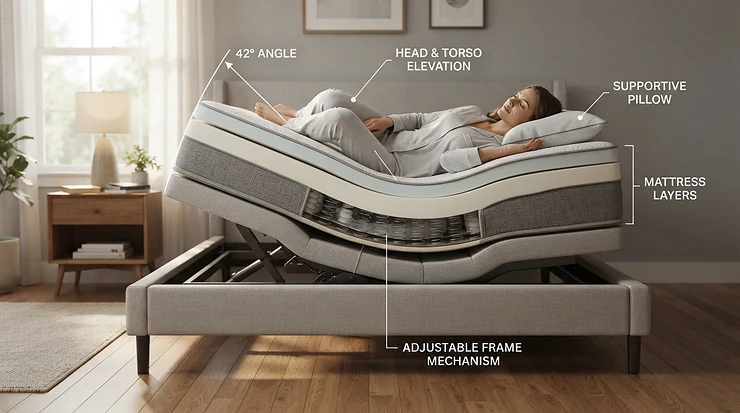
The core mechanical difference is where the incline starts. A wedge pillow creates elevation from a fixed point at your waist — everything above that point rises, everything below stays flat on the mattress. An adjustable base lifts from the hips or lower back, articulating the entire upper body as one continuous surface rather than bending sharply at a single seam. In practice, this means an adjustable base tends to distribute pressure more evenly across a longer stretch of your torso, while a wedge pillow concentrates the bend at one specific point, which some side sleepers find creates a pinching sensation at the waist over a full night. This is one reason certain adjustable-base manufacturers argue their products edge out wedges for comfort — a claim it’s fair to view as partly self-interested, but the underlying mechanical logic holds up.
Where wedges win decisively is flexibility and cost of experimentation. You can try a $60 wedge, decide the incline isn’t right, and be out relatively little money. Committing to a $1,000 adjustable base is a bigger swing, and while most reputable brands offer trial periods, the practical friction of returning a full bed frame is real. Reviewers consistently note that wedges also travel better — useful if you’re managing reflux at a relative’s house or in a hotel — while an adjustable base is, by definition, staying put.
Common Mistakes When Buying for Acid Reflux
The single most repeated mistake is buying based on incline height alone without checking who the product is designed for. A 12-inch wedge sounds like “more relief,” but if you’re a side sleeper, that height is often wasted without a design like MedCline’s that also solves positioning. Another frequent misstep: buying an adjustable base without confirming mattress compatibility, leading to premature sagging that undercuts the very elevation you paid for. Shoppers also commonly underestimate the adjustment period — expecting overnight relief and abandoning the product within days, when most reviewers report two to four weeks before the new sleep position stops feeling foreign. Finally, plenty of buyers skip checking return or trial policies entirely, which matters enormously given how personal the “right” incline angle turns out to be.
Features That Actually Matter (And Those That Don’t)
Incline angle and consistency matter enormously — a base or wedge that holds a steady 6 to 8 inches of elevation all night is doing the actual job. Cover material matters more than most buyers expect going in, particularly for anyone who runs warm; the difference between a standard foam cover and a bamboo-rayon or gel-infused option is noticeable by the second week of use. Side-sleeper-specific design, like MedCline’s arm pocket, matters a great deal if that’s your sleep position and matters not at all if you’re a committed back sleeper. On the other hand, massage functions and USB ports on premium adjustable bases are genuinely nice conveniences but contribute nothing to reflux relief itself — don’t let them tip a purchase decision on their own. Similarly, a taller wedge isn’t automatically better; beyond the 8-to-10-inch range, comfort typically declines faster than reflux benefit increases.
Long-Term Cost & Maintenance
A budget wedge pillow at $60 with a two-to-three-year usable lifespan works out to roughly $20 to $30 per year of use, plus the minor cost of occasionally replacing a worn cover. An adjustable base at $700 to $1,200, by contrast, is built to last closer to a decade with reasonable care, which puts its annualized cost closer to $70 to $150 a year — genuinely more expensive year over year, but bundled with daily-life comfort benefits, like reading or working in bed, that a wedge pillow doesn’t offer. Maintenance on a wedge is minimal: wash the cover, rotate or replace the foam core if it compresses unevenly after a few years. Adjustable bases need occasional motor and joint checks per the manufacturer’s schedule, and it’s worth confirming warranty terms before buying, since base warranties in this guide ranged from three years up to considerably longer on premium models.

Frequently Asked Questions
❓ Is a wedge pillow or adjustable bed better for acid reflux?
❓ What incline angle helps acid reflux the most?
❓ Can a cooling wedge pillow help with nighttime reflux and night sweats together?
❓ Are adjustable beds worth it just for acid reflux?
❓ How long does it take to adjust to sleeping elevated for GERD?
Conclusion
Choosing between a wedge pillow and an adjustable bed for acid reflux really comes down to matching the mechanism to your actual life — your budget, your sleep position, and how chronic your symptoms are. If you’re testing whether elevation even helps, a budget wedge like the Kölbs Bed Wedge Pillow gets you real data within a couple of weeks for minimal financial risk. If you’re a committed side sleeper, the MedCline Reflux Relief System solves a problem no generic wedge addresses. And if reflux has been a nightly companion for years and you can justify the investment, an adjustable base — from the budget-friendly Lucid L150 up to the feature-rich Nectar Premier or the durable Sven & Son bundle — trades a bigger upfront cost for consistent, hands-free elevation that doesn’t slide out of position by morning. None of these products replace a conversation with a doctor if your reflux is frequent or severe, but for managing the mechanics of nighttime symptoms, you now have seven real, specific options instead of a vague search query.
Recommended for You
- The World’s Fastest Wedge Pillow For Acid Reflux Guide 2026: 7 Picks That Actually Work
- Travel CPAP Pillow: 7 Compact Picks That Actually Work In 2026
- CPAP Pillow For Stomach Sleepers: 7 Picks That Stop Leaks (2026)
Disclaimer: This article contains affiliate links. As an Amazon Associate, I earn from qualifying purchases. If you purchase products through these links, we may earn a small commission at no additional cost to you. This article is for general informational purposes only and is not a substitute for medical advice — talk to your doctor about persistent or severe reflux symptoms.
✨ Found this helpful? Share it with your friends! 💬🤗
